Class 2 Syllabus 2026-27: Subject-Wise Topics, NCERT Books and Monthly Plan
In short
The Class 2 syllabus for 2026-27 subject by subject: NCERT Mridang, Sarangi and Joyful Mathematics chapters, English, Hindi, Maths and EVS topics, NIPUN goals, a monthly plan and a 30-minute daily routine.
Class 2 is the year many parents relax a little: the child already reads, writes and adds, the school routine is settled, and the first-year nerves are gone. But Class 2 quietly asks for a lot more. Numbers jump from two digits to three, sums start needing carrying and borrowing, multiplication appears, Hindi moves from मात्राएँ to grammar, and reading has to become fluent, not just correct.
This guide gives you the Class 2 syllabus for 2026-27 subject by subject: the NCERT books most CBSE schools use (with the actual chapter lists), English, Hindi, Maths, EVS and GK topics, what most children can do by the end of the year, a month-by-month plan, a short daily routine and the mistakes that most often slow children down in this class.
Quick answer: the Class 2 syllabus (age 7–8) usually covers English: fluent reading of short stories and poems, nouns (common, proper, one–many, gender), pronouns, verbs, describing words, is/am/are and has/have, simple past tense, opposites, rhyming words, punctuation and writing 4–5 sentences on a picture or topic; Hindi: मात्राएँ revision, संयुक्त अक्षर, र के रूप, अनुस्वार–चंद्रबिंदु, संज्ञा, सर्वनाम, क्रिया, लिंग, वचन, विलोम शब्द and छोटा अनुच्छेद; Maths: numbers up to 999 (many schools go to 1,000 or more), place value with hundreds, addition and subtraction with carrying and borrowing, multiplication as repeated addition and tables, sharing and grouping, shapes and lines, length, weight, capacity, time, calendar, money and data; and EVS/GK: body and health, food, clothes, houses, plants, animals, water, air, weather, transport, safety and festivals. NCERT’s Class 2 books are Mridang (English), Sarangi (Hindi) and Joyful Mathematics. About 30 minutes of relaxed practice at home on most days is enough.
Class 2 in 2026-27: Age, Books and What Has Changed
Class 2 is the last year of the Foundational Stage in the National Education Policy 2020 (Balvatika 1–3, then Classes 1 and 2). From Class 3 the Preparatory Stage begins, with more subjects and more writing. That makes Class 2 the year to make reading, writing and number sense really solid.
Most children in Class 2 are 7 to 8 years old. NCERT’s Class 2 books follow the National Curriculum Framework for the Foundational Stage (NCF-FS, 2022): learning through stories, rhymes, games, hands-on activities and the child’s own surroundings.
| Subject | NCERT book (2026-27) | Replaced |
|---|---|---|
| English | Mridang (Class 2) | Marigold |
| Hindi | Sarangi (सारंगी) 2 | Rimjhim (रिमझिम) |
| Maths | Joyful Mathematics 2 (Hindi medium: आनंदमय गणित) | Math-Magic |
| EVS / GK | No separate NCERT textbook in Classes 1–2 | Topics come through the language and maths books; many schools add their own EVS or GK book |
State boards and private publishers use different books, but the topics below are very similar across boards. If your child is coming from Class 1, our Class 1 syllabus guide shows what they should already know.
What Most Children Can Do by the End of Class 2
The government’s NIPUN Bharat mission sets year-wise learning goals (called Lakshya) for the Foundational Stage. For Class 2 these include reading an unfamiliar passage of 8–10 simple sentences with understanding at about 45–60 words a minute (some state versions of the targets use 30–45), and reading and writing numbers up to 999, with addition and subtraction of numbers up to 99 in daily-life situations. In everyday terms, by March most Class 2 children can:
- read a short story or poem aloud smoothly, with expression, and answer “who, what, where, why” questions about it;
- write 4–5 connected sentences about a picture, their family, their school or a festival, with capital letters, full stops and question marks;
- read Hindi stories with संयुक्त अक्षर, and write short sentences and a 4–5 line अनुच्छेद;
- read, write, compare and order numbers to 999, and say how many hundreds, tens and ones a number has;
- add and subtract 2-digit numbers with carrying and borrowing, and solve one-step story sums;
- understand multiplication as equal groups, know the 2, 3, 4, 5 and 10 tables (many schools ask for up to 10), and share things equally;
- measure with a ruler, tell the time to the half hour (often quarter hour), read a calendar and count money up to ₹100 or more.
The Class 2 Syllabus, Subject by Subject
1. English
The Class 2 Mridang book is organised in themes such as Fun with Friends, Welcome to My World, Life Around Us and Harmony, with poems and stories like “My Bicycle”, “It is Fun”, “The Crow”, “The Smart Monkey” and “We All Are Indians”, plus picture-reading activities. Across boards, Class 2 English usually covers:
- Reading: long-vowel spellings (ai, ee, oa, magic e), blends and digraphs, more sight words, reading short stories and poems with expression, and reading silently. Our phonics guide and sight words guide help if reading is still slow.
- Grammar: sentences and kinds of sentences (telling and asking), capital letters and punctuation, nouns (common and proper), one–many (-s, -es, -ies), masculine–feminine, a/an/the, pronouns, is/am/are, was/were, has/have, action words, simple present and past tense, describing words, in/on/under/behind, joining words (and, but), opposites and rhyming words. See our opposite words list and rhyming words list.
- Vocabulary: words for family, body, food, animals and their young ones, sounds animals make, days, months and colours, and simple “one word for many” (e.g. a place where we see animals: zoo).
- Writing: picture composition, “My Best Friend”, “My School”, “My Favourite Festival”, writing a few lines in order (first, then, at last). See picture composition (the same method works in Class 2 with more sentences).
- Comprehension: short unseen passages with questions; see reading comprehension tips.
- Speaking and listening: reciting poems, retelling a story in their own words, describing a picture, show-and-tell.
2. Hindi
NCERT’s Class 2 Sarangi has 26 short lessons, a mix of stories and poems: “नीमा की दादी”, “घर”, “माला की चाँदी की पायल”, “माँ”, “थाथू और मैं”, “चींटा”, “टिल्लू जी”, “तीन दोस्त”, “दुनिया रंग-बिरंगी”, “कौन”, “बैंगनी जोजो”, “तोसिया का सपना”, “तालाब”, “बीज”, “किसान”, “मूली”, “बरसात और मेंढक”, “शेर और चूहे की दोस्ती”, “आउट”, “छुपन-छुपाई”, “हाथी साईकिल चला रहा है”, “चार दिशाएँ”, “चंदा मामा”, “गिरे ताल में चंदा मामा”, “सबसे बड़ा छाता” and “बादल”. Across boards, Class 2 Hindi usually covers:
- मात्राएँ revision: all मात्राएँ with reading speed, words with ृ, अनुस्वार (ं) and चंद्रबिंदु (ँ). Our बारहखड़ी chart and मात्रा worksheets guide help here.
- संयुक्त अक्षर and र के रूप: क्ष, त्र, ज्ञ, श्र, half letters (प्यार, बच्चा, पत्ता) and the three forms of र (प्रकाश, कर्म, ट्रक).
- व्याकरण: संज्ञा (naming words), सर्वनाम, क्रिया, विशेषण (in many schools), लिंग (पुल्लिंग–स्त्रीलिंग), वचन (एक–अनेक), विलोम शब्द, पर्यायवाची (a few), गिनती 1–50 in Hindi, दिनों और महीनों के नाम.
- Reading: short stories and poems aloud; see our best Hindi story books.
- Writing: सुलेख, वाक्य बनाना, चित्र देखकर 4–5 वाक्य, छोटा अनुच्छेद (मेरा परिवार, मेरी गाय, होली).
3. Maths
Joyful Mathematics 2 has 11 chapters: 1. A Day at the Beach, 2. Shapes Around Us, 3. Fun with Numbers, 4. Shadow Story (Togalu), 5. Playing with Lines, 6. Decoration for Festival, 7. Rani’s Gift, 8. Grouping and Sharing, 9. Which Season is it?, 10. Fun at the Fair and 11. Data Handling. In the Hindi edition (आनंदमय गणित) these are “समुद्र किनारे एक दिन”, “आस-पास की आकृतियाँ”, “संख्याओं का आनंद” and so on. Across boards, the Class 2 maths topics are:
- Numbers: counting in 2s, 5s and 10s, numbers to 999 (often 1,000), number names, before–after–between, comparing with > < =, ascending and descending order, odd and even, ordinal numbers. Our number names guide covers 1–100.
- Place value: hundreds, tens and ones, expanded form (365 = 300 + 60 + 5), the smallest and largest 3-digit numbers.
- Addition and subtraction: 2-digit sums with carrying and borrowing, then 3-digit sums in many schools, mental maths, story sums. See our addition and subtraction guides.
- Multiplication: equal groups, repeated addition, the × sign, tables of 2, 3, 4, 5 and 10 (many schools up to 10). See how to teach tables.
- Division (sharing): sharing equally and making equal groups, the idea of half and quarter.
- Shapes and lines: 2-D and 3-D shapes around us, straight and curved lines, corners and sides, tangram-style shapes, shadows and pictures from different sides.
- Measurement: length with a ruler (cm) and metre, heavier–lighter and kg, holds more–holds less and litre.
- Time and calendar: o’clock, half past and often quarter past/to, days and months, reading a calendar; see how to teach time.
- Money: coins and notes, adding small amounts, shopping role play (“Fun at the Fair”).
- Patterns and data: number and shape patterns, tally marks, pictographs.
4. EVS and GK
Under NCF-FS, NCERT has no separate EVS book for Classes 1 and 2 (a separate book begins in Class 3). Most CBSE and private schools still keep an EVS or GK period in Class 2, usually with these topics:
- My body, sense organs, teeth, cleanliness, healthy and junk food.
- Family and relatives, houses of different kinds, clothes for different seasons.
- Plants: parts, uses, plants that give us food; animals: homes, food, young ones, pet, farm and wild animals, birds and insects.
- Water: sources and saving water; air; weather, seasons, the sun, moon and stars.
- Transport and communication, community helpers, road and home safety, first aid.
- Festivals, national symbols, famous monuments and our country.
For quick quiz practice, use our GK questions for kids, and try a few simple science experiments at home (float or sink is a Class 2 favourite).
5. Art, Music, Physical Education and Values
- Drawing, shading, simple Warli or rangoli patterns, paper craft and clay; see colouring for kids.
- Poems, songs, dance and role play; many schools also start a third language rhyme or two.
- Outdoor games, running, skipping, balance and ball skills.
- Sharing, kindness, honesty and taking care of things; see good habits for kids and Panchatantra stories for moral stories.
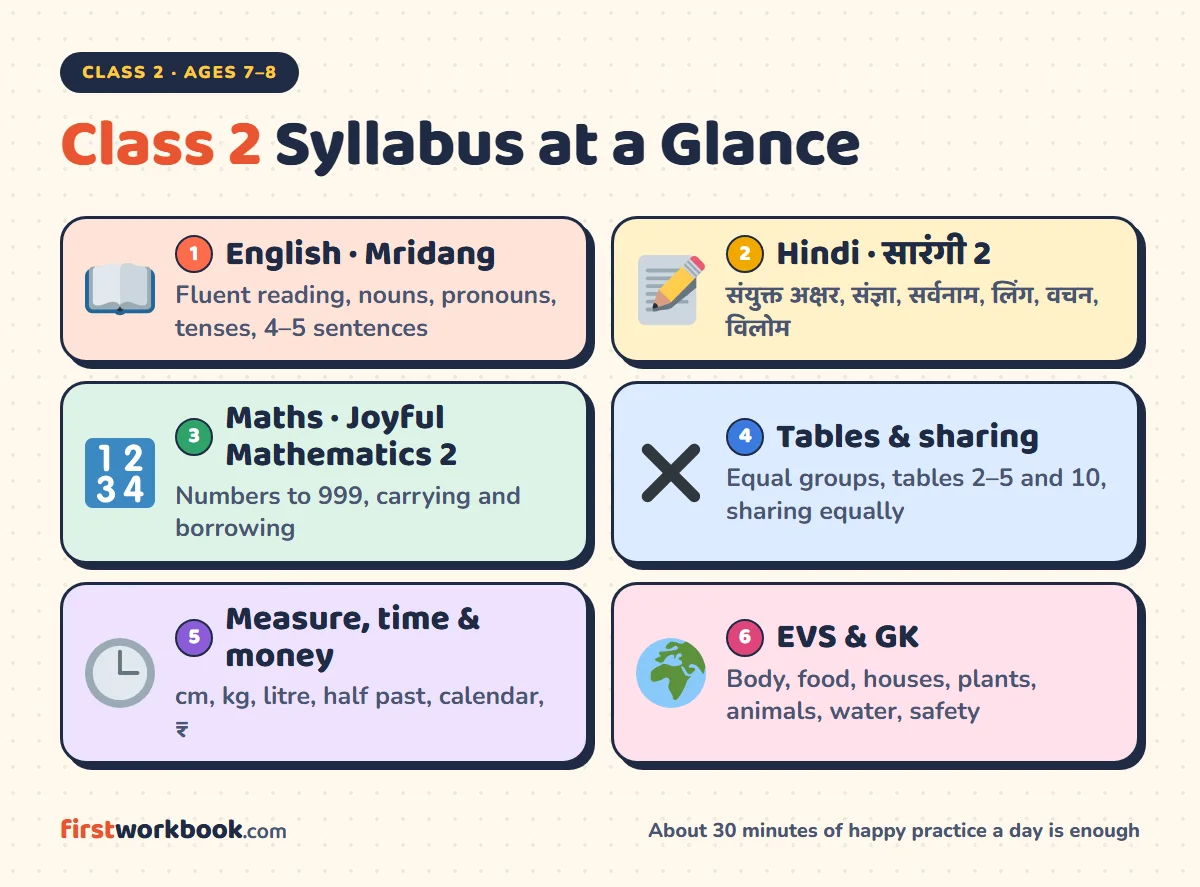
Class 2 Syllabus at a Glance
| Subject | Main topics | By the end of Class 2 |
|---|---|---|
| English | Fluent reading, nouns, pronouns, verbs, tenses, adjectives, punctuation, opposites, rhyming words, comprehension | Reads stories smoothly; writes 4–5 sentences |
| Hindi | मात्राएँ, संयुक्त अक्षर, र के रूप, संज्ञा, सर्वनाम, क्रिया, लिंग, वचन, विलोम | Reads Hindi stories; writes a small अनुच्छेद |
| Maths | Numbers to 999+, place value, +/− with carrying and borrowing, ×, sharing, shapes, measurement, time, money, data | Does 2-digit sums with carrying; knows tables 2–5 and 10 |
| EVS / GK | Body, food, houses, plants, animals, water, air, weather, transport, safety, festivals | Talks and writes 2–3 lines about each topic |
A Month-by-Month Plan for Home
Every school orders chapters differently, so match this to your child’s diary. Use it to revise what was taught that week, not to race ahead.
| Month | English | Hindi | Maths |
|---|---|---|---|
| April–May | Class 1 revision, reading aloud, sentences | मात्रा revision, reading speed | Numbers to 100, place value revision, counting in 2s, 5s, 10s |
| July | Nouns, common and proper | अनुस्वार, चंद्रबिंदु, संज्ञा | Numbers to 999, hundreds–tens–ones |
| August | One–many, a/an/the | संयुक्त अक्षर, वचन | Comparing and ordering, odd–even |
| September | Pronouns, is/am/are, has/have | र के रूप, लिंग | Addition with carrying, story sums |
| October | Action words, present tense | सर्वनाम, क्रिया | Subtraction with borrowing, shapes and lines |
| November | Describing words, rhyming words | विलोम शब्द, गिनती in Hindi | Multiplication as equal groups, tables 2 and 3 |
| December | Was/were, past tense, opposites | चित्र वर्णन, कहानी पढ़ना | Tables 4, 5, 10; length and weight |
| January | Picture composition, comprehension | अनुच्छेद लेखन | Sharing equally, time and calendar |
| February–March | Reading and writing practice, revision | Reading and revision | Money, patterns, data handling, revision |
A Simple Daily Routine (About 30 Minutes)
- 10 minutes reading: your child reads a page aloud (English one day, Hindi the next). Once a week, time one page for a minute and note the words read: watching the number grow is very motivating.
- 10 minutes maths: 4–5 sums or one table, said aloud and then written. Use money, the calendar and the kitchen scale for real practice.
- 5 minutes writing: 3–4 sentences in a small diary: “Today I…”, “आज मैंने…”.
- Talk time: one GK or EVS question at dinner, or a story you read to them at bedtime.
India’s School Bag Policy 2020 recommends no homework for Classes 1 and 2 and a school bag no heavier than about 10% of the child’s body weight, so keep home practice short and playful. Our daily learning routine for kids has more ideas.
How Are Class 2 Children Assessed?
NCF-FS asks schools to assess Foundational Stage children through observation, activities, oral work and children’s notebooks and portfolios, rather than through formal written exams. In practice many CBSE schools use class tests, worksheets, reading checks and projects in Class 2, and some private schools hold half-yearly and annual tests. If your school does, one short practice paper a week in the month before is enough. For extra challenge, see our Olympiad preparation guide for Class 1–2.
Common Mistakes Parents Make in Class 2
- Rushing to written carrying and borrowing. If a child cannot show 46 with bundles of ten sticks and six loose sticks, the “carry 1” rule is just magic to them. Spend a week with sticks, beads or coins first.
- Rote tables without meaning. Show 3 × 4 as three plates with four laddoos each before chanting. Then chant. Meaning first makes the chanting stick.
- Correct but slow reading. Class 2 is the year for fluency. Re-reading the same short passage three times on three days builds speed better than reading new pages every day.
- Ignoring Hindi संयुक्त अक्षर. Many children who read मात्राएँ well still stop at words like बच्चा or प्यार. Five minutes of half-letter words a day fixes it.
- Too much copying, too little thinking. Ask your child to write their own sentences, even with spelling mistakes, rather than copying answers neatly.
- Comparing with other children. Compare your child only with their own work from last month.
Class 2 Workbooks That Follow This Syllabus
- Class 2 English Grammar Workbook (nouns, tenses, adjectives, adverbs and tests), English Reading Comprehension and Creative Writing & Picture Composition
- Class 2 Hindi Vyakaran Workbook (संज्ञा, सर्वनाम, क्रिया, लिंग, वचन, विलोम), Hindi संयुक्त अक्षर Workbook and Hindi रचनात्मक लेखन
- Class 2 Maths Plus Workbook, Maths Word Problems & Place Value and Maths Activity Book – Measurement, Fractions & Data Handling
- Class 2 EVS Workbook – Our World and Olympiad Prep Workbook Class 1–2
- Class 2 Drawing & Colouring Book
Save with the Class 2 Book Bundle or the Class 1–2 Complete Pack, or print free Class 2 worksheets.
हिंदी में सार (Summary in Hindi)
कक्षा 2 में बच्चे की उम्र आमतौर पर 7 से 8 साल होती है और यह Foundational Stage का आख़िरी साल है। NCERT की किताबें हैं: अंग्रेज़ी के लिए मृदंग, हिंदी के लिए सारंगी 2 और गणित के लिए Joyful Mathematics 2 (आनंदमय गणित), जिसमें 11 अध्याय हैं। कक्षा 1 और 2 में EVS की अलग NCERT किताब नहीं है, पर कई स्कूल अपनी EVS या GK किताब पढ़ाते हैं। अंग्रेज़ी में धाराप्रवाह पढ़ना, संज्ञा, सर्वनाम, क्रिया, काल (present और past), विशेषण, विराम चिह्न और 4–5 वाक्य लिखना आता है। हिंदी में मात्राएँ, संयुक्त अक्षर, र के रूप, संज्ञा, सर्वनाम, क्रिया, लिंग, वचन, विलोम शब्द और छोटा अनुच्छेद सिखाया जाता है। गणित में 999 तक की संख्याएँ, सैकड़ा-दहाई-इकाई, हासिल वाला जोड़ और उधार वाला घटाव, गुणा और पहाड़े, बराबर बाँटना, आकृतियाँ, लंबाई-वज़न-धारिता, घड़ी, कैलेंडर और पैसे आते हैं। NIPUN Bharat के अनुसार कक्षा 2 के अंत तक बच्चा लगभग 45–60 शब्द प्रति मिनट की गति से समझकर पढ़ सके और 999 तक की संख्याएँ पढ़-लिख सके। घर पर रोज़ लगभग 30 मिनट पढ़ना, थोड़ा गणित और तीन-चार वाक्य लिखना काफ़ी है।
Frequently Asked Questions
What is the Class 2 syllabus for CBSE 2026-27?
CBSE schools mostly follow NCERT: Mridang for English, Sarangi 2 for Hindi and Joyful Mathematics 2 for maths, with EVS/GK taught through these books or a school-chosen book. The topics are listed subject by subject above.
How many chapters are there in Class 2 Joyful Mathematics?
Eleven: A Day at the Beach, Shapes Around Us, Fun with Numbers, Shadow Story (Togalu), Playing with Lines, Decoration for Festival, Rani’s Gift, Grouping and Sharing, Which Season is it?, Fun at the Fair and Data Handling.
Up to which number should a Class 2 child know?
NIPUN Bharat’s Class 2 goal is reading and writing numbers up to 999. Many schools teach up to 1,000, and some go further by the end of the year.
Which tables should a Class 2 child learn?
Most schools start with the 2, 3, 4, 5 and 10 tables and many go up to 10. First make sure your child understands multiplication as equal groups; then short daily chanting and table games work well.
Is there EVS in Class 2?
NCERT has no separate EVS textbook for Classes 1 and 2; EVS themes come through the language and maths books. Many CBSE, state and private schools still teach EVS or GK as a subject in Class 2.
Are there exams in Class 2?
NCF-FS recommends assessment through observation, activities and children’s work rather than formal exams in the Foundational Stage. Some schools still hold term tests, so check your school’s plan.
How much should a Class 2 child study at home?
About 30 minutes on most days, mostly reading aloud, a few sums or a table, and a few sentences of writing. Stop while your child is still enjoying it.
Research Behind This Guide
- NCERT / CIET chapter lists: Joyful Mathematics Class 2, आनंदमय गणित Class 2 and सारंगी Class 2; NCERT textbooks.
- Ministry of Education, National Curriculum Framework for the Foundational Stage 2022 and NIPUN Bharat guidelines (Lakshya targets for Class 2).
- Ministry of Education, School Bag Policy 2020 on homework and bag weight, as reported by ThePrint.
- ThePrint, NCERT’s new textbooks for Classes 1 and 2.
Free Worksheets to Practise This
Printable A4 PDFs, free to download. Pick a set and print it at home or school.
About the author

Er. Deepak Maurya
Founder, FirstWorkbook
Er. Deepak Maurya founded FirstWorkbook in Varanasi to make activity workbooks that children enjoy. A web developer with 8 years of experience, he writes practical guides for parents on learning at home, and plans the activities in our workbooks together with pre-primary teachers.
Spotted a mistake or have a question? Write to us and we'll correct it.