Reading Comprehension for Class 1: 10 Passages with Questions and Answers
⚡ In short
10 short English reading comprehension passages for Class 1 with questions and answers, the question types schools use, and easy tips to help your child read with understanding at home.
Your child can read the words on the page, but when you ask “What happened in the story?”, you get a blank look. That is where reading comprehension comes in. It is the skill of understanding what we read, and in Class 1 it starts to appear in school worksheets and exams as the “unseen passage”.
Below you will find 10 short reading comprehension passages for Class 1 with questions and answers, the question types schools use, and simple ways to help your child read with understanding at home. Print this page or read the passages together on screen.
What Is Reading Comprehension for Class 1?
In Class 1, a comprehension passage is usually 4–8 short, simple sentences about a familiar topic, such as a pet, a family, a festival or a day at school. Children read it on their own (or with a little help) and answer a few questions. The aim is to check that they can:
- Find facts that are written in the passage (who, what, where)
- Understand the order of events
- Learn new words from the sentences around them
- Give a simple answer in their own words
Common Question Types in Class 1 Comprehension
| Question type | What your child does |
|---|---|
| Answer in one word | Finds a name, colour, number or place in the passage |
| Tick the correct answer (MCQ) | Chooses one of two or three options |
| True or false | Checks a sentence against the passage |
| Fill in the blanks | Completes a sentence with a word from the passage |
| Answer in a sentence | Writes a short, full sentence, for example “Riya has a red ball.” |
| Picture comprehension | Looks at a picture and answers questions about it |
How to Read a Comprehension Passage: 4 Easy Steps
- Read the passage once, slowly. Point to each word with a finger.
- Read the questions. Underline the question word: who, what, where, when, how many.
- Go back and find the answer. Most Class 1 answers are written right there in the passage.
- Write the answer neatly and check spelling against the passage.
10 Reading Comprehension Passages for Class 1 (With Answers)
Passage 1: My Cat
I have a cat. Her name is Mini. She is white and soft. Mini likes to drink milk. She sleeps on my bed. I love Mini.
- What is the name of the cat?
- What colour is the cat?
- What does Mini like to drink?
- Where does Mini sleep?
Answers: 1. Mini 2. White 3. Milk 4. On my bed
Passage 2: The Red Ball
Riya has a red ball. She plays with it in the park. One day the ball goes into the pond. Her brother Aman gets it out with a stick. Riya says, “Thank you, Aman!”
- What colour is Riya’s ball?
- Where does Riya play?
- Where does the ball go?
- True or false: Aman gets the ball out with his hand.
Answers: 1. Red 2. In the park 3. Into the pond 4. False (he uses a stick)
Passage 3: My School
My school is big. It has a green gate. There are many trees in the school. My class teacher is Mrs. Rao. I have many friends in my class. We play on the swings after lunch.
- What colour is the school gate?
- Who is the class teacher?
- Fill in the blank: We play on the ________ after lunch.
- Is the school big or small?
Answers: 1. Green 2. Mrs. Rao 3. swings 4. Big
Passage 4: Diwali at Home
Diwali is a festival of lights. We clean our house. Mummy makes a rangoli at the door. We light diyas in the evening. Grandpa gives us sweets. We wear new clothes.
- Diwali is a festival of ________.
- Who makes the rangoli?
- When do we light diyas?
- What does Grandpa give?
Answers: 1. lights 2. Mummy 3. In the evening 4. Sweets
Passage 5: The Little Seed
Tara puts a seed in a pot. She gives it water every day. The pot is kept in the sun. After a few days, a small green plant comes out. Tara is very happy.
- What does Tara put in the pot?
- How often does she water it?
- Tick the correct answer: The pot is kept (a) in the dark (b) in the sun.
- How does Tara feel at the end?
Answers: 1. A seed 2. Every day 3. (b) in the sun 4. Very happy
Passage 6: At the Zoo
On Sunday, Kabir goes to the zoo with his father. He sees a tall giraffe and a big elephant. The monkeys jump from tree to tree. Kabir likes the monkeys the most. He eats a banana near the lake.
- When does Kabir go to the zoo?
- Who goes with him?
- Which animal is tall?
- Which animals does Kabir like the most?
Answers: 1. On Sunday 2. His father 3. The giraffe 4. The monkeys
Passage 7: Rainy Day
It is raining. Dark clouds are in the sky. Meera wears her yellow raincoat. She jumps in a puddle. Splash! Her shoes get wet. Mummy makes hot pakoras for everyone.
- What is in the sky?
- What colour is Meera’s raincoat?
- What gets wet?
- Answer in a sentence: What does Mummy make?
Answers: 1. Dark clouds 2. Yellow 3. Her shoes 4. Mummy makes hot pakoras.
Passage 8: Dadi’s Garden
Dadi has a small garden. She grows tomatoes, chillies and mint. Every morning she waters the plants. I help her pick the red tomatoes. A sparrow comes to drink water from the bowl.
- Who has a garden?
- Name two things Dadi grows.
- When does Dadi water the plants?
- Which bird comes to drink water?
Answers: 1. Dadi 2. Any two of tomatoes, chillies, mint 3. Every morning 4. A sparrow
Passage 9: The Kind Boy
Sameer sees an old man at the bus stop. The man has two heavy bags. Sameer says, “Can I help you, Uncle?” He carries one bag to the bus. The old man smiles and says, “You are a kind boy.”
- Where does Sameer see the old man?
- How many bags does the man have?
- True or false: Sameer carries both bags.
- What does the old man say?
Answers: 1. At the bus stop 2. Two 3. False (he carries one bag) 4. “You are a kind boy.”
Passage 10: My Morning
I wake up at seven o’clock. I brush my teeth and take a bath. I drink a glass of milk and eat a paratha. Then I wear my uniform and pack my bag. Papa takes me to school on his scooter.
- At what time do I wake up?
- What do I eat?
- Put in order: (a) pack my bag (b) brush my teeth (c) drink milk
- How do I go to school?
Answers: 1. Seven o’clock 2. A paratha 3. (b), (c), (a) 4. On Papa’s scooter
Tips to Build Reading Comprehension at Home
- Read aloud every day. Ten minutes of a storybook at bedtime builds vocabulary faster than any worksheet. Try our short moral stories for kids.
- Stop and ask questions. “Why is the boy sad?” “What will happen next?” These questions teach children to think while reading, not after.
- Make sure decoding is strong. A child who struggles to sound out words has no energy left to understand them. If that is the case, work on phonics at home and common sight words first.
- Ask for a retell. After a story, ask your child to tell it back in three parts: beginning, middle and end.
- Talk about new words. When you meet a new word, guess its meaning from the sentence together, then use it during the day.
- Answer in full sentences. Turn the question into the answer: “What colour is the ball?” becomes “The ball is red.” Schools often give marks for full sentences.
- Keep it short and regular. One passage a day, 4–5 days a week, works better than a long weekend session.
Common Mistakes Children Make (and How to Fix Them)
| Mistake | Fix |
|---|---|
| Answering from memory, not the passage | Ask “Show me where it says that” and underline the line |
| Copying the whole sentence as the answer | Practise finding just the key word for one-word questions |
| Spelling mistakes in answers | Copy the word carefully from the passage, letter by letter |
| Skipping the question word | Circle who, what, where, when before answering |
More Reading Comprehension Practice
Once your child is comfortable with the passages above, they need regular, graded practice. These FirstWorkbook books can help:
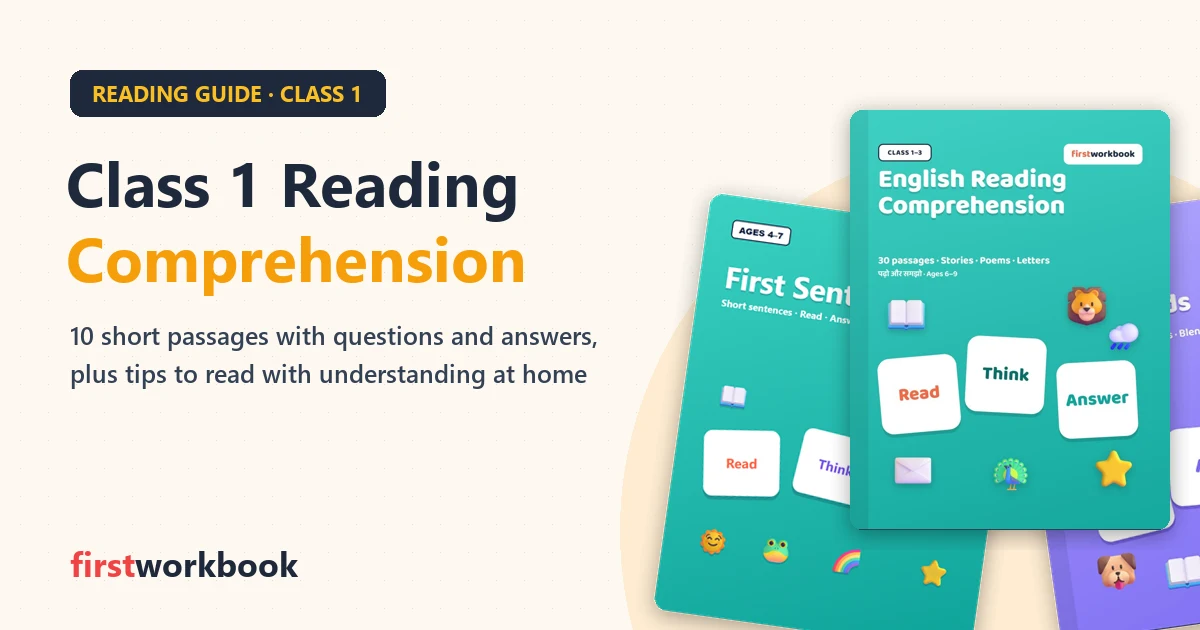
- English Reading Comprehension (Class 1–3): 30 short picture passages, stories and poems in three levels with MCQs, true-false, fill-ups and answer-in-a-sentence questions, plus a full answer key.
- First Sentences Reading Workbook: 12 short sentence activities with simple questions, for children just starting to read.
- Phonics & Sight Words Workbook (LKG–Class 1): letter sounds, CVC words and 50 sight words, the base for fluent reading.
Every book is available as a printed copy delivered across India or as an instant PDF that you can print at home.
Frequently Asked Questions
What is an unseen passage for Class 1?
An unseen passage is a short piece of text the child has not read before, given in a worksheet or exam with questions. It checks whether the child can read and understand on their own.
How long should a Class 1 comprehension passage be?
Usually 4–8 short sentences, about 40–80 words, with 3–5 questions. Towards the end of Class 1, passages may get a little longer.
My child reads well but cannot answer questions. Why?
Some children focus so hard on saying each word correctly that they miss the meaning. Read the passage aloud to them once, ask one or two questions after every few lines, and slowly let them take over.
Should my child answer in one word or a full sentence?
Follow the question. “Answer in one word” needs just the word. “Answer in a sentence” or open questions need a full sentence that starts with words from the question.
How can I make comprehension fun?
Use picture books, comic strips, cereal boxes and road signs. Ask fun questions, let your child ask you questions too, and act out the story with toys.
Read Together, Understand Together
Reading comprehension grows when children read a little every day and talk about what they read. Start with one passage from this page tonight, ask the questions in a friendly voice and celebrate every correct answer. For 30 more graded passages with answers, try the English Reading Comprehension workbook.