15 Short Moral Stories for Kids in English (with Lessons and Questions)
⚡ In short
15 short moral stories for kids in English, from The Thirsty Crow to Panchatantra and Akbar Birbal tales, each with its moral, questions to ask and tips for parents.
Every grandparent in India seems to have a story ready for bedtime. The thirsty crow, the clever rabbit, the monkey who outsmarted the crocodile. These stories have lasted for hundreds of years for a simple reason: children remember a lesson far better when it comes wrapped in a story.
This guide brings together 15 short moral stories for kids in English, each one small enough to read in two or three minutes. Every story ends with its moral and a couple of questions you can ask your child. After the stories, you will find tips on how to tell stories well, which stories suit which age, and simple activities to turn story time into learning time.
Why Moral Stories Matter for Children
- They teach values without lectures. "Do not lie" is easy to forget. The boy who cried wolf is not.
- They build listening and attention. Following a story from start to end trains children to focus.
- They grow vocabulary. Stories use words children do not hear in daily talk, such as greedy, clever, proud and patient.
- They help children understand feelings. Asking "How did the mouse feel?" teaches empathy.
- They prepare children for reading. Children who hear lots of stories understand how stories work: a beginning, a problem and an ending. This makes reading comprehension easier later.
- They create a daily bond. Ten minutes of story time is often the calmest, closest part of the day.
15 Short Moral Stories for Kids in English
1. The Thirsty Crow
On a hot summer day, a crow was flying around looking for water. He was very thirsty. At last he found a pot in a garden, but the water was at the very bottom. His beak could not reach it.
The crow did not give up. He looked around and saw some small pebbles. He picked up one pebble and dropped it into the pot. Then another, and another. Slowly, the water rose higher and higher. Finally, the crow could drink. He drank happily and flew away.
Moral: Where there is a will, there is a way.
Ask your child: Why did the water come up? What else could the crow have done?
2. The Lion and the Mouse
A lion was sleeping in the forest when a little mouse ran across his face. The lion woke up angry and caught the mouse in his big paw. "Please let me go," cried the mouse. "One day I will help you." The lion laughed. How could a tiny mouse help a lion? But he let the mouse go.
A few days later, the lion was caught in a hunter's net. He roared and roared but could not get free. The mouse heard him, ran over and nibbled through the ropes with her sharp teeth. Soon the lion was free. "Thank you, little friend," said the lion.
Moral: No act of kindness is ever wasted. Even small friends can be a big help.
Ask your child: Why did the lion laugh? Have you ever helped someone bigger than you?
3. The Hare and the Tortoise
A hare always made fun of the tortoise for being slow. One day the tortoise said, "Let us have a race." All the animals came to watch. The hare ran so fast that he was soon far ahead. "The tortoise is so slow, I can take a nap," he thought, and he fell asleep under a tree.
The tortoise kept walking, slowly and steadily, without stopping. When the hare woke up, he ran as fast as he could, but the tortoise had already crossed the finish line.
Moral: Slow and steady wins the race. Pride can make us lose.
Ask your child: Why did the hare lose even though he was faster? What does "steady" mean?
4. The Boy Who Cried Wolf
A shepherd boy looked after sheep near a village. He was bored, so one day he shouted, "Wolf! Wolf! A wolf is eating the sheep!" The villagers ran up the hill to help, but there was no wolf. The boy laughed. A few days later, he did the same thing again, and again the villagers came running for nothing.
Then one evening a real wolf came. "Wolf! Wolf!" the boy cried. But this time nobody came. They thought he was joking again. The wolf scared away many of the sheep.
Moral: People do not believe a liar, even when he tells the truth.
Ask your child: Why did the villagers stop coming? How can we make people trust us?
5. The Ant and the Grasshopper
All summer long, a grasshopper sang and danced in the sun. Nearby, an ant worked hard every day, carrying grains of food to her home. "Why work so hard? Come and play," said the grasshopper. "I am saving food for the winter," said the ant.
When winter came, the fields were covered in snow. The grasshopper had nothing to eat and was cold and hungry. The ant was warm in her home with plenty of food. The kind ant shared a little, and the grasshopper promised to work hard next summer.
Moral: Work today so you are ready for tomorrow.
Ask your child: What did the ant do that the grasshopper did not? Is it okay to play too?
6. The Fox and the Grapes
A hungry fox saw a bunch of juicy grapes hanging from a vine. He jumped to reach them but missed. He jumped again and again, but the grapes were too high. At last he walked away, saying, "Those grapes are probably sour anyway."
Moral: It is easy to pretend we did not want something we could not get. It is better to be honest about how we feel.
Ask your child: Were the grapes really sour? How was the fox feeling?
7. The Monkey and the Crocodile (Panchatantra)
A monkey lived on a jamun tree by a river. Every day he shared sweet jamuns with a crocodile, and they became friends. The crocodile's wife said, "If the fruit is so sweet, the monkey's heart must be sweeter. Bring it to me."
The crocodile invited the monkey home and carried him on his back across the river. In the middle of the water he said, "My wife wants to eat your heart." The clever monkey stayed calm. "Oh no! I left my heart on the tree. Take me back and I will get it." The foolish crocodile swam back, and the monkey jumped up to safety, never to trust the crocodile again.
Moral: Stay calm in danger and use your mind. Choose your friends wisely.
Ask your child: How did the monkey escape? Was the crocodile a good friend?
8. The Clever Rabbit and the Lion (Panchatantra)
A cruel lion hunted so many animals that the forest animals made a deal: each day, one animal would go to him. One day, it was a small rabbit's turn. The rabbit walked very slowly and arrived late. "Why are you late?" roared the lion.
"Another lion stopped me on the way. He says he is the king of this forest," said the rabbit. The angry lion demanded to see him. The rabbit led him to a deep well. The lion looked in, saw his own reflection, and roared. The reflection seemed to roar back. The lion jumped in to fight it, and the forest was free.
Moral: Brains are stronger than muscles.
Ask your child: Who did the lion see in the well? What made the rabbit so brave?
9. The Greedy Dog
A dog found a big bone and was carrying it home in his mouth. On the way, he crossed a bridge over a stream. Looking down, he saw another dog in the water with an even bigger bone. He wanted that bone too, so he barked at it. As soon as he opened his mouth, his own bone fell into the water and was gone. The other dog was only his reflection.
Moral: Greed can make us lose what we already have.
Ask your child: Who was the dog in the water? What should the dog have done?
10. The Honest Woodcutter
A poor woodcutter was cutting a tree by a river when his iron axe slipped and fell into the deep water. He sat down and cried. A river fairy appeared and brought up a golden axe. "Is this yours?" she asked. "No," said the woodcutter. She brought up a silver axe. "No, that is not mine either." Then she brought up his old iron axe. "Yes, that is mine!" he said happily.
The fairy was so pleased with his honesty that she gave him all three axes.
Moral: Honesty is the best policy.
Ask your child: Why did the woodcutter say no to the golden axe? Would you have said no?
11. The Two Goats
Two goats came from opposite sides to cross a narrow bridge over a river. Neither wanted to step back. "Move, I was here first," said one. "No, you move," said the other. They pushed and fought in the middle of the bridge until both lost their balance and fell into the river.
The next day, two other goats met on the same bridge. One goat lay down, and the other carefully stepped over her. Both crossed safely.
Moral: Working together is better than fighting. Sometimes giving way is the smart choice.
Ask your child: What did the second pair of goats do differently?
12. The Goose That Laid Golden Eggs
A farmer had a goose that laid one golden egg every day. The farmer and his wife became rich, but they grew greedy. "If the goose lays golden eggs, it must be full of gold inside," they thought. So they cut the goose open. There was no gold inside, and now there were no more golden eggs either.
Moral: Be patient and thankful for what you have. Greed destroys good things.
Ask your child: Was one egg a day enough? Why did they lose everything?
13. Birbal's Khichdi (Akbar and Birbal)
One cold winter, Emperor Akbar announced that anyone who stood in the freezing lake all night would get a reward. A poor man did it. When asked how, he said, "I looked at a lamp burning far away in the palace." Akbar said, "Then you got warmth from the lamp," and refused to give the reward.
The next day, Birbal did not come to court. Akbar went to find him and saw Birbal sitting beside a small fire, with a pot of khichdi hanging high up on a tree. "How will that cook?" laughed Akbar. "If a man can get warmth from a lamp far away, my khichdi can cook from this fire," said Birbal. Akbar understood his mistake and gave the poor man his reward.
Moral: Be fair, and keep your promises.
Ask your child: Why did Birbal hang the pot so high? What lesson did Akbar learn?
14. The Elephant and the Ants
A proud elephant liked to stamp on the anthills near the river, just for fun. The ants begged him to stop, but he only laughed. "You are so tiny. What can you do?" One day, a group of ants crawled into the elephant's trunk and began to bite. The elephant shook and cried in pain. "Please stop! I am sorry!" From that day, the elephant never troubled the ants again.
Moral: Never bully anyone because they are smaller than you.
Ask your child: How did the ants feel when their homes were broken? What should the elephant do to say sorry?
15. The Bundle of Sticks
An old farmer had four sons who were always quarrelling. One day he gave each son a single stick and asked him to break it. Each one did, easily. Then he tied four sticks together in a bundle and asked them to break it. None of them could, no matter how hard they tried.
"You are like these sticks," said the father. "Alone, you are easy to break. Together, nobody can harm you."
Moral: Unity is strength.
Ask your child: Why could they not break the bundle? How can brothers and sisters be like the bundle?
Which Stories Suit Which Age?
- Ages 3 to 4: Very short stories with animals and one clear idea. Start with The Thirsty Crow, The Greedy Dog, The Hare and the Tortoise and The Lion and the Mouse. Use actions and animal sounds.
- Ages 5 to 6: Add stories with a twist or a trick, such as The Monkey and the Crocodile, The Clever Rabbit and the Lion, The Honest Woodcutter and The Two Goats.
- Ages 7 to 9: Children enjoy stories where they must think about why something happened. Birbal's Khichdi, The Fox and the Grapes, The Goose That Laid Golden Eggs and The Bundle of Sticks lead to great conversations.
How to Tell a Story So Children Love It
- Use different voices. A deep voice for the lion, a squeaky one for the mouse. Children remember characters better.
- Pause before the twist. "And when the lion looked into the well, he saw..." Let your child guess.
- Add actions. Drop pretend pebbles with the crow, tiptoe with the tortoise.
- Make it local. The farmer can live in your village or city. The goat can eat a roti. Small changes make stories feel real.
- Do not rush to the moral. Ask "What did you learn?" first. Children often find the lesson themselves, and that sticks better.
- Repeat favourites. Young children love the same story again and again. Repetition builds language and confidence.
- Read in both languages. If your home language is Hindi, tell a story in Hindi one day and in English the next. Children learn new words by connecting them to ones they already know.
Fun Activities After Story Time
- Draw the story: Ask your child to draw their favourite scene and tell you what is happening.
- Act it out: Family members play the characters. The Two Goats and The Lion and the Mouse are perfect for this.
- Change the ending: "What if the hare had not slept?" This builds imagination and thinking skills.
- Sequence cards: Draw three or four scenes on cards, mix them up and let your child put them in order.
- Story of the week: Pick one moral, such as honesty, and notice it during the week: "You told the truth about the broken cup. That was like the honest woodcutter!"
- New words jar: Write one new word from each story on a slip of paper (greedy, steady, reflection) and use it during the day.
Common Mistakes to Avoid
- Turning every story into a lecture. Let the story do the teaching. One short question is enough.
- Using stories as threats. "If you lie, a wolf will come" creates fear, not values.
- Telling stories only at bedtime. Car rides, mealtimes and waiting rooms are great story moments too.
- Choosing stories that are too long. For young children, two to three minutes is plenty. You can always tell another.
- Stopping when children start reading. Older children still benefit from being read to, and from reading aloud to younger siblings.
Frequently Asked Questions
At what age should I start telling moral stories to my child?
You can start as early as 2 to 3 years with very simple animal stories. By 4 to 5 years, most children can follow a full story and talk about its lesson.
How many stories should I tell in a day?
One or two short stories a day is plenty. Regular, short story time works better than long sessions once in a while.
Should I tell the moral at the end?
Ask your child what they learned first, then say the moral in one simple line. If they get it wrong, gently guide them with a question rather than correcting them.
Are Panchatantra stories good for kids?
Yes. The Panchatantra is one of the oldest collections of stories in the world, written to teach wisdom through animal tales. Stories like The Monkey and the Crocodile and The Clever Rabbit teach quick thinking, friendship and good judgement.
Can moral stories help my child read English?
Very much. Hearing stories builds vocabulary and understanding. Once your child can read simple words, short moral stories with pictures make excellent first reading practice because the plots are already familiar.
Should I tell stories in Hindi or English?
Both. Stories in your home language build strong understanding, and the same stories in English help children learn new words with less effort. Many families alternate days.
Conclusion
Moral stories are one of the simplest and most powerful tools a parent has. In just a few minutes a day, they teach honesty, kindness, patience and clever thinking, while building listening, vocabulary and a love of books. Start with one story tonight, ask a question at the end, and let your child surprise you with what they understand.
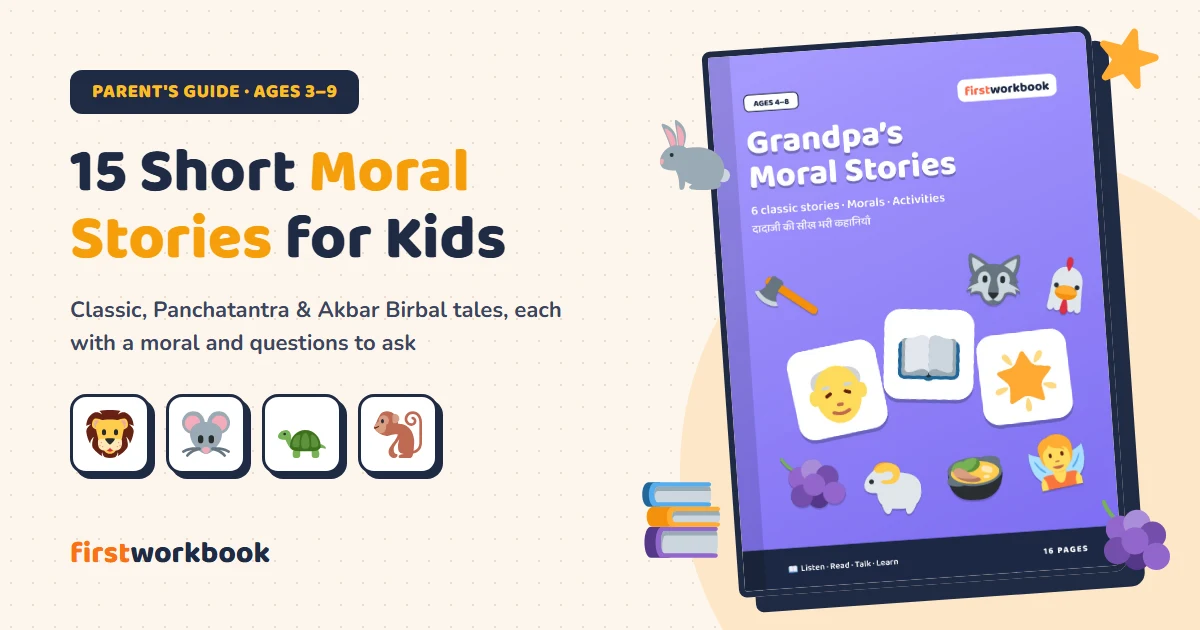
Want ready-made story books? Grandpa's Moral Stories and Grandma's Tales are full of short illustrated stories with simple lessons. For classic animal fables, try Nani's Panchatantra Tales. Prefer Hindi? Read Nani Ki Panchatantra Kahaniyan, Dadaji Ki Seekh Bhari Kahaniyan or Akbar Birbal Ki Kahaniyan. For early readers, the Stories & Rhymes Reader has short stories with read-along questions.