Nursery Admission Interview Questions and Answers: A Parent's Guide
⚡ In short
Common nursery admission interview questions for children and parents, sample answers, what teachers look for and a simple 4-week plan to prepare your 3-year-old.
Nursery admission season is here, and with it comes the question every parent of a 3-year-old asks: “What will the school ask my child?” The good news is that a nursery “interview” is not a test. It is usually a short, friendly chat to see whether your child is comfortable, can talk a little and is ready to sit in a classroom.
This guide lists the nursery admission interview questions schools commonly ask children and parents, sample answers, what teachers actually look for, and a simple 4-week plan to help your child walk in feeling confident.
First, Is There Really an Interview for Nursery?
It depends on where you live:
- Delhi and many RTE-following schools: The Right to Education Act, 2009 (Section 13) does not allow schools to use a screening procedure for the child or parents at admission. Delhi private schools admit nursery children through a points system (distance from school, sibling, alumni and so on) and a draw of lots. Delhi admissions for a new session usually open in late November or December; watch edudel.nic.in for the official schedule.
- Many other cities and schools: Schools often hold an informal “interaction” with the child and a parent meeting before confirming a seat.
- Everywhere: Even where there is no interview, your child still has to settle into a classroom on day one. The same skills that help in an interaction help in the first week of school.
So whether or not your school talks to your child, the preparation below is worth doing.
What Teachers Actually Look For
No school expects a 3-year-old to read or write. In a short interaction, teachers usually notice:
- Comfort: Can the child leave the parent’s lap for a few minutes, or at least respond from it?
- Speaking: Can they say their name and answer simple questions in any language they know?
- Listening: Do they follow a one-step instruction like “Give me the red block”?
- Basic awareness: Colours, a few shapes, common animals and fruits, body parts.
- Hand use: Holding a crayon, scribbling, stacking blocks or turning pages.
- Manners: Greeting, saying thank you, waiting for a turn.
A shy child is not “failing”. Teachers meet hundreds of shy children every year. What helps most is a child who has heard these questions before at home, in a relaxed way.
Nursery Admission Interview Questions for Children
About Myself and Family
- What is your name? — “My name is Aarav.” (Full name is a bonus.)
- How old are you? — “I am three.” Showing three fingers is fine too.
- What is your mother’s / father’s name?
- Do you have a brother or sister?
- Who is in your family? — “Mummy, Papa, Dadi and me.”
- What is your favourite food / toy / colour?
Colours, Shapes and Numbers
- What colour is this? (red, blue, yellow, green are the usual ones)
- Can you show me the circle? Which one is the square?
- How many blocks are here? (counting objects up to 5, sometimes 10)
- Which one is big and which one is small?
- Can you sort these by colour?
The World Around Me
- What animal is this? What sound does a cow / dog / cat make?
- Name a fruit. What colour is a banana?
- Show me your nose / eyes / ears.
- What do we use to brush our teeth?
- Where do you live? What do you see on the way to the park?
Picture Talk and Activity
- What is happening in this picture? (a park, a kitchen, a festival scene)
- Can you find the one that is different? (odd one out)
- Can you colour this / draw a line / build a tower?
- Can you sing a rhyme for me? — “Twinkle Twinkle” or “Machli Jal Ki Rani Hai” are perfect.
Practise these as a game, not a quiz. Ask one or two questions at breakfast or while walking, and clap for every answer, even half answers.
Questions Schools Ask Parents
Where schools meet parents, the chat is about fit and support at home. Common questions:
- Why did you choose this school? Mention something specific: the activity-based approach, distance, the library, the values.
- Tell us about your child. Share one strength, one interest and how they spend their day.
- How do you spend time with your child? Stories at bedtime, park visits, cooking together, colouring.
- Who looks after the child during the day?
- How do you handle tantrums or screen time? Be honest; schools like parents who have a routine.
- What do you expect from the school?
Keep answers short and genuine. Rehearsed speeches are easy to spot.
A Simple 4-Week Preparation Plan
| Week | Focus | 10–15 minutes a day |
|---|---|---|
| Week 1 | Me and my family | Name, age, family members, favourite things; look at family photos and talk. |
| Week 2 | Colours and shapes | Spot colours and shapes at home; sorting toys; colouring inside big outlines. |
| Week 3 | World around me | Animals and their sounds, fruits, vegetables, body parts; picture books. |
| Week 4 | Picture talk and manners | Describe a picture, odd one out, a rhyme; practise greeting, “please” and “thank you”. |
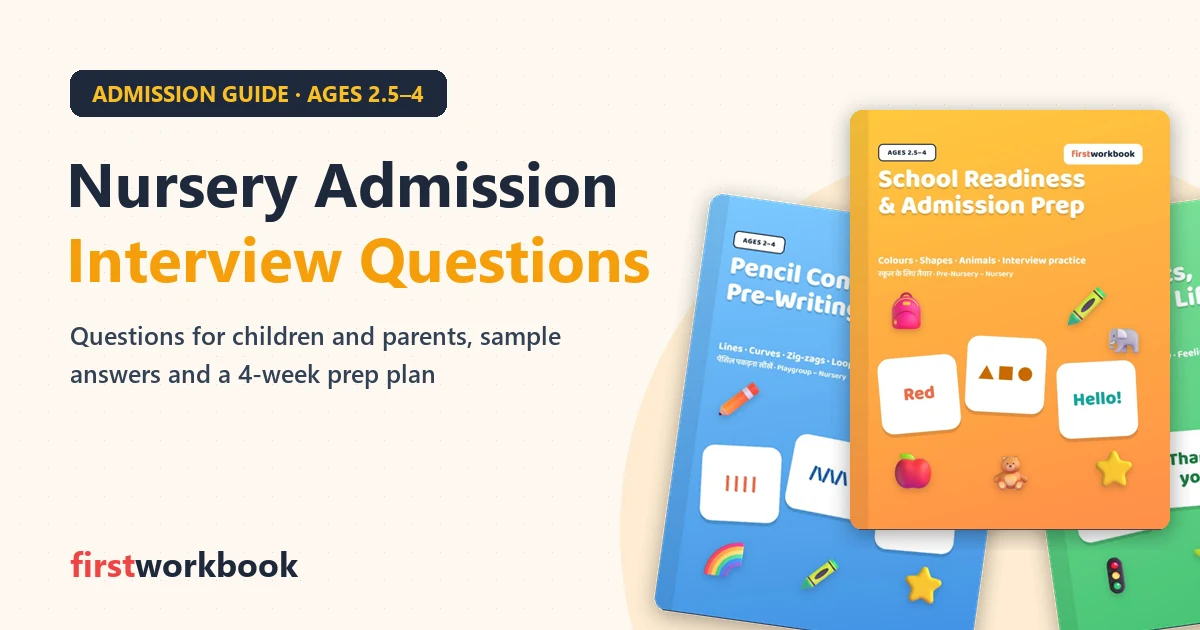
Make it easy: The School Readiness & Nursery Admission Prep workbook follows this exact plan. Its 40 picture pages for ages 2.5 to 4 cover colours, shapes, animals, fruits, body parts, big-small, same-different and odd-one-out, plus a section of commonly asked admission questions with picture prompts and a parent guide on what schools look for. Your child cannot read yet? That is fine; every page works with pictures.
Build Pencil Grip and Hand Skills Too
Teachers often hand a child a crayon during an interaction, and the first weeks of nursery are full of colouring and pre-writing lines. A good grip now saves months of correction later.
- Let your child tear paper, roll play dough and pick up small things like beads or rajma.
- Use thick crayons first; they are easier for small hands.
- Draw standing, sleeping and slanting lines together, then curves and zig-zags.
For guided practice, Pencil Control & Pre-Writing Patterns takes children aged 2 to 4 from straight lines to curves, loops and spirals. If you would like one page a day without planning, the 30 Day Daily Workbook mixes lines, letters, numbers, colours and matching for ages 3 to 4. Our guide to fine motor skills activities has more play ideas.
Teach the Manners That Teachers Notice
A simple “Good morning” and “Thank you” leaves a lovely impression and makes the first days of school smoother. Practise at home:
- Greeting guests and saying bye.
- Waiting for a turn while playing.
- Asking for the toilet or water.
- Washing hands before eating and putting toys back.
Good Habits, Manners & Life Skills turns these into colourful pages with a good-habits chart your child can tick every day.
On the Day: Tips for Parents
- Keep the morning normal. Good sleep, a light breakfast and a visit to the toilet before you go in.
- Do not drill in the car. Last-minute questioning makes children anxious.
- Carry documents in one folder: birth certificate, address proof, photos and any form the school asked for.
- Let your child answer. Do not answer for them or prompt loudly.
- If they go quiet, stay calm. Smile and tell the teacher they are a little shy. That is completely normal at this age.
- Praise the effort afterwards, whatever happened inside.
Frequently Asked Questions
What questions are asked in a nursery admission interview?
Mostly simple ones: the child’s name and age, family members, colours, shapes, counting up to 5 or 10, animals and their sounds, fruits, body parts, picture talk and a rhyme. Parents are usually asked why they chose the school and how they spend time with their child.
Are interviews allowed for nursery admission?
Under the RTE Act, schools covered by it should not use a screening procedure for the child or parents. Delhi private schools admit nursery children through a points system and draw of lots. Some schools in other places still hold an informal interaction, so check your school’s admission notice.
My child is shy and may not talk. What should I do?
Practise questions as a game at home for a few weeks, visit the school area beforehand if you can, and on the day let your child sit on your lap if needed. Teachers understand that 3-year-olds are often shy.
Does my child need to read or write for nursery admission?
No. Schools do not expect reading or writing at this age. Recognising colours, shapes and familiar objects, speaking a little and holding a crayon is more than enough.
When do Delhi nursery admissions start?
In recent years the Directorate of Education has opened private school nursery admissions in late November or early December, with the first list in January. Always check the official schedule on edudel.nic.in.
Which book is best for nursery admission preparation?
Choose a picture-based book that covers colours, shapes, animals, body parts, matching and common questions rather than writing drills. Our School Readiness & Nursery Admission Prep book was made for exactly this, for ages 2.5 to 4.
Ready, Steady, School!
Your child does not need to know everything. They need to feel safe, say a few words and enjoy a little activity. Ten happy minutes a day for a month is enough. Start today with one question at breakfast, and when you are ready, get the School Readiness & Nursery Admission Prep book as a printed copy or an instant PDF. For what comes after admission, read our Nursery, LKG and UKG syllabus guide.