25 Fine Motor Skills Activities for Preschoolers (Ages 3 to 6) to Do at Home
⚡ In short
Easy fine motor skills activities for kids aged 3 to 6 with cutting, colouring, clay and household items, plus age milestones, a weekly plan and warning signs.
Before a child can write neatly, they need strong, steady little hands. Holding a pencil, cutting along a line, buttoning a shirt, and even eating with a spoon all depend on fine motor skills. When these skills are weak, children get tired quickly while writing, press too hard, or avoid drawing altogether.
The best part is that fine motor skills grow through play. You do not need expensive toys. Paper, clay, crayons, scissors, clothes pegs and a few kitchen items are enough.
In this guide, you will find what fine motor skills are, typical milestones by age, 25 easy fine motor skills activities for preschoolers, a simple weekly plan, and the signs that suggest your child may need extra support.
What Are Fine Motor Skills?
Fine motor skills are the small, precise movements of the fingers, hands and wrists, working together with the eyes. They include:
- Grasp: holding crayons, pencils and spoons correctly.
- Hand strength: squeezing, pinching and pressing.
- Bilateral coordination: using both hands together, like holding paper with one hand while cutting with the other.
- Hand-eye coordination: guiding the hand to where the eyes are looking, like tracing a line.
- Finger isolation: moving one finger at a time, like pointing or pressing a button.
These are the building blocks of pre-writing skills. A child with good fine motor control finds tracing, colouring and writing much easier and more enjoyable.
Fine Motor Milestones by Age
Every child develops at their own pace, so treat these as typical ranges, not strict deadlines.
| Age | What many children can do |
|---|---|
| 3 years | Snips paper with scissors, cuts paper in half, copies a circle, builds a tower of 8–9 blocks, strings large beads |
| 4 years | Cuts along a straight line and around a big circle, copies a cross (+) and a square, starts using a finger-based grip on crayons |
| 5 years | Cuts simple shapes, copies a triangle, colours mostly inside lines, writes some letters and numbers, uses a tripod grip more often |
| 6 years | Cuts complex shapes, writes letters with fairly even size, ties simple knots, manages buttons and zips independently |
If your child is a little behind in one area, do not worry. Regular play-based practice usually closes the gap quickly.
25 Fine Motor Skills Activities for Preschoolers
Hand Strength Activities
1. Clay and playdough play. Roll snakes, make balls, pinch pots and press shapes. This is one of the best all-round hand strengtheners.
2. Tearing paper. Tear old newspaper into strips, then into small pieces to stick on a picture. Tearing uses both hands and builds finger strength.
3. Clothes peg game. Clip pegs around the edge of a paper plate or a cardboard box. Count them as you go to add a little maths.
4. Sponge squeezing. Fill one bowl with water and squeeze a sponge into an empty bowl. Children love this, and it strengthens the whole hand.
5. Kneading atta. Let your child help knead a small ball of dough in the kitchen. A real-life activity that works hand muscles beautifully.
Pinch and Grip Activities
6. Tong transfer. Move pom-poms, cotton balls or chana from one bowl to another using kitchen tongs or a tweezer.
7. Sorting dals and beans. Mix rajma and chana in a plate and ask your child to sort them with fingers. Supervise closely to avoid choking for young children.
8. Sticker peeling. Peeling stickers and placing them on a line or a shape trains the pincer grasp.
9. Coin bank. Push coins or buttons into a slot cut in a box lid. Great for finger isolation.
10. Bead stringing. Start with big wooden beads on a shoelace, then move to smaller beads on a thread.
Scissor Skill Activities
11. Snipping strips. Give thin strips of paper that can be cut with a single snip. Perfect for 3-year-olds.
12. Cutting straight lines. Draw thick straight lines on paper and ask your child to cut along them. Gradually make the lines thinner.
13. Cutting curves and zig-zags. Once straight lines are easy, move to waves and zig-zags.
14. Cut and paste pictures. Cut out pictures from old magazines and paste them on a theme page, such as "Things that are red" or "Animals."
15. Paper craft projects. Make paper puppets, masks or simple animals. Craft books with safe cutting lines make this easy to set up.
Safety tip: Always use child-safe, round-tipped scissors and teach the "thumb on top" rule: the thumb goes in the small hole and points to the ceiling.
Pre-Writing and Colouring Activities
16. Colouring big pictures. Start with large, bold shapes. As control improves, move to pictures with smaller sections.
17. Colour by number. Combines number recognition with careful colouring inside the lines.
18. Line tracing worksheets. Trace straight, slanted, curved and zig-zag lines. These are the exact strokes used in letters and numbers.
19. Dot-to-dot pictures. Joining dots improves pencil control and teaches number order.
20. Mazes. Simple mazes train the hand to stay within a path, a key skill for neat writing.
Sensory and Everyday Activities
21. Rice or sand tray drawing. Spread rice or sand on a tray and draw shapes and letters with a finger.
22. Buttoning and zipping. Let your child button their own shirt or zip a bag. Old clothes on a teddy bear work well too.
23. Pouring water. Pour water from a small jug into cups. This builds wrist control and focus.
24. Building blocks and LEGO. Pressing small pieces together builds finger strength and planning skills.
25. Folding paper. Fold paper in half, then into quarters, then try simple origami like a boat or a cup.
A Simple Weekly Fine Motor Plan
Just 15 to 20 minutes a day is enough. Mix one strength activity with one skill activity.
| Day | Warm-up (5 min) | Main activity (10–15 min) |
|---|---|---|
| Monday | Playdough snakes | Line tracing worksheet |
| Tuesday | Tearing paper | Cut and paste picture page |
| Wednesday | Clothes pegs | Colouring a big picture |
| Thursday | Tong transfer | Cutting curves and zig-zags |
| Friday | Bead stringing | Dot-to-dot or maze |
| Saturday | Kitchen helper (atta, pouring) | Paper craft project |
| Sunday | Free play | Rice tray drawing |
How Fine Motor Skills Help With Writing
A child who can cut, colour and build with ease usually has:
- A stable grip, so the pencil does not slip or wobble.
- Correct pressure, so writing is neither too faint nor too dark.
- Better endurance, so the hand does not tire after a few lines.
- Neater letters, because the hand goes where the eyes want it to.
That is why teachers often say: strong hands first, neat writing later. Once your child shows good control, you can move to letter tracing. Our guide on alphabet and number tracing worksheets explains the next step.
Tips for Parents
- Keep it playful. If an activity feels like a test, children lose interest. Make it a game.
- Use short sessions. Stop while your child is still enjoying the activity.
- Sit at the right height. Feet flat, table at elbow height, paper steady.
- Offer the right tools. Short, thick crayons encourage a better grip than long, thin ones.
- Praise effort, not perfection. Wobbly lines are part of learning.
- Reduce screen time. Tapping and swiping does not build the same hand strength as real-world play. See our list of screen-free activities for kids at home for more ideas.
When to Seek Extra Help
Talk to your paediatrician or an occupational therapist if your child:
- Cannot snip or cut across paper by around 4 years.
- Strongly avoids drawing, colouring or crafts.
- Has a very weak, awkward or fisted grip after age 5.
- Tires very quickly or complains of hand pain during simple tasks.
- Has trouble with everyday tasks like buttons, spoons or opening lunch boxes.
Early support is simple and effective, and many children catch up quickly with the right activities.
Frequently Asked Questions
What are some easy fine motor activities for 3-year-olds?
Playdough, tearing paper, peeling stickers, big bead stringing, snipping paper strips and colouring large pictures are all great for 3-year-olds.
When should a child start using scissors?
Most children can start snipping paper with child-safe scissors around 3 years, with close supervision. Cutting along a line usually comes around 4.
How can I improve my child's pencil grip?
Build hand strength first with clay, pegs and tongs. Then give short, thick crayons that naturally encourage a tripod grip. Avoid forcing a grip before the hand is ready.
Are worksheets good for fine motor skills?
Yes, when used with hands-on play. Tracing, colouring, mazes and cut-and-paste worksheets give focused practice, while clay and everyday tasks build the strength behind it.
How long should fine motor activities last?
For preschoolers, 15 to 20 minutes a day is plenty. Short, daily practice works better than long sessions once a week.
Conclusion
Strong little hands make every later skill easier, from writing and drawing to dressing and eating. With these fine motor skills activities for preschoolers, a few household items and 15 minutes a day, you can give your child a confident, joyful start.
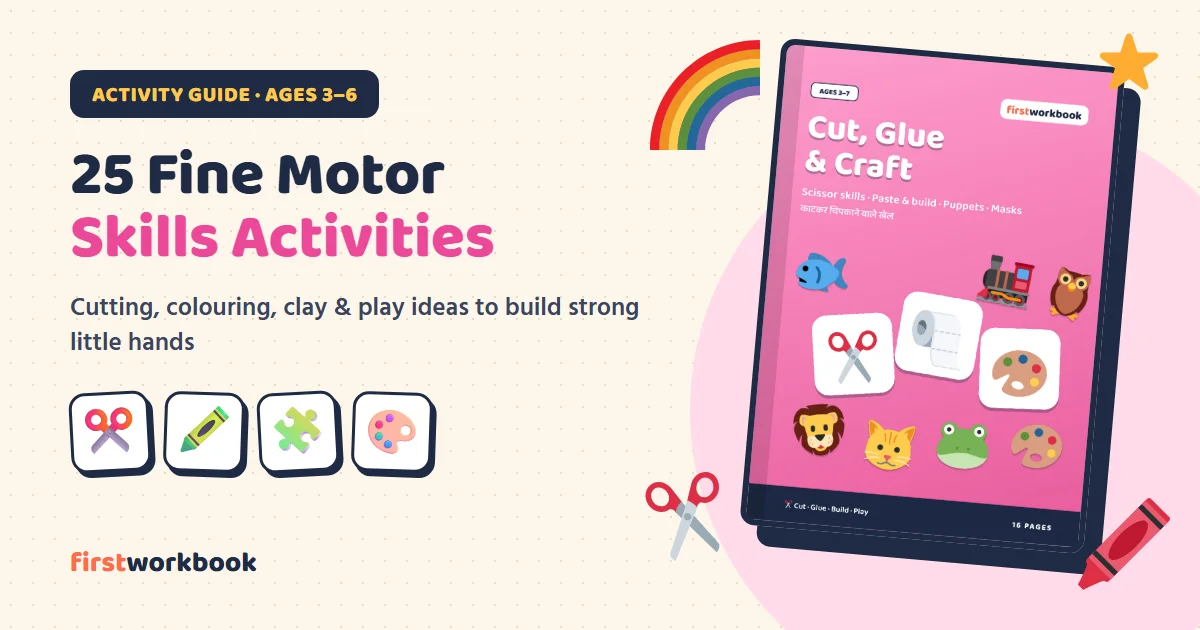
Looking for ready-to-use activity pages? Our Cut, Glue & Craft Activity Book has safe scissor-skill cutting lines and paste-and-build projects, the Mega Colouring & Drawing Book builds pencil control with big, bold pages, and the Art Workbook offers line and curve tracing for ages 3 to 5.