200+ Rhyming Words for Kids: Word Families, Hindi Rhymes, Games and Tips
In short
200+ rhyming words for kids grouped by word family, Hindi tukant shabd, what to expect at each age, a 7-step way to teach rhyming, 10 games, rhyming sentences, a 4-week plan and free worksheets.
“Cat, hat, bat… mat!” Most children start playing with rhyming words long before they can read, and they laugh while doing it. That play is far more useful than it looks. Hearing that cat and hat end with the same sound is one of the first steps towards hearing the separate sounds inside words, and that skill sits right underneath phonics, reading and spelling.
This guide gives you 200+ rhyming words for kids, grouped by word family so they are easy to teach, plus Hindi rhyming words (तुकांत शब्द), what to expect at each age, a 7-step way to teach rhyming at home, 10 games, rhyming sentences, the mistakes children commonly make, a 4-week plan and free worksheets.
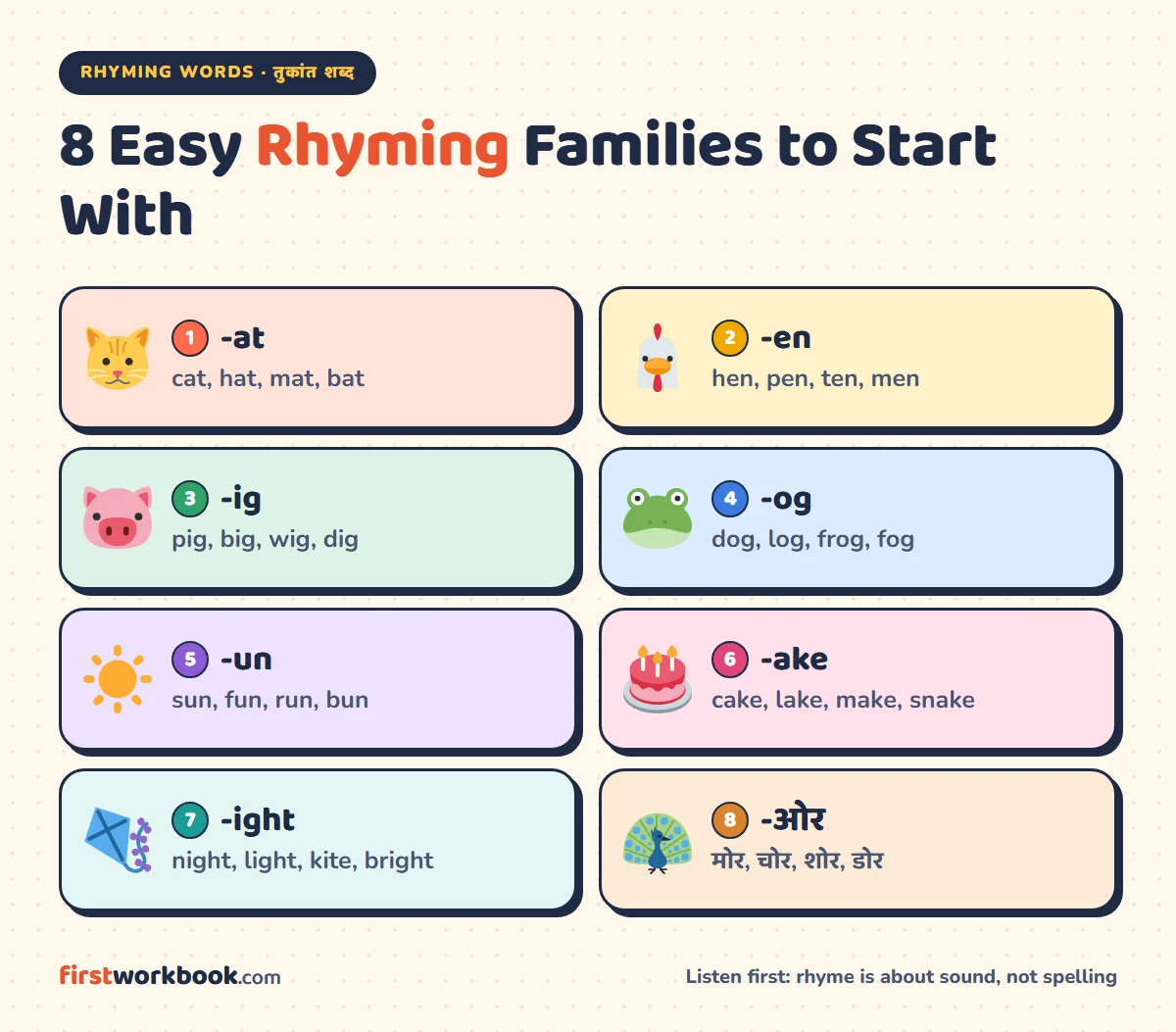
Quick answer: rhyming words are words that sound the same at the end, from the last vowel sound onwards: cat–hat–mat, sun–fun–run, cake–lake–make, night–light–kite. Children usually enjoy rhymes from about 2–3, can hear whether two words rhyme by about 4–5, and can make their own rhyming words by about 5–6 (UKG to Class 1). Teach rhyme by ear first (songs, poems, games), then move to word families like -at, -an, -ig, -op, where rhyming words are also spelt alike.
What Are Rhyming Words?
Two words rhyme when the ending sound is the same and only the beginning sound changes. In c-at, h-at and b-at, the beginning sound changes (c, h, b) and the ending -at stays. Teachers call the beginning part the onset and the ending part the rime, which is why groups like -at, -at, -at are called word families.
Rhyme is about sound, not spelling. Blue and two rhyme, though they are spelt differently; cow and low look alike but do not rhyme. That is why rhyming is best taught by listening first and reading second.
Why Rhyming Matters for Reading
Rhyming is one part of phonological awareness: the ability to notice and play with the sounds in spoken words. The research link is strong and old:
- In a classic study in Nature (1983), Lynette Bradley and Peter Bryant found that children who struggled to read were strikingly poor at noticing rhyme and alliteration, and that young children trained to sort words by their sounds, and then by the letters that spell those sounds, later read and spelt better than children who were not.
- In a follow-up study (Bryant, MacLean and Bradley, 1990), children’s sensitivity to rhyme and alliteration predicted their reading two years later, even after allowing for differences in vocabulary, intelligence and family background. The authors argue that rhyme helps children form spelling groups: if you can read light, you can guess night, fight and bright.
- The U.S. National Early Literacy Panel (2008), which pooled hundreds of studies, named phonological awareness as one of the strongest early predictors of later reading, writing and spelling.
Rhyming is not a magic shortcut: children still need to learn letter sounds and blending (see our phonics guide). But a child who can hear rhyme usually finds phonics, word families and spelling much easier.
Rhyming Skills by Age
Every child develops at their own pace, but this is a typical path. Use it to choose the next step, not to worry.
| Age / class | What most children can do | What to practise |
|---|---|---|
| 2–3 (Pre-Nursery) | Enjoy rhymes and songs, join in the last word | Nursery rhymes with actions; pause before the rhyming word |
| 3–4 (Nursery) | Say many rhymes from memory; notice funny-sounding words | Rhyming picture books, silly rhymes (“wig on a pig”) |
| 4–5 (LKG) | Tell whether two words rhyme (“Do cat and hat rhyme?”) | Yes/no rhyme games, odd-one-out with pictures |
| 5–6 (UKG) | Make a rhyming word, even a nonsense one (“cat… zat!”) | Word families with pictures, rhyming pairs, CVC words |
| 6–7 (Class 1) | Read and write rhyming words in families; complete a rhyme in a poem | -at, -ig, -op families; long-vowel families like -ake, -ee |
| 7–8 (Class 2) | Find rhymes with different spellings; write a 2–4 line rhyming poem | -ight, -ear, -ow; rhyming poems and riddles |
200+ Rhyming Words for Kids, by Word Family
Level 1: Short-vowel word families (UKG – Class 1)
Three-letter words with one short vowel. These are also CVC words, so children can read them as soon as they know letter sounds.
| Family | Rhyming words |
|---|---|
| -at | cat, bat, hat, mat, rat, sat, fat, pat |
| -an | can, fan, man, pan, ran, van, tan, ban |
| -ap | cap, map, tap, nap, lap, gap, sap |
| -ag | bag, rag, tag, wag, nag |
| -ad | dad, bad, mad, sad, pad, had |
| -en | hen, pen, ten, men, den |
| -et | net, pet, wet, jet, set, vet, get |
| -ed | bed, red, fed, led, wed |
| -ig | pig, big, dig, wig, fig, jig |
| -in | pin, tin, bin, win, fin, chin |
| -ip | lip, hip, dip, tip, sip, zip, ship |
| -it | sit, hit, bit, fit, kit, pit |
| -op | top, hop, mop, pop, cop, stop |
| -ot | pot, hot, dot, cot, not, got |
| -og | dog, log, fog, jog, frog |
| -ug | bug, mug, rug, jug, hug, tug |
| -un | sun, fun, run, bun, spun |
| -ub | tub, rub, cub, hub, sub |
Level 2: Blends, digraphs and long vowels (Class 1)
| Family | Rhyming words |
|---|---|
| -ake | cake, lake, make, bake, take, snake, shake |
| -ate | gate, late, plate, skate, date |
| -ame | game, name, same, came, frame |
| -ay | day, play, say, way, pay, tray, may |
| -ain | rain, train, pain, chain, brain |
| -ee | tree, bee, see, three, free, knee |
| -eat | eat, seat, meat, heat, beat, neat |
| -ing | king, ring, sing, wing, swing, thing |
| -ill | hill, mill, fill, pill, will, still |
| -ell | bell, well, shell, sell, tell, smell |
| -all | ball, tall, wall, fall, call, small |
| -ack | back, pack, sack, black, snack |
| -ock | sock, rock, lock, clock, block |
| -ish | fish, dish, wish |
| -ine | line, nine, mine, fine, pine |
| -oat | boat, coat, goat, float |
Level 3: Trickier rhymes and different spellings (Class 2)
| Sound | Rhyming words |
|---|---|
| -ight | night, light, kite, bright, white, fight, right, bite |
| -ow (as in cow) | cow, how, now, wow, bow |
| -ow (as in snow) | snow, slow, grow, go, toe, blow |
| -ear | ear, near, dear, deer, year, clear |
| -air | chair, hair, bear, pear, there, care |
| -oon | moon, spoon, soon, noon, balloon |
| -oo | blue, two, shoe, zoo, new, true |
| -ouse | house, mouse, blouse |
| -ar | car, star, far, jar |
| -ird / -urd | bird, third, word, heard |
Level 3 is where rhyme and spelling separate: kite rhymes with night, bear with chair, shoe with two. Point this out as a fun puzzle: “They sound the same, but look how differently they are spelt!”
Rhyming Words in Hindi (तुकांत शब्द)
Hindi is wonderful for rhyme, and Hindi baal geet use it all the time (“मछली जल की रानी है, जीवन उसका पानी है”). These pairs work well from Nursery to Class 2:
| Ending | तुकांत शब्द |
|---|---|
| -आल | दाल, बाल, गाल, लाल, थाल, जाल |
| -ओर | मोर, चोर, शोर, ज़ोर, डोर, भोर |
| -आम | आम, काम, नाम, शाम, दाम |
| -आनी | पानी, रानी, नानी, कहानी |
| -ओटी | रोटी, चोटी, मोटी, छोटी |
| -अर | घर, पर, डर, भर, मटर |
| -ाना | नाना, खाना, गाना, जाना, दाना |
| -ओता | तोता, सोता, रोता, धोता |
| -आय | गाय, चाय, राय |
| -अंदर | बंदर, अंदर, सुंदर, समंदर |
| -इल्ली | बिल्ली, दिल्ली, गिल्ली |
| -आड़ी | गाड़ी, साड़ी, झाड़ी, पहाड़ी |
If your child is new to Hindi, start with the sound play and the pictures; reading these words needs मात्राएँ (see our बारहखड़ी chart). Our learn Hindi for kids guide has more first words.
How to Teach Rhyming Words at Home: 7 Steps
- Fill the day with rhymes. Sing and say nursery rhymes and Hindi baal geet every day. Pause before the rhyming word and let your child shout it: “Twinkle twinkle little star, how I wonder what you…”
- Point out rhymes. “Listen: star, are. They sound the same at the end. They rhyme!” Children need to hear the word rhyme used many times.
- Ask yes/no questions. “Do sun and fun rhyme? Do sun and cup rhyme?” Stretch the ending if needed: “s-un, f-un”.
- Play odd one out. Say three words, two that rhyme and one that does not: “cat, hat, dog”. Use pictures for younger children.
- Make rhymes together. “What rhymes with pig?” Accept nonsense words (“zig!”): they show your child can hear the pattern, which is the real skill.
- Move to word families. Once your child knows letter sounds, write -at on a card and change the first letter: c-at, h-at, m-at, s-at. Now rhyme helps reading.
- Read and write rhymes. Complete the missing rhyming word in a poem, then write two-line rhymes together: “I saw a cat / sitting on a mat.”
10 Rhyming Games for Kids
- Rhyme or not? Say two words. Thumbs up if they rhyme, thumbs down if not.
- I spy a rhyme: “I spy something that rhymes with log” (dog). Works on walks and car rides.
- Rhyming basket: put toys and objects in a basket (sock, clock, car, star, cat, hat). Children pull out pairs that rhyme.
- Rhyme chain: take turns saying a word that rhymes with the last one until someone gets stuck: bat, cat, hat, mat…
- Silly name rhymes: “Riya, Piya, Tiya!” Children love rhyming with names in the family.
- Odd one out cards: draw three pictures on a card, two that rhyme. Child crosses out the odd one.
- Word family houses: draw a house with -ig on the roof. Child writes or sticks words that “live” there: pig, big, wig, dig.
- Rhyming riddles: “I rhyme with tree, I buzz and I make honey” (bee).
- Finish my poem: say a line and let your child give the rhyming line: “My cat is fat…” – “…she sleeps on a mat!”
- Rhyme hop: write word-family words in chalk squares. Call a word; child hops to a square that rhymes with it.
Rhyming Sentences and Short Poems for Kids
- The cat sat on the mat.
- A bug is in the mug.
- The hen has ten eggs in her den.
- I see a bee on the tree.
- The goat is in the boat.
- A snake swam in the lake.
- Fly my kite, up so bright, in the sky till night.
- मेरी गाय पीती नहीं चाय।
- छोटा बंदर घर के अंदर।
Ask your child to change one word to make a new rhyme: “The rat sat on the hat!” Then they can draw it. Rhyming stories also make bedtime reading easier; see our short moral stories.
Common Rhyming Mistakes (and How to Fix Them)
| Mistake | Why it happens | What helps |
|---|---|---|
| Gives a word that starts the same (cat → cup) | Listening to the beginning, not the end | Stretch and stress the ending: “c-at”; clap on the ending |
| Gives a word with the same meaning (cat → kitten) | Thinking about meaning, not sound | Say “rhyme is about how it sounds, not what it means”; play yes/no games |
| Thinks cow and low rhyme | Looking at spelling, not listening | Say both words aloud slowly; close eyes and listen |
| Gets stuck making a rhyme | Making rhymes is harder than hearing them | Go back to odd-one-out, then give a choice of two words |
| Cannot hear rhyme at all by age 5–6 | May just need more exposure; sometimes a hearing or speech issue | Daily rhymes for a few weeks; if no change, check hearing and talk to the teacher |
A 4-Week Rhyming Plan (10 Minutes a Day)
| Week | Focus | Daily activity |
|---|---|---|
| Week 1 | Hearing rhyme | 2 rhymes with pauses; “rhyme or not?” game with 10 word pairs |
| Week 2 | Odd one out | Picture cards of three; rhyming basket with toys |
| Week 3 | Making rhymes | Rhyme chain, silly name rhymes, “what rhymes with…?” |
| Week 4 | Reading word families | One family a day (-at, -an, -ig, -op, -ug); read, sort and write 4 words |
For older children in Class 1–2, use weeks 3–4 with long-vowel and Level 3 families, and finish by writing a 4-line rhyming poem together.
Books and Worksheets for Rhyming Practice
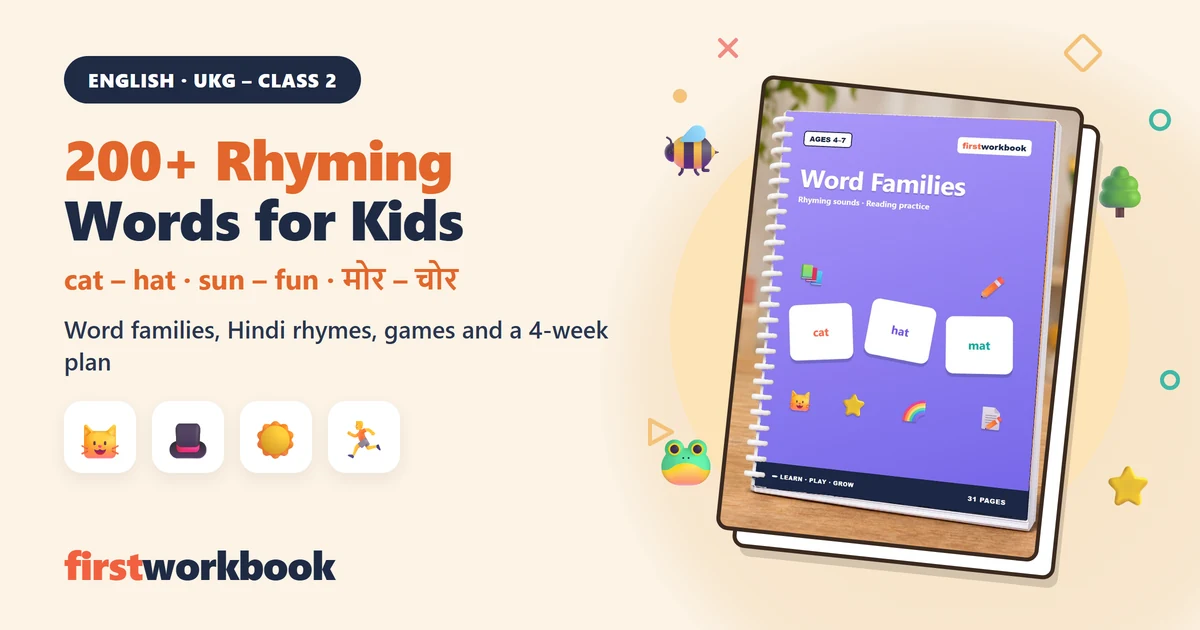
- Word Families & Rhyming Words Workbook: twelve common word families with short reading prompts, questions and space for writing and drawing.
- Phonics Workbook – Short & Long Vowel Sounds and Phonics Workbook – Blends & Digraphs for reading the Level 1–2 families.
- Classic Nursery Rhymes for Kids and My First Rhyme Book for daily rhyme time, and the Nursery Rhymes Book (English & Hindi baal geet) for Hindi rhymes.
- UKG, Class 1 and Class 2 English Grammar Workbooks, where rhyming words are part of the grammar year.
Save with the English Reading Pack, or print free rhyming words worksheets. Opposites are the natural next step: see our 100 opposite words for kids.
हिंदी में सार (Summary in Hindi)
तुकांत शब्द (rhyming words) वे शब्द हैं जिनकी आख़िरी आवाज़ एक जैसी होती है, जैसे cat–hat–mat, sun–fun–run या हिंदी में दाल–बाल–गाल, मोर–चोर–शोर। Rhyme सुनना phonological awareness का हिस्सा है, यानी शब्दों की आवाज़ों को पहचानना। शोध (Bradley और Bryant, 1983; Bryant और साथी, 1990) बताता है कि जो बच्चे तुक पहचानते हैं, वे आगे चलकर पढ़ना और spelling आसानी से सीखते हैं। 2–3 साल के बच्चे कविताओं का आनंद लेते हैं, 4–5 साल तक वे बता पाते हैं कि दो शब्द तुक मिलाते हैं या नहीं, और 5–6 साल तक ख़ुद तुकांत शब्द बना लेते हैं। शुरुआत कविताओं और खेलों से करें, फिर -at, -an, -ig जैसे word families पढ़ाएँ। रोज़ 10 मिनट के खेल, जैसे “rhyme or not?”, odd one out और rhyme chain, काफ़ी हैं। याद रखें: rhyme आवाज़ से तय होती है, spelling से नहीं।
Frequently Asked Questions
What are rhyming words for kids?
Words that sound the same at the end, such as cat–hat, sun–fun, cake–lake and night–kite. Only the beginning sound changes.
At what age do children understand rhyming?
Most children enjoy rhymes from 2–3, can tell whether two words rhyme by about 4–5, and can make their own rhymes by about 5–6. Some take a little longer; lots of daily rhymes and games usually help.
What are some easy rhyming words for UKG?
Start with short-vowel families: cat–hat–mat, pen–hen–ten, pig–big–wig, top–hop–mop, bug–mug–rug and sun–fun–run.
What are rhyming words in Hindi called?
तुकांत शब्द. Examples: दाल–बाल–गाल, मोर–चोर–शोर, पानी–रानी–नानी, रोटी–चोटी–मोटी, बंदर–अंदर–सुंदर.
Do rhyming words have to be spelt the same?
No. Rhyme is about sound: blue–two–shoe and bear–chair rhyme even though they are spelt differently, while cow and low look alike but do not rhyme.
Why is rhyming important for reading?
Hearing rhyme is an early part of phonological awareness, which research links strongly to later reading and spelling. Rhyme also helps children read new words by analogy: if they can read cake, they can work out lake and snake.
Research Behind This Guide
- Bradley, L. and Bryant, P. (1983), Categorizing sounds and learning to read: a causal connection, Nature 301, 419–421; summary at Reading Rockets.
- Bryant, P., MacLean, M. and Bradley, L. (1990), Rhyme, language, and children’s reading, Applied Psycholinguistics.
- National Early Literacy Panel (2008), Developing Early Literacy: summary, NICHD.
Free Worksheets to Practise This
Printable A4 PDFs, free to download. Pick a set and print it at home or school.
About the author

Er. Deepak Maurya
Founder, FirstWorkbook
Er. Deepak Maurya founded FirstWorkbook in Varanasi to make activity workbooks that children enjoy. A web developer with 8 years of experience, he writes practical guides for parents on learning at home, and plans the activities in our workbooks together with pre-primary teachers.
Spotted a mistake or have a question? Write to us and we'll correct it.