CVC Words for Kids: 150+ Word List and How to Teach Them
In short
CVC words like cat, pen, pig, dog and sun are the first words a child reads by sounding out. Get a 150+ word list by vowel, a teacher’s 7-step method, a 4-week home plan and games.
Your child knows the sounds of the letters. “A for apple, B for ball” is perfect. But when you point at the word cat and ask “What does this say?”, they look at the picture, guess “kitten”, or just say the letter names: “see… ay… tee”.
This is the most common sticking point between knowing the alphabet and real reading, and the bridge across it has a name: CVC words. In this guide you will find what CVC words are, when your child is ready, a list of 150+ words sorted by vowel, a teacher’s 7-step method, a 4-week plan for home, games, common mistakes and a short Hindi summary.
What Are CVC Words?
CVC stands for Consonant – Vowel – Consonant. A CVC word has three sounds: a consonant sound, a short vowel sound in the middle, and a consonant sound at the end. Cat (c-a-t), pen (p-e-n), pig (p-i-g), dog (d-o-g) and sun (s-u-n) are all CVC words.
They are the first words most phonics programmes ask a child to decode (read by sounding out) and encode (spell by hearing the sounds). Every letter makes its most common sound, there are no silent letters, and the vowel is always short, so the child can read the word without having memorised it.
Think sounds, not letters. “Box” has three letters but four sounds (b-o-k-s), because x says /ks/. Words ending in w or y (cow, toy) and words with r after the vowel (car, her) also do not follow the short-vowel pattern. Keep them for later.
Is My Child Ready for CVC Words?
Age is a rough guide. In most Indian schools CVC reading begins in UKG (age 5–6), and some children start in the second half of LKG. The government’s NIPUN Bharat goals expect children in Balvatika to recognise letters with their sounds and read simple words of two to three letters, which is exactly the CVC stage.
Rather than going by age, look for these four signs:
- Letter sounds: your child can give the sound (not just the name) of at least 10–12 consonants and the five short vowels a, e, i, o, u.
- First sound: they can tell you that mango starts with /m/ and sun starts with /s/.
- Oral blending: if you say “/d/ … /o/ … /g/”, they can say “dog”, with no letters in sight.
- Rhyme: they can tell you whether cat and hat rhyme.
If oral blending is still difficult, spend two more weeks on the listening games in Step 1 below before showing any written words. It is time well spent.
CVC Words List: 150+ Words Sorted by Vowel
Teachers group CVC words in two ways: by vowel (all the short-a words together) and by word family (words that share an ending, such as -at or -og). Word families help with rhyme and quick reading, while mixed lists check that the child is really reading every sound. Use both.
Short a CVC words
| Word family | Words |
|---|---|
| -at | cat, bat, hat, mat, rat, sat, fat, pat |
| -an | can, fan, man, pan, van, ran, tan |
| -ap | cap, map, nap, tap, lap, sap |
| -ag | bag, rag, tag, wag, nag |
| -ad / -am | dad, sad, mad, pad, had, jam, ham, ram, yam |
Short e CVC words
| Word family | Words |
|---|---|
| -en | pen, hen, ten, men, den |
| -et | net, wet, pet, jet, set, get, let, vet |
| -ed | bed, red, fed, led, wed |
| -eg / -eb | leg, peg, beg, keg, web |
| others | yes, hem, gem, yet |
Short i CVC words
| Word family | Words |
|---|---|
| -ig | pig, big, dig, fig, wig, jig |
| -in | pin, bin, tin, fin, win, kin |
| -it | sit, hit, bit, pit, kit, fit, lit |
| -ip | lip, dip, hip, zip, tip, sip, rip |
| -id / -im | lid, hid, kid, rid, rim, him, dim |
Short o CVC words
| Word family | Words |
|---|---|
| -og | dog, log, fog, hog, jog, bog |
| -ot | pot, hot, dot, cot, not, got, lot, rot |
| -op | top, hop, mop, pop, cop |
| -ob / -od | job, rob, sob, cob, mob, nod, rod, pod |
| -om / -on | mom, Tom, Ron, Don |
Short u CVC words
| Word family | Words |
|---|---|
| -un | sun, bun, run, fun, nun |
| -ug | bug, hug, mug, jug, rug, tug, dug |
| -ut | nut, cut, hut, but, rut |
| -ub / -ud | tub, rub, sub, cub, mud, bud |
| -up / -us | cup, pup, bus |
Tip: start with words a child can picture. Cat, pen, pig, dog, sun, bus, cup beat rut, kin, nag every time, because the child gets the reward of meaning as soon as they blend.
Which Vowel Should You Teach First?
There is no single official order, and different phonics programmes do it differently. A sensible, widely used sequence is:
- Short a first, because it is the easiest vowel to hear and has the most picture-friendly words.
- Then short i and short o.
- Then short u.
- Short e last, because /e/ and /i/ sound alike, and many Indian children also mix up /e/ and /a/ (bed and bad, pen and pan).
Spend about a week on each vowel on its own, then mix them. Mixed practice is where real reading shows, because the child can no longer guess the middle sound.
For the consonants, begin with sounds you can stretch, such as m, s, f, n, l. “Mmmaaat” is easier to blend than “b-a-t”, where the /b/ is gone in an instant.
How to Teach CVC Words: A Teacher’s 7-Step Method
Step 1: Blend by ear (no letters yet)
Play “robot talk”. You say a word slowly, sound by sound, and your child says it fast: “/s/ /u/ /n/” → “sun!”. Do this in the car, at lunch and at bedtime for 2–3 minutes a day. Children who can blend by ear find it far easier to blend on paper.
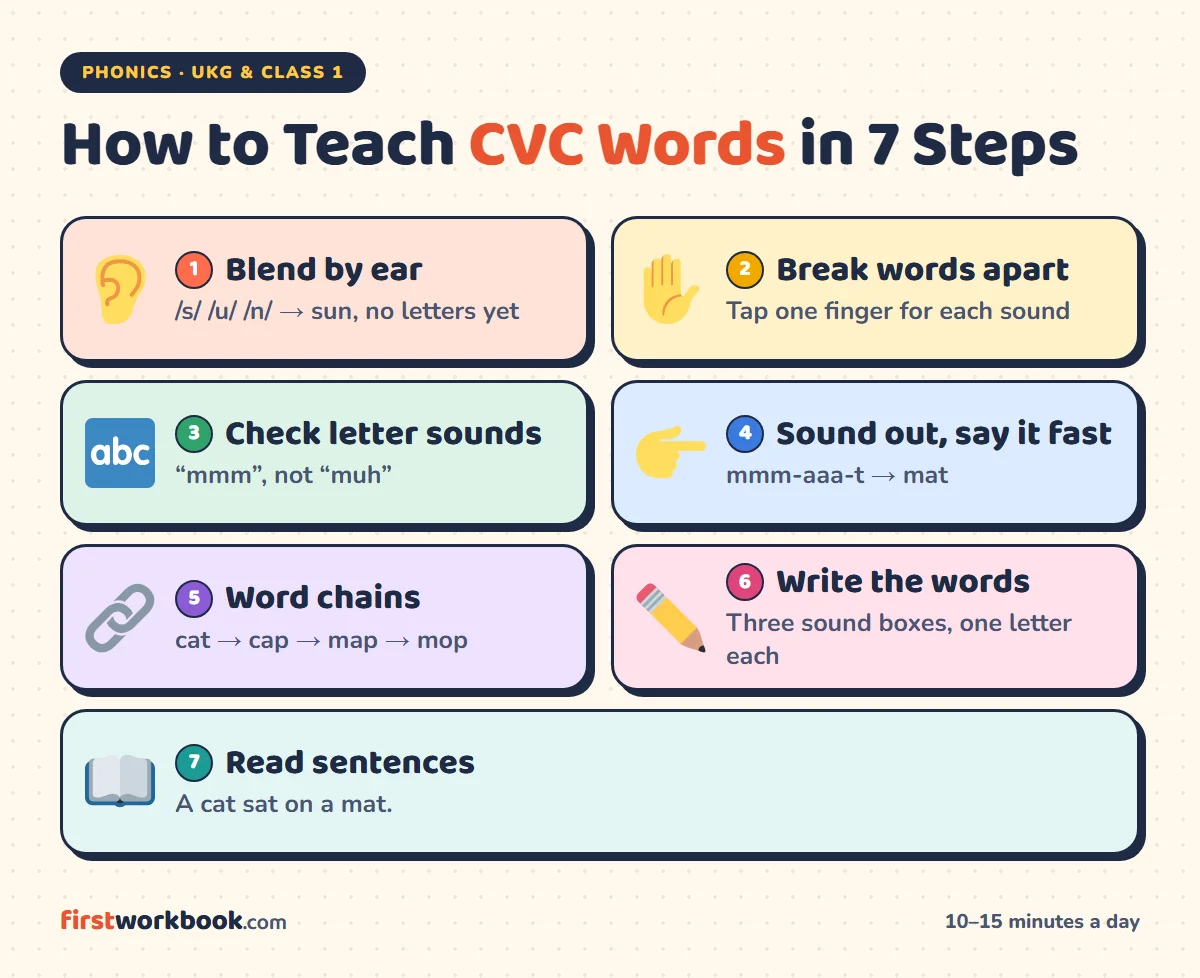
Step 2: Break words apart by ear
Now reverse it. Say “pig” and ask your child to tap one finger for each sound: /p/ /i/ /g/. Three sounds, three taps. This skill, called segmenting, is what they will use for spelling.
Step 3: Check the letter sounds
Make sure each letter is said as a short, clean sound. /m/ is “mmm”, not “muh”. /t/ is a quick whisper, not “tuh”. Extra “uh” sounds are the main reason children say “cuh-a-tuh” and cannot hear “cat”.
Step 4: Sound it out, then say it fast
Write mat in big letters. Your child touches each letter and says its sound, then sweeps a finger under the whole word and says it fast. Better still, teach continuous blending: hold each sound into the next, “mmmaaat”, so there is no gap to fill.
Step 5: Word chains
Change one letter at a time with magnetic letters or paper cards: cat → cap → map → mop → top → tip → tin. Each new word changes only one sound, so your child must look at every letter, not just the first one.
Step 6: Write the words
Draw three boxes. Say “hen”. Your child says the sounds, pushes a coin into a box for each one, then writes a letter in each box. Spelling CVC words this way makes reading them stronger too.
Step 7: Read them in sentences
As soon as your child can read 15–20 CVC words, put them in short sentences. You will need a few sight words such as a, the, is, on, in, which you teach as whole words:
- A cat sat on a mat.
- The pig is in the mud.
- Dad has a red pen.
- The dog can dig.
- Sit on the big rug.
- A bug is in the cup.
- The sun is hot.
- Get the hat and the bag.
For help with those common sight words, see our guide on how to teach sight words and word families.
A 4-Week CVC Plan for Home (15 Minutes a Day)
| Week | Focus | Daily routine (about 15 minutes) |
|---|---|---|
| Week 1 | Short a (-at, -an, -ap) | 3 min robot talk · 5 min reading word cards · 4 min word chain · 3 min writing 3 words |
| Week 2 | Short i and short o | Revise 5 short-a words · new families -ig, -in, -og, -ot · one sentence a day |
| Week 3 | Short u and short e | New families -un, -ug, -en, -et · practise pairs like pen/pan, bed/bad |
| Week 4 | All vowels mixed | Mixed word cards · CVC bingo · read 5 sentences · spell 5 words from dictation |
Keep the sessions short and stop while your child is still enjoying it. Three short sessions a week done happily beat one long session done in tears. If your child is still unsure at the end of week 4, simply repeat weeks 3 and 4. Speed comes later; accuracy comes first.
7 Fun CVC Games You Can Play at Home
- Word hunt: hide 10 word cards around the room. Your child reads each one as they find it.
- Feed the monster: cut a mouth in a cardboard box. Read the word, then “feed” it to the monster.
- CVC bingo: each player gets a grid of 9 words. Call out a word, find it and cover it.
- Roll and read: write six words on a paper dice and read whichever word lands on top.
- Silly or real: mix real words (pig) with nonsense ones (pog). Your child reads each and says whether it is real. Nonsense words prove they are decoding, not guessing.
- Picture match: lay out pictures of a cat, sun, bus and pen and match each to its word card.
- Change one letter: take turns changing one letter to make a new real word: hot → hop → hip → hit.
More ideas for making English practice playful are in make learning English fun for kids.
Common Mistakes Parents Make
- Spelling with letter names. “See-ay-tee” never blends into “cat”. Use sounds for reading and spelling; letter names are for the alphabet song.
- Adding “uh” to sounds. “Buh-a-tuh” becomes “buhatuh”. Clip the sounds short.
- Guessing from the first letter or the picture. Cover the picture and ask your child to touch each letter. Nonsense-word games fix this quickly.
- Teaching only word families. A child who reads cat, hat, mat may only be changing the first sound. Always finish with a mixed list.
- Rushing to long words. Blends (frog, stop) and long vowels (cake, rain) come after CVC words are easy and quick.
- Too much at once. Ten minutes of focused practice is better than an hour of worksheets.
What Comes After CVC Words?
Once your child reads mixed CVC words without sounding out every letter, the usual next steps are:
- Blends: two consonants together, as in frog, crab, stop, milk (CCVC and CVCC words).
- Digraphs: two letters, one sound, as in ship, chin, this.
- Magic e: cap → cape, kit → kite, hop → hope.
- Vowel teams: ai, ee, oa, as in rain, feet, boat.
Our full parent guide, how to teach phonics at home, walks through each stage, and when your child starts reading short passages, try reading comprehension for Class 1.
Free CVC Worksheets and Workbooks
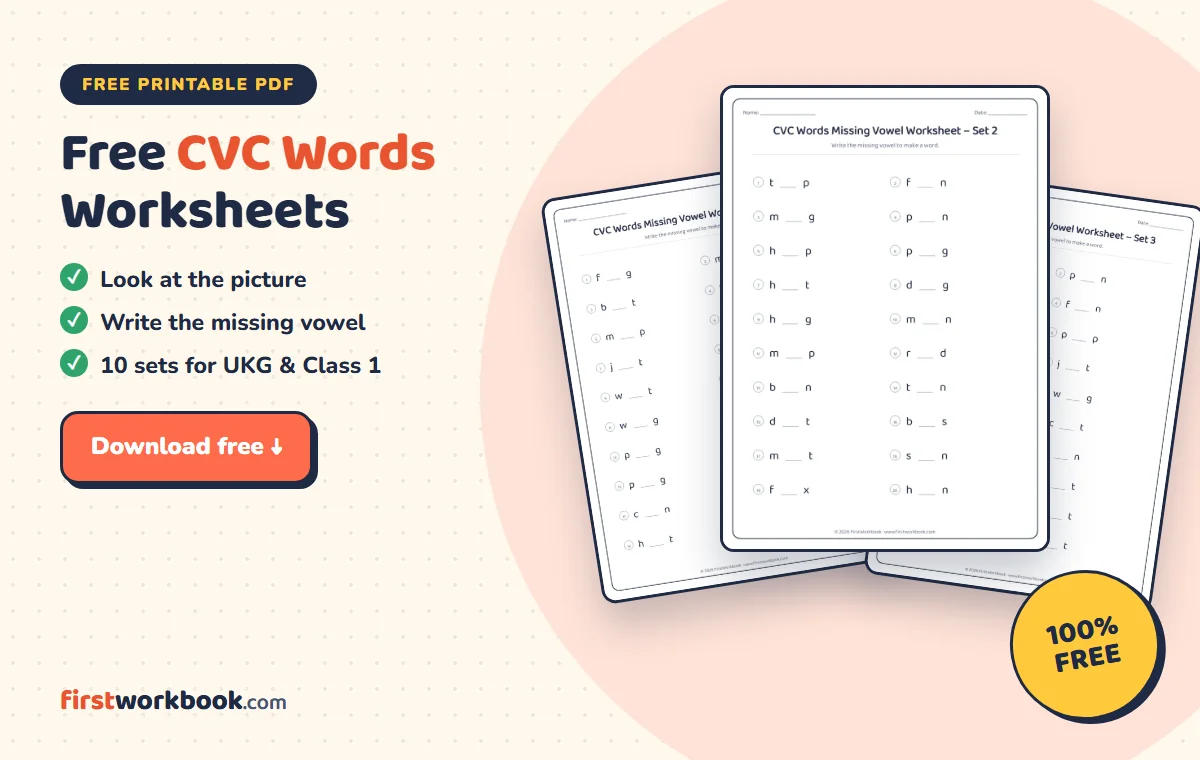
For daily practice, print our free CVC words missing vowel worksheets. Each set asks your child to look at a picture and write the missing middle vowel, which is exactly the skill that separates reading from guessing. You can also try the beginning sounds, ending sounds and rhyming words worksheets.
If you prefer a structured book that follows this order, these printed and PDF workbooks are made for this stage:
- LKG English Workbook: small letters and letter sounds, the groundwork for CVC reading.
- UKG English Workbook: reading words and simple sentences.
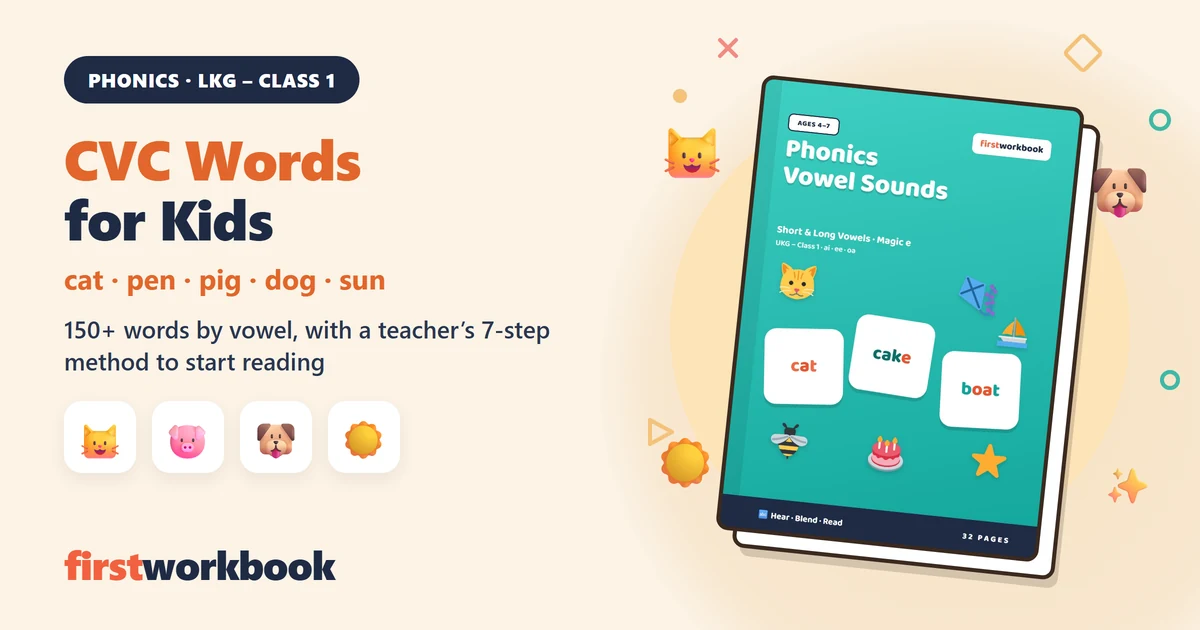
- Phonics Workbook: Short & Long Vowel Sounds: CVC words, missing vowels, magic e and vowel teams (ages 4–7).
- Phonics Workbook: Blends & Digraphs: the next step after CVC words.
हिंदी में सार (Summary in Hindi)
CVC शब्द तीन आवाज़ों वाले छोटे अंग्रेज़ी शब्द होते हैं: पहले एक व्यंजन (consonant), बीच में एक छोटी स्वर ध्वनि (short vowel) और अंत में फिर एक व्यंजन, जैसे cat, pen, pig, dog, sun। बच्चा इन्हें रटे बिना, हर अक्षर की आवाज़ जोड़कर पढ़ सकता है। इसलिए यही असली पढ़ाई की पहली सीढ़ी है।
ज़्यादातर बच्चे UKG (5–6 साल) में CVC शब्द पढ़ना शुरू करते हैं। शुरू करने से पहले देख लें कि बच्चा अक्षरों के नाम नहीं, उनकी आवाज़ जानता है, और बोलकर दी गई आवाज़ें जोड़ सकता है (/d/ /o/ /g/ → dog)।
तरीका आसान है: पहले सिर्फ़ बोलकर आवाज़ें जोड़ने का खेल खेलें, फिर लिखे शब्द पर उँगली रखकर हर आवाज़ बोलें और जल्दी से पूरा शब्द पढ़ें। Short a से शुरू करें, फिर i, o, u और आख़िर में e। रोज़ 10–15 मिनट काफ़ी हैं। “सी-ए-टी” (letter names) से शब्द नहीं बनता, इसलिए हमेशा आवाज़ों का इस्तेमाल करें, और आवाज़ों के आगे “अ” न जोड़ें (“बअ” नहीं, सिर्फ़ /b/)।
Frequently Asked Questions
What are CVC words with examples?
CVC words are three-sound words made of a consonant, a short vowel and a consonant, such as cat, bed, pig, dog and sun.
At what age should a child read CVC words?
Most children are ready between 4½ and 6, which is LKG to UKG in Indian schools. Readiness matters more than age: the child should know letter sounds and be able to blend sounds they hear.
Is “box” a CVC word?
It is spelled like one, but x makes two sounds (/k/ /s/), so many teachers leave it out of early CVC lists. The same goes for words ending in w, x or y.
How many CVC words should my child read before moving on?
There is no magic number. A good sign is that your child reads a mixed list of 20–30 CVC words accurately and fairly smoothly, and can spell simple ones from dictation.
Should I teach sight words and CVC words together?
Yes, a few. Words like the, is, a, to appear in almost every sentence, so teaching 10–15 of them alongside CVC words lets your child read real sentences early.
Research Behind This Guide
- National Institute of Child Health and Human Development, National Reading Panel report: systematic phonics instruction helps children in kindergarten and Grade 1 learn to read.
- Reading Rockets, Systematic Phonics Scope and Sequence (Keys to Literacy): phonemic awareness before decoding, CVC words before blends.
- Ministry of Education, Government of India, NIPUN Bharat guidelines: foundational literacy goals for Balvatika and Class 1.
- Lead in Literacy, How to Teach CVC Words: teacher guidance on blending and vowel order.
Free Worksheets to Practise This
Printable A4 PDFs, free to download. Pick a set and print it at home or school.
About the author

Er. Deepak Maurya
Founder, FirstWorkbook
Er. Deepak Maurya founded FirstWorkbook in Varanasi to make activity workbooks that children enjoy. A web developer with 8 years of experience, he writes practical guides for parents on learning at home, and plans the activities in our workbooks together with pre-primary teachers.
Spotted a mistake or have a question? Write to us and we'll correct it.