Pre Nursery Syllabus (Age 2–3): What to Teach Your Child at Home
In short
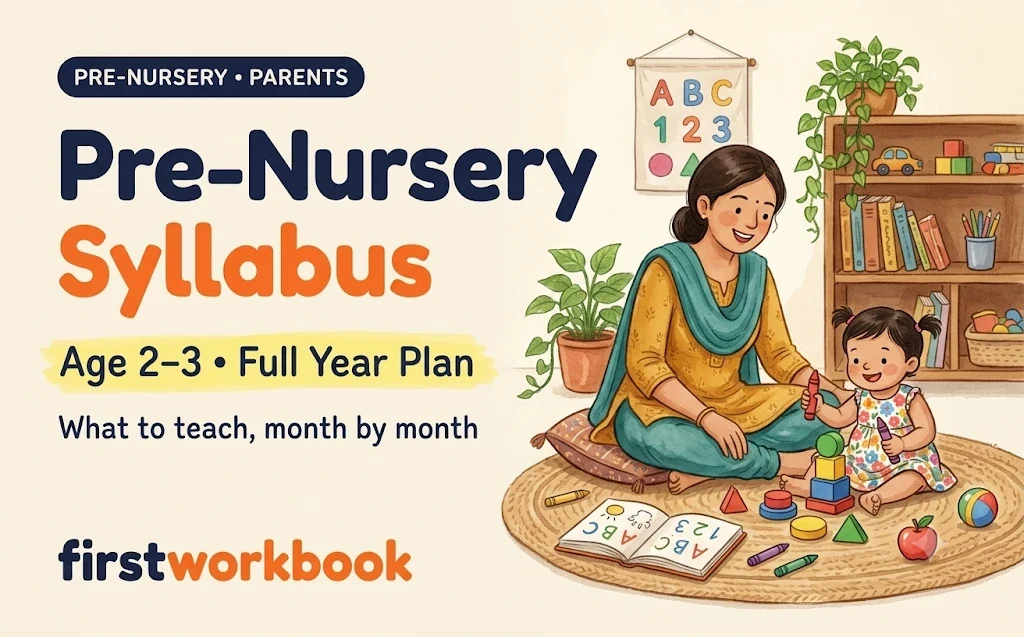
A gentle pre nursery syllabus for children aged 2 to 3: language, rhymes, numbers 1–5, colours, shapes, fine motor play and self-help skills, with a month-by-month plan and daily routine.
Your child is two and a half. The neighbour’s child of the same age already “knows A to Z”, the playschool brochure lists twelve subjects, and you are wondering whether you are already behind.
Take a breath. At this age the most important learning does not happen on a worksheet. It happens while your child talks to you, stacks blocks, sings a rhyme, scribbles with a fat crayon and tries to put on their own slippers. A good pre nursery syllabus protects that kind of learning and adds just a little structure on top.
This guide explains what pre nursery (also called playgroup) is, what children aged 2 to 3 typically learn, a subject-by-subject syllabus, a simple daily routine, and the signs that tell you your child is ready for nursery. Everything is based on India’s early-childhood framework and international child-development guidance, not on what a brochure wants to sell you.
Quick answer: a pre nursery syllabus for age 2–3 should cover talking and listening, rhymes and stories, picture words, colours and shapes, counting 1 to 5, big and small, body parts and family, scribbling and colouring, fine-motor play (tearing, pasting, playdough), running and climbing, and simple self-care. No formal writing is needed. Ten to fifteen minutes of guided activity a day, plus lots of play and conversation, is enough.
What Is Pre Nursery (Playgroup)?
Pre nursery is the first year of school-like learning, usually for children aged 2 to 3 years (some schools take children from 1.5 or 2.5). It comes before Nursery (3–4), LKG (4–5) and UKG (5–6).
India’s National Education Policy 2020 and the National Curriculum Framework for the Foundational Stage (NCF-FS, 2022) cover children from age 3 to 8, starting with three years of pre-school (Balvatika). That means there is no official national syllabus for age 2–3. Each playschool designs its own. This is actually good news for parents: you do not need to “complete” anything. You need to give your child rich experiences across a few important areas.
The NCF-FS groups early learning into a few broad domains: physical development, socio-emotional and ethical development, cognitive development, language and literacy, aesthetic and cultural development, and positive learning habits. NCERT’s play-based Jaadui Pitara kit is built on the same idea: children this age learn through play, talk, toys, drawing, songs and movement. The syllabus below follows those same areas, adjusted for a two-year-old.
What Most Children Can Do Around Age 2½ to 3
Before deciding what to teach, it helps to know what is typical. The U.S. Centers for Disease Control and Prevention (CDC) publishes milestone checklists that show what most children do by a given age. Here is a short summary in our own words:
| Area | Around 30 months | Around 3 years |
|---|---|---|
| Language | Uses about 50 words. Joins two words with an action word (“doggie run”). Names things in a picture book. | Has short back-and-forth conversations. Asks who/what/where/why. Says their first name. Is understood by others most of the time. |
| Thinking | Pretend play (feeding a doll). Follows two-step instructions. Knows at least one colour. | Draws a circle after being shown. Understands simple warnings (“hot!”). |
| Movement | Jumps with both feet. Twists lids and doorknobs. Turns book pages one at a time. | Strings large beads. Puts on loose clothes. Uses a fork or spoon. |
| Social | Plays beside other children. Follows simple routines like clean-up time. | Joins other children in play. Settles within a few minutes after drop-off. |
Children develop at different speeds, and a checklist is not a test. If you notice that your child has lost skills they once had, or you are worried about their speech, hearing or movement, talk to your paediatrician. Early support works best.
The Pre Nursery Syllabus, Subject by Subject
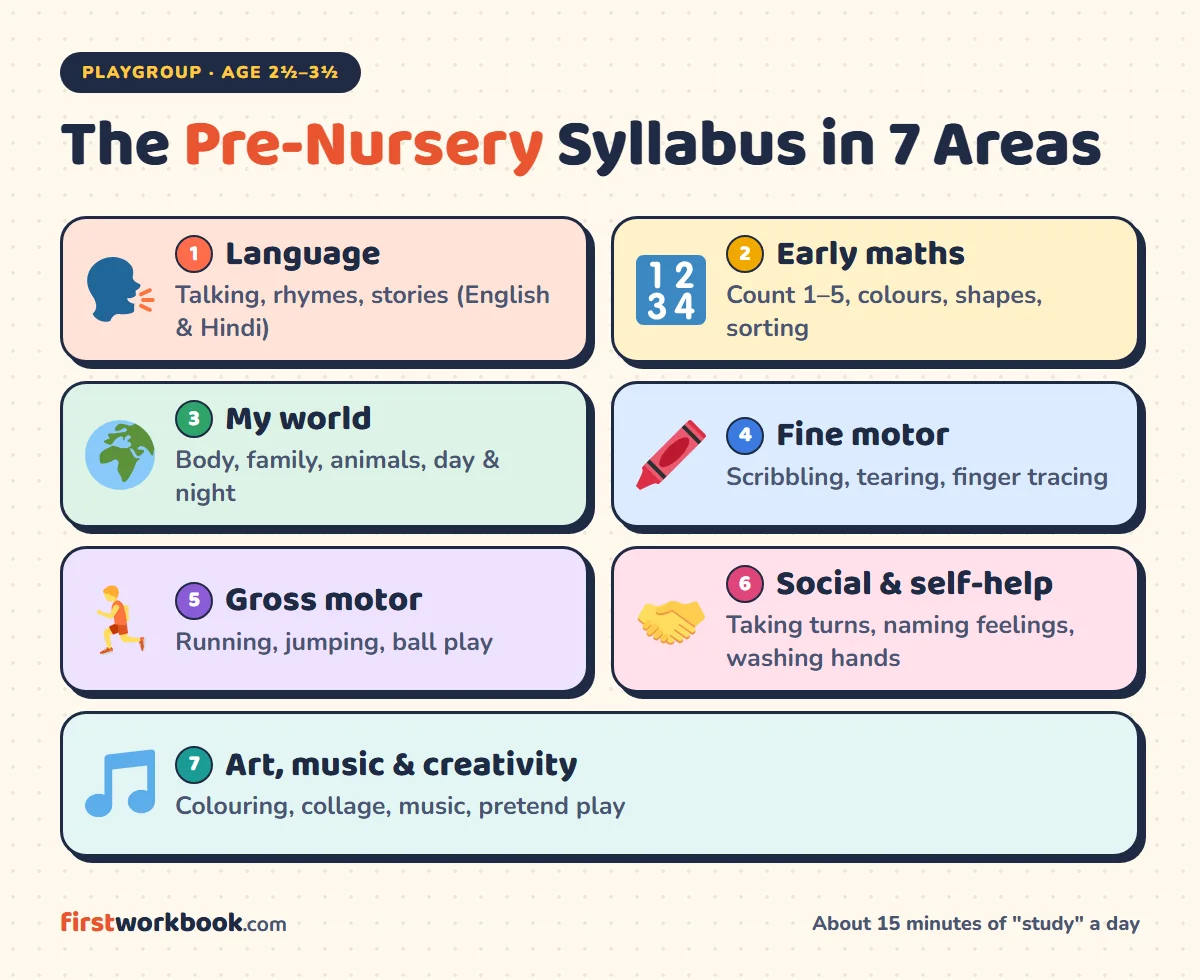
1. Language and communication (English and Hindi)
- Talking: name everyday objects, describe what you are doing (“I am cutting the apple”), ask simple questions and wait for answers.
- Rhymes and songs: 10–15 rhymes in the year, with actions. Mix English rhymes with Hindi ones like “मछली जल की रानी है”.
- Stories: one short picture-book story every day. Point to the pictures and ask “What is this?”
- Picture words: fruits, animals, vehicles, things at home, body parts.
- Letter awareness (no writing): big letters A–Z and Hindi swar अ–अः shown with pictures (A for apple, आ से आम). The aim is recognition and sound, not memorising the full chart.
If your family speaks Hindi or another Indian language at home, use it freely. The NCF-FS recommends using the child’s home language as much as possible in the early years. A strong home language makes learning English easier later, not harder.
2. Early maths (numbers and concepts)
- Counting 1 to 5 with real objects (spoons, blocks, grapes), then 1 to 10 as a song.
- Recognising numerals 1 to 5.
- Big and small, long and short, more and less, full and empty.
- Colours: red, yellow, blue, green first, then orange, pink, black, white.
- Shapes: circle, square, triangle (spotting them in the house is a great game).
- Sorting and matching: put all the red blocks together, match socks, pair shoes.
3. My world (EVS / general awareness)
- Body parts and what they do (“eyes to see, ears to hear”).
- Family members, in English and in your home language (दादा, दादी, नाना, नानी).
- Animals and their sounds, fruits and vegetables, vehicles.
- Day and night, hot and cold, rain and sun.
- Good habits: washing hands, saying please and thank you, putting toys away.
4. Fine motor skills and pre-writing
- Scribbling with chunky crayons on large paper. Let your child hold the crayon in their fist; a proper grip develops later.
- Tearing paper and pasting it, playdough (roll, squeeze, poke), threading large beads.
- Finger painting and thumb printing.
- Later in the year: tracing standing lines, sleeping lines and big curves with a finger, then a crayon. See our guide to pre-writing lines and pencil control for ideas.
Writing letters is not part of a healthy pre nursery syllabus. Small hand muscles are still developing, and pushing letter writing at two often leads to tears and a poor grip that is hard to fix later.
5. Gross motor and physical play
- Running, jumping with both feet, climbing a few steps, kicking and throwing a ball.
- Dancing to music, freeze dance, animal walks (walk like an elephant, hop like a frog).
The World Health Organization recommends that children aged 1 to 4 spend at least 180 minutes a day in physical activity of any kind, spread across the day. For a two-year-old, active play is learning.
6. Social, emotional and self-help skills
- Taking turns, sharing, waiting for a short time.
- Naming feelings: happy, sad, angry, scared.
- Eating with a spoon, drinking from a cup, washing hands, starting toilet training, helping to put on slippers.
- Saying goodbye calmly and settling after drop-off (a key skill for starting school).
7. Art, music and creativity
- Free colouring, sticker art, collage with leaves and paper.
- Music and movement, simple instruments (a spoon and a steel plate count!).
- Pretend play: kitchen set, doctor set, dolls and cars.
Pre Nursery Syllabus at a Glance
| Area | By the end of pre nursery, many children can… |
|---|---|
| English | Sing 8–10 rhymes, name 50+ picture words, recognise a few letters (often the first letter of their name) |
| Hindi | Sing a few Hindi rhymes, name family members and common objects, recognise some swar like अ, आ, इ with pictures |
| Numbers | Count 1–5 objects, say 1–10 as a song, identify big/small |
| Colours and shapes | Name 4–6 colours and 2–3 shapes |
| My world | Name body parts, family members, common animals, fruits and vehicles |
| Fine motor | Scribble, tear and paste, roll playdough, string big beads, trace a straight line with a finger |
| Self-help | Eat with a spoon, wash hands with help, follow a simple routine |
A Month-by-Month Plan for Home
Use this as a loose guide. Repeat any month as often as your child enjoys it.
| Months | Focus |
|---|---|
| 1–2 | Me and my family: body parts, family names, 3 rhymes, colours red and yellow, scribbling, tearing paper |
| 3–4 | My home and food: fruits and vegetables, counting 1–3 with real things, circle shape, playdough, 3 new rhymes |
| 5–6 | Animals: animal sounds and names, big and small, colours blue and green, thumb printing, A–E and अ–ई with pictures |
| 7–8 | Vehicles and outdoors: counting 1–5, square and triangle, sorting, bead stringing, finger-tracing standing and sleeping lines |
| 9–10 | Seasons and festivals: weather words, more and less, festival crafts, colour inside big shapes, more letters with pictures |
| 11–12 | Getting ready for nursery: name recognition, longer stories, two-step instructions, self-help routines, revision of favourites |
A Simple Daily Routine (About 15 Minutes of “Study”)
- Morning (5 minutes): one rhyme with actions and a quick “show me your nose” game.
- Midday (5–10 minutes): one activity page or a hands-on task: count spoons, colour a fruit, tear and paste.
- Evening: outdoor play, then a picture-book story at bedtime.
Two-year-olds have short attention spans, so stop while your child is still having fun. One happy page beats four pages finished in tears.
About screens: the WHO recommends that children aged 2 to 4 have no more than one hour of sedentary screen time a day, and less is better. Reading and storytelling with a caregiver is encouraged instead. Learning apps do not replace talking, playing and reading with you.
Common Mistakes Parents Make
- Starting letter writing too early. Build hand strength with play first. Writing comes in nursery and LKG.
- Drilling A to Z by rote. Reciting the alphabet is not the same as understanding it. Five letters with pictures and sounds are worth more than 26 memorised names.
- Comparing with other children. Development at this age varies a lot. Compare your child only with their own progress last month.
- Too much screen time “for learning”. Talking with a real person is how small children learn language best.
- Skipping self-care skills. Washing hands, eating independently and settling at drop-off matter as much for nursery as knowing colours.
Is My Child Ready for Nursery?
Most children are ready to move on when they can:
- speak in short sentences and follow simple instructions,
- sit and listen to a short story,
- hold a crayon and scribble or colour on purpose,
- count a few objects and name a few colours,
- manage basic self-care with a little help, and
- separate from you for a short time without long distress.
Once your child is in nursery, our Nursery, LKG and UKG syllabus guide shows what comes next. If you have a school interview coming up, read our nursery admission interview questions.
What comes next? Read our Nursery syllabus guide (age 3–4).
Pre Nursery Workbooks That Follow This Syllabus
Our Pre-Nursery set was designed around this gentle, play-first approach. Every page has one big picture and one simple task, with no writing pressure:
- Pre-Nursery English Workbook: A–Z with pictures, colour-the-letter and picture words
- Pre-Nursery Hindi Workbook (मेरी पहली हिंदी): all 12 swar with big pictures, colouring and Hindi picture words
- Pre-Nursery Maths Workbook: numbers 1–5, big and small, shapes
- Pre-Nursery EVS Workbook: body, family, animals, fruits and good habits
- Pre-Nursery Art & Creativity Book: scribbling, colouring, thumb print, tear and paste
- Pre-Nursery Pattern Writing & Logic Book: pre-writing lines and first thinking games
All six come together in the Pre-Nursery Book Bundle, as instant PDFs or printed books with free delivery.
हिंदी में सार (Summary in Hindi)
प्री-नर्सरी (प्लेग्रुप) 2 से 3 साल के बच्चों के लिए होती है। इस उम्र के लिए भारत में कोई तय राष्ट्रीय सिलेबस नहीं है। इसलिए किताब “पूरी करने” की जल्दी न करें, बच्चे को खेल-खेल में सीखने दें।
- भाषा: रोज़ बातचीत, कविताएँ, चित्र वाली कहानियाँ। अंग्रेज़ी और हिंदी दोनों में चीज़ों के नाम।
- अक्षर: A–Z और स्वर (अ–अः) सिर्फ़ चित्रों के साथ पहचानें। इस उम्र में लिखवाना ज़रूरी नहीं।
- गिनती और समझ: 1 से 5 तक असली चीज़ों से गिनना, रंग, आकार, बड़ा-छोटा।
- हाथों का अभ्यास: क्रेयॉन से आड़ी-तिरछी लकीरें, काग़ज़ फाड़कर चिपकाना, क्ले, मोती पिरोना।
- आदतें: हाथ धोना, चम्मच से खाना, खिलौने समेटना, “प्लीज़” और “थैंक यू” कहना।
- समय: रोज़ 10–15 मिनट की “पढ़ाई” काफ़ी है, बाक़ी समय खेल और बातचीत। स्क्रीन दिन में एक घंटे से कम।
Frequently Asked Questions
What is the right age for pre nursery?
Most schools take children between 2 and 3 years old. Some start at 18 months. Your child does not need to “know” anything before joining.
Should my 2-year-old learn to write A to Z?
No. At this age, focus on recognising a few letters with pictures and building hand strength through play. Writing letters usually begins in nursery or LKG.
How many hours should a pre nursery child study at home?
About 10–15 minutes of guided activity a day is enough, split into short bursts. The rest of the day should be play, conversation, stories and outdoor time.
Is pre nursery compulsory?
No. NCF-FS formal pre-school begins at age 3. Many children learn everything they need for nursery at home through play and conversation.
Should I teach Hindi and English together?
Yes. Young children can easily learn two or more languages at once. Use the language you are most comfortable with for stories and talk, and add the other through rhymes and picture words.
Research Behind This Guide
- National Curriculum Framework for Foundational Stage (Ministry of Education, 2022): learning domains, play-based learning and home-language use for ages 3–8.
- NCERT Jaadui Pitara manual: play-based learning material for the Foundational Stage.
- CDC milestones at 30 months and at 3 years: language, thinking, movement and social milestones.
- WHO guidelines on physical activity, sedentary behaviour and sleep for children under 5 (2019): activity and screen-time recommendations.
Free Worksheets to Practise This
Printable A4 PDFs, free to download. Pick a set and print it at home or school.
About the author

Er. Deepak Maurya
Founder, FirstWorkbook
Er. Deepak Maurya founded FirstWorkbook in Varanasi to make activity workbooks that children enjoy. A web developer with 8 years of experience, he writes practical guides for parents on learning at home, and plans the activities in our workbooks together with pre-primary teachers.
Spotted a mistake or have a question? Write to us and we'll correct it.