
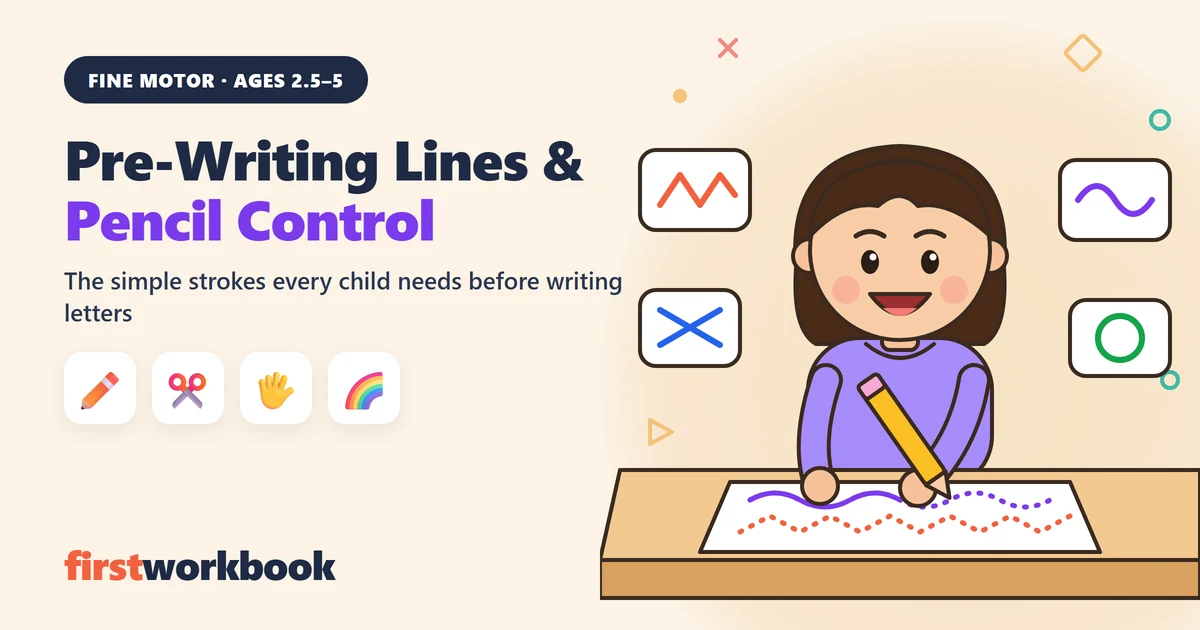
Pre-Writing Lines & Pencil Control: The Crucial Steps Before Letters
In short
Why jumping straight to alphabet tracing causes frustration — and how mastering pre-writing strokes, hand arches, and pencil control builds effortless handwriting in preschoolers.
Few developmental milestones bring parents more excitement than watching a young child begin to write their very first letters. Eager to give their toddlers a head start, well-intentioned parents frequently purchase alphabet copybooks and urge three-year-olds to trace capital letters: 'A', 'B', 'M', or 'S'. Yet, in living rooms and preschool classrooms everywhere, this rushed rush toward early handwriting frequently leads to frustration, awkward pencil grips, tearful meltdowns, and hand fatigue.
The reason is simple yet universally overlooked: Handwriting is not a visual memorization skill; it is a complex biomechanical coordination feat. Before a child can form a recognizable letter, their fingers, palms, wrists, and shoulders must develop significant neuromuscular strength, stability, and control. Attempting to write letters before mastering foundational pre-writing lines and pencil control patterns is the developmental equivalent of asking a baby to run before they can sit or crawl.
In early childhood occupational therapy and Montessori pedagogy, pre-writing strokes are recognized as the indispensable stepping stones to effortless, fluent handwriting. This definitive guide provides parents and nursery educators with an evidence-based roadmap to develop pencil control in children aged 2.5 to 5. We examine hand anatomy, developmental stroke progressions, sensory hand-strengthening games, and structured workbook routines featuring FirstWorkbook's Pencil Control & Pre-Writing Patterns Workbook and Alphabet & Number Tracing Masterbook.
The Biomechanics of Handwriting: Hand Anatomy and Core Stability
To understand why toddlers struggle with thin pencils and complex letter curves, we must look at human physical anatomy. The ability to write smoothly relies on a principle called proximal stability leads to distal mobility. This means fine motor control at the fingertips (distal) is entirely dependent upon strong, stable muscles in the shoulder girdle, trunk, and wrist (proximal).
1. Hand Arches and the Web Space
The human hand is not flat; it features three dynamic arches: the longitudinal arch, distal transverse arch, and oblique arch. These arches allow the palm to cup and stabilize while the fingers manipulate utensils. Additionally, an efficient pencil grip requires an open, circular "web space"—the curved gap between the thumb and index finger. When a child's hand muscles are weak, their web space collapses flat, forcing them to squeeze the pencil with white-knuckled pressure, leading to hand cramps within two minutes.
2. Radial-Ulnar Separation
An adult hand naturally splits into two functional halves:
- The Radial Side (Skill Side): The thumb, index finger, and middle finger perform precise, dynamic pinching and manipulating movements.
- The Ulnar Side (Stability Side): The ring finger and pinky finger curl firmly into the palm, resting on the paper to provide a stable anchor.
Young toddlers under age three use their entire hand as a single unified unit (a whole-fist palmar grasp). Developing radial-ulnar separation—allowing the thumb side to move independently while the pinky side stabilizes—is a critical biological milestone that pre-writing activities specifically train.
3. Proprioception and Visual-Motor Integration
Writing requires continuous coordination between what the eyes perceive and how the hand applies physical pressure to paper. If a child presses so hard that the pencil tip snaps, or so lightly that the marks are invisible, their proprioceptive feedback system is still calibrating. Tactile pre-writing paths provide explicit sensory boundaries that refine pressure modulation.
The 9 Developmental Pre-Writing Strokes (The Milestones)
Pioneering developmental studies confirm that children learn to draw lines in a predictable, universal developmental sequence. Never force a child to write letters that contain strokes beyond their current milestone level:
| Pre-Writing Stroke | Average Milestone Age | Visual Description | Letters & Numbers It Enables |
|---|---|---|---|
| 1. Vertical Line (|) | 24 – 30 Months (Age 2–2.5) | Top-to-bottom straight standing line | L, T, I, H, F, E, 1, 4 |
| 2. Horizontal Line (—) | 30 – 36 Months (Age 2.5–3) | Left-to-right straight sleeping line | T, H, E, F, L, 4, 7 |
| 3. Circle Shape (○) | 36 Months (Age 3) | Continuous closed counter-clockwise loop | O, C, Q, G, 0, 6, 8, 9 |
| 4. Cross / Plus Sign (+) | 40 – 44 Months (Age 3.5) | Intersecting vertical and horizontal lines | t, f, +, 4 |
| 5. Square Shape (□) | 48 Months (Age 4) | Four 90-degree corners connected by straight lines | Spatial boundary control & enclosed shapes |
| 6. Right Diagonal Line (/) | 50 – 52 Months (Age 4.2) | Slanted line from bottom-left to top-right | K, N, M, V, W, X, Y, Z |
| 7. Left Diagonal Line (\) | 52 – 54 Months (Age 4.5) | Slanted line from top-left to bottom-right | A, K, M, N, V, W, X, Y, Z |
| 8. Diagonal Cross (X) | 56 – 60 Months (Age 4.8–5) | Intersecting diagonal lines crossing mid-air | X, x, k, y, 7 |
| 9. Triangle Shape (△) | 60 Months (Age 5) | Three acute angles connected by diagonals | A, 4, advanced geometric synthesis |
Crucial Insight: Notice that the letter 'A' requires two diagonal lines and a horizontal cross. A child who cannot draw an independent diagonal cross (X) will inevitably struggle to write a legible 'A'. Building stroke fluency first ensures that letter formation becomes effortless.

Pencil Grip Evolution: What to Expect and When
Forcing an adult tripod grip on a young toddler causes wrist distortion and muscle fatigue. Grip naturally evolves through four recognized developmental stages:
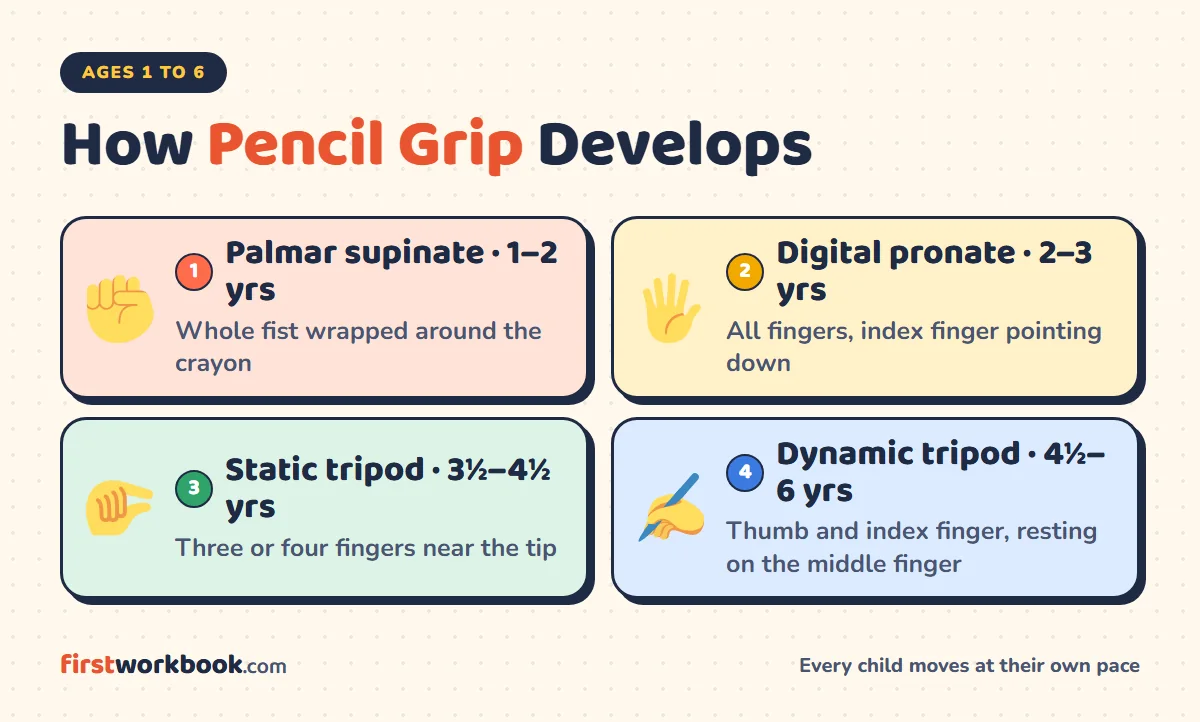
- Palmar Supinate Grasp (1–2 Years): The child holds a crayon with their entire fist wrapped around it, palm facing up or forward. Movement originates from the shoulder and whole arm.
- Digital Pronate Grasp (2–3 Years): All four fingers hold the utensil with the index finger pointing down toward the tip. Movement originates primarily from the elbow.
- Static Tripod / Quadrupod Grasp (3.5–4.5 Years): The child holds the utensil with three or four fingers near the tip, but hand muscles remain rigid. Movement is powered by wrist motion.
- Dynamic Tripod Grasp (4.5–6 Years): The pencil is held lightly between the thumb and index finger, resting on the middle finger, with an open circular web space. Tiny, localized finger movements drive the stroke.
6 Hands-On Activities to Build Hand Strength and Pencil Control
1. Playdough Resistance Gymnastics
Playdough is the single finest natural hand-strengthener available. Before picking up a pencil, have your child perform these four daily exercises:
- Snake Rolling: Rolling dough between palms or flat on the table strengthens palmar arches.
- The Pinch & Snip: Roll a long snake and use blunt safety scissors to snip it into pieces.
- Meatball Rolling: Pinch off small dough balls and roll them using only the thumb, index, and middle finger (the skill fingers).
- Hidden Treasure Hunt: Embed small plastic beads or coins inside a ball of dough and have the child use their pincer grasp to dig them out.
2. Vertical Surface Mark-Making (Easel & Wall Chalkboards)
Working on a vertical surface (an upright chalkboard, easel, or taping large butcher paper to a wall) offers tremendous neurological advantages:
- It forces the wrist into natural extension (cocked backward), which automatically triggers an ergonomic tripod finger grip.
- It builds shoulder girdle and core stability against gravity.
- It provides a larger spatial field for sweeping arm movements before refining to small desk lines.
3. Sensory Tray Tracing (Sand, Salt, or Shaving Cream)
Pour fine colored sand, cornmeal, or table salt into a shallow baking tray. Model a pre-writing stroke (e.g., a wavy snake curve or zigzag mountain). Have your child replicate the stroke using their bare index finger.
The Magic: Sensory trays are pressure-free and self-correcting. If the line is wobbly, a gentle shake of the tray resets the surface instantly, eliminating the frustration of eraser marks.
4. Tongs, Tweezers, and Clothespin Sorting
Provide kitchen tongs or jumbo child tweezers and have your child transfer pom-poms, cotton balls, or dry pasta into ice cube trays. Squeezing clothespins onto cardboard edges targets the exact adductor pollicis muscles needed for pencil stamina.
5. Water Dropper and Pipette Squeeze Art
Using small medicine eye-droppers, instruct your child to squeeze tinted water droplet-by-droplet onto coffee filters or cotton rounds. This exercises precision finger modulation and pincer coordination.
6. Structured Daily Practice with High-Quality Pattern Workbooks
Once sensory hand strength is established, structured paper-and-pencil practice provides the essential bridge to formal writing. A superior pre-writing workbook does not rush straight to letters; it celebrates patterns.
In FirstWorkbook's Pencil Control & Pre-Writing Patterns Workbook, children follow thick dotted paths: helping bees buzz to flowers (wavy lines), guiding rocket ships to stars (diagonal slants), and tracing rain droplets (standing lines). After mastering patterns, children progress seamlessly to FirstWorkbook's Alphabet & Number Tracing Masterbook.
The Crucial Link Between Scissor Skills and Pencil Grip
In pediatric occupational therapy, cutting with safety scissors is recognized as the ultimate preparatory exercise for pencil grip. Operating scissors requires the identical biomechanical motor patterns needed for handwriting:
- Thumbs-Up Orientation: Proper scissor cutting forces the thumb to remain pointed upward, training forearm supination.
- Bilateral Coordination: The dominant hand operates the blades while the non-dominant helper hand holds, stabilizes, and rotates the paper.
- Finger Dissociation: The thumb moves independently of the index and middle fingers, strengthening the dynamic tripod muscles.
Scissor Skill Milestones by Age
Scissor mastery progresses through distinct phases:
- Snip Phase (2–2.5 Years): Single random snips on thick strips of cardstock or playdough snakes.
- Fringe Phase (3 Years): Snipping repeatedly along the border of paper without cutting across.
- Straight Line Cut (3.5–4 Years): Cutting across a 6-inch straight line within a half-inch margin.
- Curved Lines & Shapes (4.5–5.5 Years): Cutting circles, triangles, and complex wavy contours smoothly.
Pairing cutting activities with pre-writing tracing accelerates bilateral control dramatically.
Weekly Fine Motor & Pre-Writing Schedule (Nursery & LKG)
Incorporate this structured 5-day motor-development routine into your home practice:
| Day | Primary Fine-Motor Module | Tactile Sensory Anchor | Daily Target Time |
|---|---|---|---|
| Monday | Standing & Sleeping Lines (Vertical / Horizontal) | Finger tracing in sand tray or shaving cream | 15 minutes |
| Tuesday | FirstWorkbook Pencil Control Dotted Paths | Tracing with thick triangular beeswax crayons | 15 minutes |
| Wednesday | Scissor Snip & Dough Gymnastics | Cutting playdough snakes & rolling mini meatballs | 15 minutes |
| Thursday | Curved Waves & Circular Loops | Vertical wall chalkboard or easel drawing | 15 minutes |
| Friday | Diagonal Slants & Zigzag Mountains | Tongs & tweezer pom-pom sorting into ice trays | 15 minutes |
Choosing the Right Writing Utensils for Little Hands
Handing a standard long, thin #2 graphite pencil to a 3-year-old is a critical parenting mistake. The excessive length creates a lever effect that wobbles in tiny hands.
- Stage 1 (Ages 2–3): Palm-grasp egg crayons or thick triangular block crayons.
- Stage 2 (Ages 3–4): Chubby triangular beeswax crayons or mini golf pencils (short pencils naturally prevent whole-fist grasping).
- Stage 3 (Ages 4–5): Triangular beginner graphite pencils with soft lead (2B) that glides effortlessly across paper without requiring excessive downward pressure.
The same rules apply to crayons and colour pencils. Read our guide to colouring for kids for an age-wise comparison of crayons, colour pencils, sketch pens and paints.
Top 5 Posture and Seating Red Flags in Early Handwriting
When observing your child at their drawing table, look out for these five frequent biomechanical warning signs:
- The "Hooked Wrist": The wrist curves sharply inward above the writing line. This occurs when paper is angled incorrectly, causing intense muscular strain.
- Slumped Trunk / Head Resting on Desk: Signals poor core postural endurance. Incorporate daily tummy-time reading, animal crawls, and playground monkey bar climbing.
- White-Knuckled Grip Pressure: Indicates weak palmar arches or sensory under-responsiveness. The child is over-gripping out of fear of losing control.
- Feet Dangling in Mid-Air: Without solid foot stability, the entire spine wobbles, degrading hand control. Add a firm box or footrest under their feet.
- Non-Dominant Hand Resting in Lap: The helper hand must firmly hold and stabilize the paper. Teach children the "L-Shape Anchor": non-dominant hand flat on the page border.
Frequently Asked Questions (FAQs)
Q1: My 3.5-year-old switches hands constantly while drawing. Should I force them to pick one hand?
Do not force hand dominance. Hand preference typically consolidates between ages 3 and 5. Switching hands during coloring simply indicates that intrinsic muscles are tiring or the child is crossing the body's midline. Place crayons centrally in front of the child and let them choose naturally.
Q2: Why does my child press down so hard that the crayon snaps?
Excessive pencil pressure indicates immature proprioceptive feedback or poor hand arch stability. The child presses hard because they cannot yet feel where their fingers are in space without forceful feedback. Engage in deep-pressure sensory play: kneading firm dough, pushing wheelbarrows, and drawing on soft foam sheets.
Q3: How many minutes of pre-writing practice should we do daily?
Keep sessions brief and joyful: 10 to 15 minutes daily is ideal. Two well-focused workbook pages with enthusiastic parental encouragement is far superior to thirty minutes of exhausted scribbling.
Conclusion: Building Confidence from the Ground Up
Fluent, legible handwriting is not an innate gift; it is a physical craft built upon hand strength, spatial awareness, and stroke fluency. By honoring the natural developmental progression—nurturing hand arches through playdough, mastering pre-writing lines, and practicing joyful daily workbook patterns—you set your child up for a lifetime of confident, strain-free writing.
Start today. Explore FirstWorkbook's Pencil Control & Pre-Writing Patterns Workbook and give your child the strong, steady foundation they deserve.
About the author

Er. Deepak Maurya
Founder, FirstWorkbook
Er. Deepak Maurya founded FirstWorkbook in Varanasi to make activity workbooks that children enjoy. A web developer with 8 years of experience, he writes practical guides for parents on learning at home, and plans the activities in our workbooks together with pre-primary teachers.
Spotted a mistake or have a question? Write to us and we'll correct it.