Emotional Intelligence for Kids: How to Teach Feelings & Big Emotions
In short
Help children aged 3–8 understand and regulate big emotions. Science-backed co-regulation tools, calming techniques, and workbook activities for parents.
Parenting literature and educational discourse frequently emphasize academic milestones: reading at four, performing mental math at five, or mastering multiple languages in elementary school. Yet, decades of longitudinal research conducted by developmental psychologists and neuroscientists—including landmark studies by Dr. Daniel Goleman and the Yale Center for Emotional Intelligence—reveal a profound truth: Emotional Intelligence (EQ) is a far stronger predictor of lifelong happiness, academic success, healthy relationships, and professional fulfillment than Cognitive IQ.
Every parent has witnessed the intense emotional storms of early childhood: a three-year-old collapsing in tears over a broken biscuit, a five-year-old lashing out in aggressive fury when a toy tower topples, or a seven-year-old withdrawing into anxious silence before a school performance. In these moments, well-meaning adults frequently react with dismissive clichés: "Stop crying, it's not a big deal," or "Big boys don't get angry."
However, modern pediatric neuroscience proves that children do not misbehave because they are intentionally malicious. They meltdown because their neurological "emotional alarm system" (the amygdala) is fully mature at birth, whereas their "rational control center" (the prefrontal cortex) takes over two decades to fully wire. When overwhelmed by intense feelings, young children literally lack the biological neurological architecture to self-regulate without co-regulation from supportive adults.
This authoritative, comprehensive guide outlines an evidence-based roadmap to nurture emotional intelligence in children aged 3 to 8. We examine the neuroscience of emotional regulation, practical home co-regulation strategies, emotion vocabulary expansion, and structured workbook integration featuring FirstWorkbook's My Feelings & Emotions Activity Workbook and Good Habits & Life Skills Workbook.
The Neuroscience of Big Feelings: Amygdala vs. Prefrontal Cortex
To support a child through emotional turbulence, parents must first understand the biological hardware of the developing human brain. Renowned neuroscientist Dr. Daniel Siegel popularized the invaluable "Hand Model of the Brain" to demystify this dynamic for parents and children alike.
1. The "Downstairs Brain" (The Limbic System & Amygdala)
Located deep within the brainstem and limbic system, the downstairs brain is primitive, reactive, and instinctive. It regulates basic survival mechanisms: heart rate, breathing, fight-or-flight responses, and strong raw emotions such as fear, anger, panic, and excitement. When a child perceives a threat—whether a physical danger or a psychological frustration like having to turn off the television—the amygdala sounds an internal alarm, releasing adrenaline and cortisol.
2. The "Upstairs Brain" (The Prefrontal Cortex)
The upstairs brain, situated directly behind the forehead, is the sophisticated executive suite. It governs logical reasoning, empathy, self-reflection, impulse control, problem-solving, and emotional regulation. Unlike the primitive downstairs brain, the prefrontal cortex develops exceedingly slowly, reaching complete maturity only around age 25.
3. "Flipping the Lid": Why Logic Fails During a Meltdown
When intense emotional stress overwhelms a young child, the neural connection between the upstairs and downstairs brain abruptly severs—an event colloquially termed "flipping the lid". In this biological state, the upstairs rational brain is completely offline. Attempting to lecture, rationalize, or punish an emotionally flooded child is biologically futile. The child cannot process logical language while trapped in an amygdala hijacking; they require physiological co-regulation and emotional safety first.
Developmental Milestones: Emotional Intelligence Across Ages 3 to 8
| Developmental Age | Class / Stage | Emotional Identification Capabilities | Self-Regulation & Empathy Milestones |
|---|---|---|---|
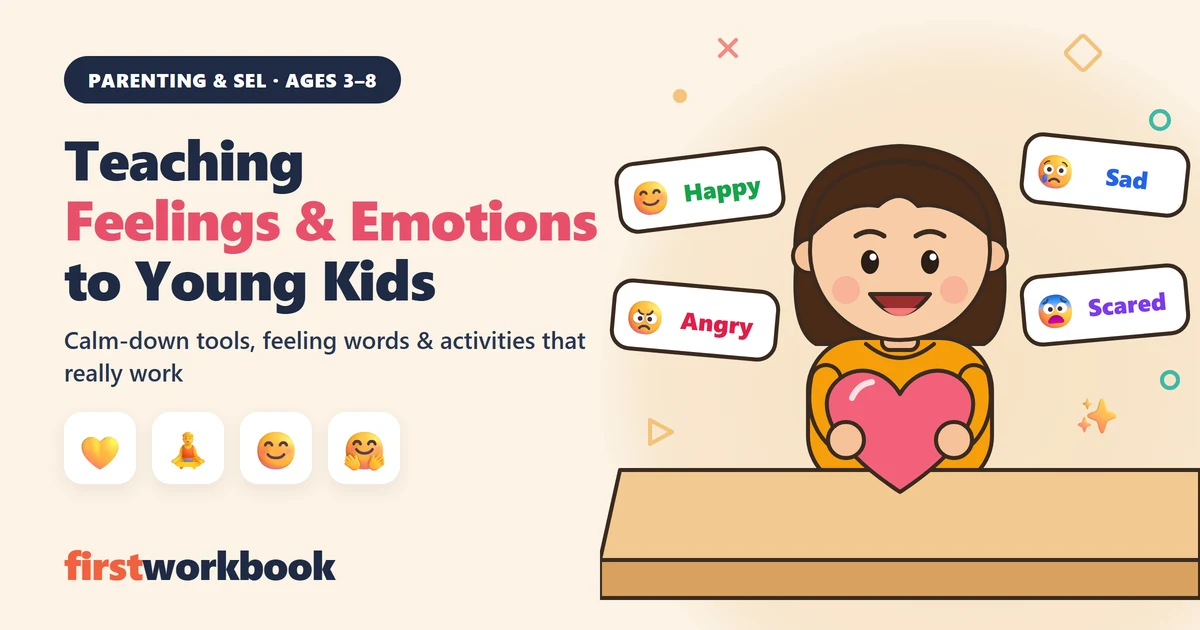
| Ages 3–4 | Nursery / Preschool | Identifies basic primary emotions (Happy, Sad, Angry, Scared) using visual facial cues | Requires active adult co-regulation; expresses feelings primarily through physical gestures and tears; comforts a crying peer with a toy |
| Ages 5–6 | LKG / UKG | Differentiates nuanced feelings (Frustrated, Excited, Nervous, Proud, Jealous); connects feelings to causes | Can begin using simple breathing techniques with reminders; understands that different people can feel differently about the same event |
| Ages 7–8 | Classes 1–2 | Recognizes complex blended emotions (e.g., feeling excited and nervous simultaneously before a race) | Practices independent calming strategies; demonstrates cognitive perspective-taking; articulates internal emotional triggers verbally |
The 4 Pillars of Emotional Intelligence for Young Children
Pillar 1: Emotional Literacy (Naming the Beast to Tame It)
Dr. Dan Siegel famously coined the phrase: "Name it to tame it." Brain imaging studies at UCLA demonstrate that when an individual puts linguistic labels onto emotional feelings (a process called affect labeling), activity in the amygdala decreases dramatically while inhibitory regions of the prefrontal cortex activate.
Most young children possess an extremely limited emotional vocabulary: "mad", "sad", or "bad". Expanding their vocabulary to include nuanced descriptors—frustrated, overwhelmed, lonely, disappointed, embarrassed, ecstatic, grateful—gives children the precise linguistic tools needed to express internal distress without resorting to screaming, biting, or throwing items.
Pillar 2: Somatic Body Awareness (Listening to Physical Signals)
Emotions are not purely mental phenomena; they are profound physiological experiences felt throughout the body. Teaching children to identify bodily somatic sensations before an emotional eruption occurs is essential:
- Anger: Clenched fists, tight jaw, burning cheeks, rapid heart rate.
- Anxiety / Fear: Fluttering stomach ("butterflies"), shallow breathing, cold fingers.
- Sadness: Heavy chest, lump in the throat, drooping shoulders, lethargy.
Pillar 3: Active Co-Regulation and Calming Toolkits
Self-regulation cannot occur without years of prior co-regulation. Co-regulation means the calm nervous system of the parent serves as an external emotional anchor for the turbulent nervous system of the child. When your child screams, your job is not to join them in chaos, but to offer a calm, grounded harbor.
Pillar 4: Cognitive Reframing and Problem Solving
Once physiological calm is restored and the upstairs brain comes back online, parents can guide children through constructive problem-solving: "Your block tower fell down, and you felt deeply frustrated. That makes complete sense. Now that we have taken our deep breaths, what can we do differently to build a wider, stronger base?"
6 Actionable Emotional Intelligence Activities to Practice at Home
1. Creating a Dedicated "Calm-Down Corner" (Peace Sanctuary)
Replace punitive "time-out" chairs—which foster isolation and resentment—with a positive "Calm-Down Corner". Co-create this space alongside your child in a quiet room corner. Equip the area with:

- A comfortable floor cushion or beanbag
- A sensory glitter calm-down bottle (shaking and watching swirling glitter soothes visual focus)
- A soft plush toy for deep-pressure hugging
- A set of visual emotion cards or FirstWorkbook's My Feelings & Emotions Activity Workbook
- A small pinwheel for slow, controlled exhalations
Crucially, emphasize that this sanctuary is never a punishment; it is a safe space for recharging internal batteries.
2. Playful Somatic Breathing Techniques
Telling an upset child to "just calm down and take a deep breath" is rarely effective. Instead, teach playful sensory breathing techniques during moments of happiness, so they can be summoned during distress:
- The Birthday Candle Breath: Hold up five fingers representing birthday candles. Inhale deeply through the nose, then exhale slowly through the mouth to blow out each finger one by one.
- The Hot Cocoa Breath: Cup both hands as if holding a mug of warm hot chocolate. Inhale deeply to smell the sweet chocolate aroma, then gently exhale to cool the cocoa.
- Belly Balloon Breathing: Have your child lie flat on their back and place a small rubber duck or toy car upon their belly. Instruct them to breathe in so their "belly balloon" lifts the toy upward, and breathe out to lower it smoothly.
3. The "Emotion Weather Report" Daily Check-In
At the dinner table or during bedtime winding down, invite each family member to share their internal "Weather Report":
- "I am feeling Sunny and warm today because I built a great Lego castle."
- "I have some Rain Clouds and thunder because my friend did not share the ball at recess."
- "I feel Foggy because I had a hard time understanding today's math lesson."
Using meteorological metaphors normalizes the truth that emotions, like weather patterns, are transient—they arrive, linger, and eventually pass across the sky.
4. Emotion Detective: Decoding Facial Expressions
Cut out diverse faces from family photos or magazines depicting various emotions. Play "Emotion Detective" by covering the mouth and asking the child to guess the feeling from the eyes and eyebrows alone, or vice-versa. This sharpens subtle non-verbal social observation, which is foundational for authentic interpersonal empathy.
5. The Gratitude Jar Ritual
Gratitude directly stimulates the release of serotonin and dopamine, lowering baseline anxiety. Place a clear glass jar on the kitchen counter alongside slips of colored paper. Each evening, invite your child to draw or dictate one specific moment they felt thankful for that day. Read through the accumulated notes together on New Year's Eve or during challenging days.
6. Structured Social-Emotional Workbook Exercises
Visual, structured worksheets help children organize abstract feelings into concrete, understandable concepts. Through guided drawing, scenario-matching, and self-reflection prompts, children process social situations at their own pace.
Using My Feelings & Emotions Activity Workbook, children illustrate their facial expressions, map where anger lives in their body, categorize kind vs. hurtful behaviors, and practice real-life social problem solving alongside Good Habits, Manners & Life Skills Workbook.
A Parent's Guide to Co-Regulation Scripts
What parents say in the heat of a tantrum shapes a child's internal emotional monologue for decades. Replace common dismissive reactions with empathetic, boundary-affirming co-regulation scripts:
| Common Dismissive Reaction | Empathetic Co-Regulation Script | Psychological Impact |
|---|---|---|
| "Stop crying right now, it's nothing to cry about!" | "It is okay to cry. You are feeling really sad right now, and I am sitting right here with you." | Validates the emotional experience while communicating safety and unconditional presence. |
| "Go to your room until you can behave yourself!" | "Your body is feeling very overwhelmed. Let us go sit in our calm corner together until you feel safe." | Replaces fear of abandonment with supportive co-regulation. |
| "Why did you hit your brother? You are being so mean!" | "You were furious that he took your toy. It is completely okay to feel angry; it is not okay to hit. Let us use our words." | Separates the acceptable internal feeling (anger) from the unacceptable external behavior (hitting). |
The 4-Step "PEACE" Conflict Resolution Framework for Kids
When sibling rivalry or playground disputes erupt, teach your children this memorable, step-by-step problem-solving sequence:

- P - Pause: Stop moving, unclench fists, and take three deep "birthday candle" breaths.
- E - Express: Use "I-Messages" instead of accusations: "I felt frustrated when you snatched the crayon" rather than "You are mean!"
- A - Ask: Listen actively to the other person's perspective: "How did you feel when that happened?"
- C - Collaborate: Brainstorm at least two fair solutions together (e.g., set a 5-minute timer, or find an alternative game).
- E - Embrace: Conclude with a handshake, high-five, or hug to restore positive connection.
Weekly Social-Emotional Learning (SEL) Family Ritual Matrix
To nurture emotional resilience effortlessly, weave these short micro-practices into your weekly home rhythm:
| Day of Week | SEL Micro-Ritual | Core Emotional Competency | Ideal Timing |
|---|---|---|---|
| Monday | Emotion Weather Report Check-In | Emotional literacy & affect labeling | Dinner table (5 mins) |
| Tuesday | FirstWorkbook Feelings Coloring Sheet | Somatic body mapping & facial recognition | Study block (15 mins) |
| Wednesday | Roleplay Conflict Resolution (PEACE) | Empathy, turn-taking, & cooperative negotiation | After-school play (10 mins) |
| Thursday | Mindful Calming Sensory Breath Practice | Physiological self-regulation & vagus nerve stimulation | Bedtime wind-down (5 mins) |
| Friday | The Family Gratitude Jar Contribution | Positive psychology, optimism, & dopamine boost | Friday evening (10 mins) |
Frequently Asked Questions (FAQs)
Q1: Is it harmful to show my own anger or sadness in front of my children?
No. Pretending to be emotionally invulnerable sets an unrealistic, confusing precedent. What matters is how you express and repair those emotions. If you lose your temper and raise your voice, model accountability once calm: "I felt frustrated earlier and I yelled. It was not okay for me to yell. I apologize. Next time, I will take three deep breaths when I feel overwhelmed." This teaches children that mistakes happen and healthy emotional repair is always possible.
Q2: Does acknowledging big feelings spoil children or encourage more tantrums?
No. There is a fundamental difference between validating emotions and permitting inappropriate behaviors. You can completely validate an emotion while maintaining an unbreakable boundary: "I know you deeply wish we could stay at the toy store all day. It feels so disappointing to leave. And, it is time to go to the car now." Empathy softens the heart; firm boundaries keep the child safe.
Q3: What if my child refuses to talk about their feelings?
Never interrogate an emotionally closed child. Many children, especially boys or introverted personalities, process feelings through play, art, and storytelling rather than direct conversation. Provide drawing paper, playdough, or FirstWorkbook's Feelings Workbook. Often, a child will draw a monster with burning red eyes or narrate a story about a lonely dinosaur long before they say "I felt angry at school today."
Conclusion: Raising Emotionally Resilient, Empathetic Human Beings
Emotional intelligence is not a genetic trait bestowed upon a fortunate few; it is a set of learnable life skills developed through mindful parenting, co-regulation, emotional literacy, and daily practice. By honoring your child’s feelings, teaching them to listen to their bodily cues, and equipping them with constructive calming tools, you give them the greatest gift of all: emotional self-mastery, deep empathy, and mental resilience that will anchor them for the rest of their lives.
Start today. Print a daily feeling chart, practice one silly breathing game before dinner, and explore FirstWorkbook's My Feelings & Emotions Activity Workbook to begin this transformative journey together.
About the author

Er. Deepak Maurya
Founder, FirstWorkbook
Er. Deepak Maurya founded FirstWorkbook in Varanasi to make activity workbooks that children enjoy. A web developer with 8 years of experience, he writes practical guides for parents on learning at home, and plans the activities in our workbooks together with pre-primary teachers.
Spotted a mistake or have a question? Write to us and we'll correct it.