
8 Easy Kitchen Science Experiments for Kids to Do at Home
In short
Turn your kitchen into a science lab with 8 mesmerizing, safe experiments for kids aged 4–9 covering density, surface tension, acid-base reactions, and plant biology.
Children are born natural scientists. From the moment a toddler drops a spoon from a high chair to observe gravity, or a preschooler splashes water in the bathtub to test displacement, their curious minds are constantly formulating hypotheses, testing physical variables, and drawing intuitive conclusions about how the universe works. Long before children encounter formal physics, chemistry, or biology textbooks in secondary school, their innate curiosity is primed to explore the wonders of the physical world.
Yet, in many traditional academic environments, science education is reduced to memorizing abstract definitions, reciting periodic tables, or copying diagrams from chalkboards. When science becomes a sterile classroom chore, children lose the thrill of genuine discovery. The spark of empirical wonder fades, replaced by the belief that science is difficult, boring, or reserved only for laboratory professionals in white coats.
The antidote is simple, joyous, and readily accessible: Hands-on kitchen and home science experiments. Your kitchen pantry, refrigerator, and back garden contain all the raw materials needed to conduct breathtaking experiments spanning density, acid-base chemistry, surface tension, seed biology, and capillary action. When children mix baking soda and vinegar, sprout chickpeas, or construct a homemade density column, they do not merely learn scientific facts—they learn how to think critically, observe patiently, and ask profound questions.
This comprehensive, research-backed guide provides parents and elementary educators with a complete blueprint for conducting safe, mesmerizing, and deeply educational science experiments at home with children aged 4 to 9. We examine the scientific method for kids, step-by-step experiment instructions, safety protocols, and structured workbook documentation using FirstWorkbook's My First Science Experiments & Observation Book and Plants & Life Cycles Workbook.
The Cognitive Power of Early STEM Learning
Early childhood development specialists emphasize that early STEM (Science, Technology, Engineering, and Mathematics) exposure builds cognitive foundations far beyond scientific knowledge.
1. Teaching the Scientific Method as a Life Skill
The scientific method is not just an academic protocol; it is a universal framework for rational problem-solving. Through simple home experiments, children master four sequential steps:
- Question: What happens if we mix oil and water?
- Hypothesis: I think the oil will sink to the bottom because it feels heavier.
- Experiment & Observation: Pour the liquids, watch what happens, and record the visual result.
- Conclusion: The oil floated! My hypothesis was challenged, and now I understand density.
This empirical habit immunizes children against misinformation, encouraging them to seek evidence and test assumptions throughout life.
2. Sensory-Rich Memory Encoding
Reading about an effervescent chemical reaction in a book stimulates only the visual linguistic cortex. Hearing the vigorous hiss of bubbling carbon dioxide, smelling the sharp tang of vinegar, and feeling the cooling temperature of an endothermic reaction creates multi-sensory neural pathways. Rich sensory experiences produce vivid, permanent episodic memories that make future academic chemistry intuitive.
3. Cultivating the "Fabulous Fail" (Embracing the Unexpected)
In science, an experiment that does not turn out as predicted is not a failure; it is fascinating new data. When a paper boat sinks faster than expected or a crystal fails to form overnight, scientists ask: "Why did that occur? What variable did we overlook?" Reframing unexpected results as exciting mysteries fosters resilience, intellectual humility, and an indomitable growth mindset.
Developmental Science Milestones: Ages 4 to 9
| Developmental Stage | Class Level | Observational & Sensory Capabilities | Target Scientific Concept Mastery |
|---|---|---|---|
| Ages 4–5 (Preschool / LKG) | LKG | Distinguishes colors, textures, and temperatures; predicts basic sink-or-float outcomes | States of matter (solid, liquid); simple color mixing; plant growth needs (water, sunlight) |
| Ages 5–6 (Kindergarten / UKG) | UKG | Uses simple measuring cups; sorts objects by physical properties (magnetic vs. non-magnetic) | Acid-base reactions; surface tension basics; life cycles (caterpillar to butterfly, seed to plant) |
| Ages 7–9 (Primary Classes 1–3) | Classes 1–3 | Uses rulers, thermometers, and scales; documents detailed data sketches in a journal | Density columns; capillary action; refraction of light; ecosystem balance; evaporation & condensation |
8 Mesmerizing, Safe Science Experiments You Can Do Right Now
1. The Erupting Color Volcano (Acid-Base Reaction)
Scientific Principle: Acid-Base Neutralization & Gas Formation
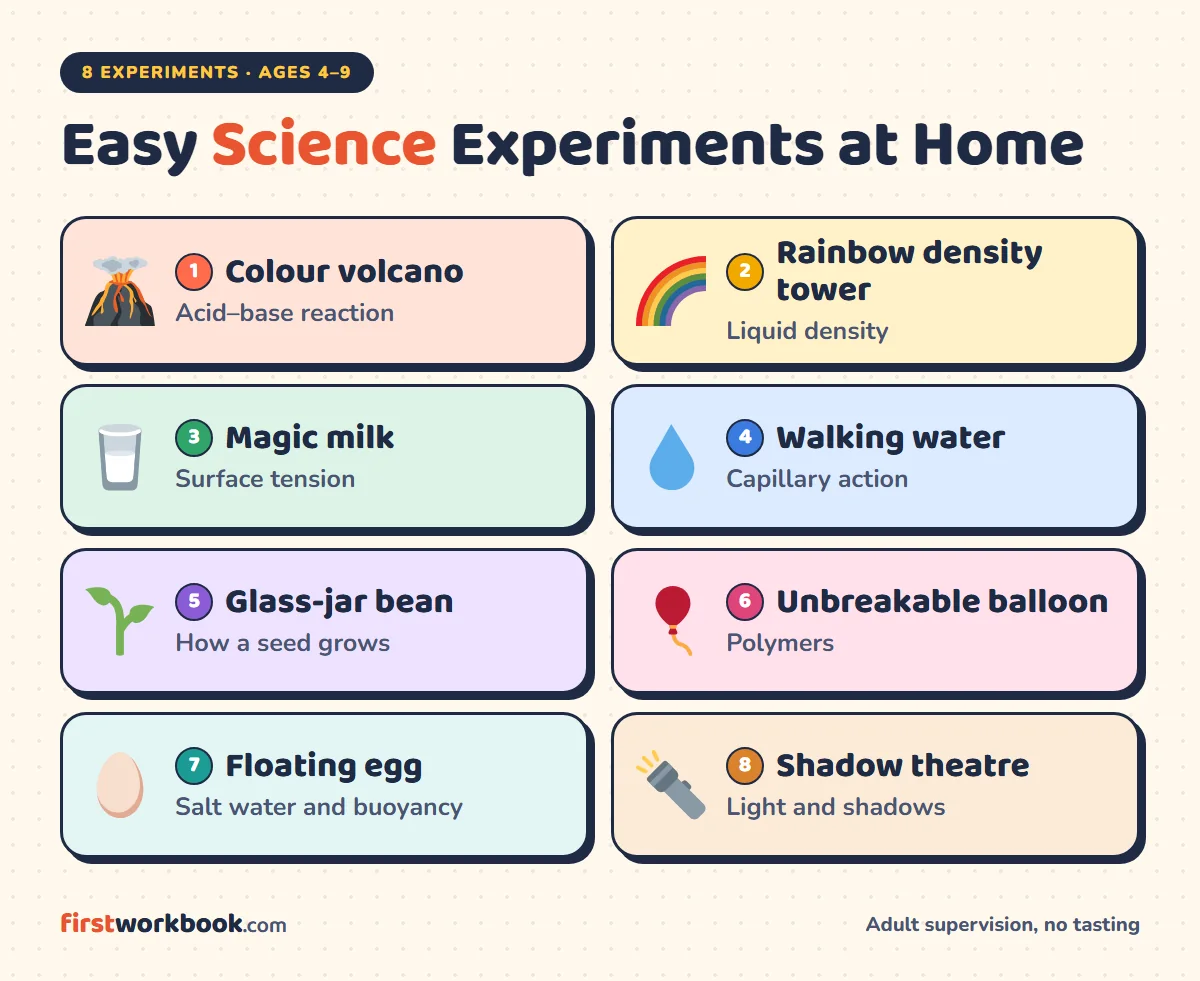
Materials: 3 tablespoons baking soda (sodium bicarbonate), 1/2 cup distilled white vinegar (acetic acid), 3 drops food coloring, 1 drop liquid dish soap, and a tall drinking glass or plastic bottle.
Procedure: Place the glass inside a wide rimmed baking tray. Spoon baking soda into the glass, add food coloring and dish soap, and stir gently. Prompt your child to predict what will happen when the vinegar is poured. In one smooth motion, pour the vinegar into the mixture.
The Science Explained: Baking soda is a chemical base, while vinegar is an acid. When combined, they react vigorously to produce water, sodium acetate, and copious amounts of carbon dioxide gas (CO2). The dish soap traps the escaping carbon dioxide gas, producing a towering, cascading foam eruption.
2. The Rainbow Density Tower (Liquid Density & Buoyancy)
Scientific Principle: Relative Fluid Density & Immiscibility
Materials: A tall, narrow clear glass, 1/4 cup honey or golden syrup, 1/4 cup dishwashing liquid (blue or green), 1/4 cup water tinted red with food dye, and 1/4 cup vegetable oil.
Procedure: Slowly pour the liquids into the center of the glass in exact order: honey first, followed by dish soap, then water (pour gently down the inside wall of the glass using a spoon), and finally vegetable oil on top. Allow the liquids to settle for two minutes.
The Science Explained: Different liquids possess different densities (mass per unit of volume). Honey is dense and heavy, sinking to the very bottom. Dish soap is lighter than honey but denser than water. Oil is the least dense and floats at the very top. Drop a grape, a plastic Lego brick, and a metal paperclip into the column to see which liquid layer each object rests upon!
3. Magic Milk and Dancing Colors (Surface Tension & Molecular Bonds)
Scientific Principle: Surface Tension & Lipid-Surfactant Interaction
Materials: A shallow dinner plate, 1/2 cup whole full-fat milk, assorted liquid food colorings, cotton cotton buds (Q-tips), and liquid dish soap.
Procedure: Pour milk into the plate to form a shallow layer. Add 4 individual drops of different food colors near the center. Dip the cotton bud in clear dish soap, then gently touch the soapy tip to the center of the milk plate without stirring.
The Science Explained: Milk is an emulsion consisting of water, proteins, and suspended fat molecules. Liquid soap is a surfactant that drastically lowers the surface tension of water while its hydrophobic molecules race around to bond with fat globules. The dramatic, swirling explosion of dancing colors visually maps the invisible molecular race occurring in real time.
4. The Walking Water Experiment (Capillary Action)
Scientific Principle: Capillary Action, Adhesion, & Cohesion
Materials: 5 identical clear cups arranged in a row, water, red and blue food coloring, and 4 folded strips of absorbent paper towels.
Procedure: Fill cups 1 and 5 with water, tinting cup 1 red and cup 5 blue. Leave cups 2, 3, and 4 completely empty. Fold paper towels into long bridges connecting cup 1 to 2, 2 to 3, 3 to 4, and 4 to 5. Check the cups every 30 minutes over two hours.
The Science Explained: Water molecules are cohesive (they attract one another) and adhesive (they attract other surfaces like cellulose fibers). Through capillary action—the identical biological mechanism trees use to pull groundwater hundreds of feet up to high leaves—water climbs up the paper towel against gravity and deposits into the empty cups, blending into purple along the way.
5. Germinating the "Glass-Jar Bean" (Botanical Life Cycles)
Scientific Principle: Seed Dormancy, Germination, & Geotropism
Materials: A clean clear glass jam jar, 3 raw dried kidney beans (rajma) or chickpeas, and absorbent paper towels or cotton balls.
Procedure: Line the inside of the jar with damp paper towels. Wedge the dried beans between the glass and the paper towel halfway up the jar so they remain visible from outside. Place the jar on a sunny windowsill, keeping the towels moist.
The Science Explained: Within 48 hours, the seed absorbs water (imbibition) and breaks its outer coat. The primary root (radicle) emerges and grows downward due to gravity (geotropism), while the green shoot emerges and reaches upward toward the sun (phototropism). Have your child document daily root and shoot measurements in a science journal.
6. The Unbreakable Balloon Skewer (Polymer Science)
Scientific Principle: Cross-Linked Polymers & Elasticity
Materials: A standard latex balloon, a wooden barbecue skewer, and a dab of cooking oil or petroleum jelly.
Procedure: Inflate the balloon halfway and tie it firmly. Coat the tip of the wooden skewer with cooking oil. Slowly, with a twisting motion, push the skewer through the thick rubber nipple at the very top of the balloon, and out through the thick base near the tie knot.
The Science Explained: The balloon does not pop! Latex consists of long chains of polymer molecules. On the sides of the balloon, these chains are stretched thin under high tension; puncturing the side causes catastrophic rupture. At the top and knot, the rubber chains are relaxed and under low tension, allowing the oiled skewer to slip between polymer strands without snapping them.
7. Floating Egg in Saltwater (Buoyancy & Salinity)
Scientific Principle: Water Density Modulation & Archimedian Buoyancy
Materials: 2 tall drinking glasses, water, 4 tablespoons table salt, and 2 fresh raw eggs.
Procedure: Fill both glasses with fresh tap water. Stir four tablespoons of salt into glass #2 until completely dissolved. Place one raw egg gently into glass #1, and the second egg into the saltwater glass.
The Science Explained: The egg in fresh water sinks to the bottom because the egg's density is greater than tap water. Adding dissolved salt significantly increases the mass and density of the water. When the saltwater becomes denser than the egg, the egg bobs buoyantly to the surface—the exact reason humans float effortlessly in the Dead Sea.
8. The Kitchen Shadow Theater (Optics & Light Refraction)
Scientific Principle: Light Rays, Opacity, & Shadow Geometry
Materials: A dark room, a single-source flashlight or phone torch, and cardboard cutouts on wooden craft sticks.
Procedure: Cast shadows onto a blank white wall. Move the cardboard puppet closer to the light source, then farther away toward the wall. Observe how shadow borders change from sharp to blurry (umbra and penumbra).
The Science Explained: Light travels in straight rays. When an opaque object blocks light, it casts an absence of light (a shadow). Moving the object closer to the source blocks a wider cone of light rays, casting an exponentially larger silhouette on the wall.
The Science Observation Journal: Documenting Discoveries
Conducting experiments is thrilling; however, documenting observations transforms playful fun into lasting cognitive mastery. Keeping a dedicated science logbook trains visual tracking, fine motor drawing, handwriting, and data literacy.
In FirstWorkbook's My First Science Experiments & Observation Book, young learners record their predictions, sketch before-and-after illustrations, rate the "wow factor" of each reaction, and write simple one-sentence conclusions. Pair this with our Plants & Life Cycles Workbook to turn everyday gardening into a rich empirical exploration.
Safety Protocols for Home Science
- Eye Protection: Provide fun child-sized safety goggles. Beyond actual safety, wearing goggles creates an authentic roleplay mindset: "I am a real laboratory scientist!"
- Clean Workspace: Always conduct experiments inside wide plastic trays or rimmed baking sheets to contain spills.
- No Tasting Rule: Establish an unbreakable laboratory agreement: even when using food ingredients like vinegar and salt, we never ingest experimental concoctions.
- Adult Supervision: An adult must always be present to supervise glass handling, hot water, or scissors.
Frequently Asked Questions (FAQs)
Q1: My child is only 4 years old. Are they too young to understand scientific terms like 'density' or 'chemical reaction'?
Never underestimate a child's linguistic appetite for real scientific terminology. Four-year-olds effortlessly pronounce complex dinosaur names like Tyrannosaurus Rex and Pachycephalosaurus. When introduced within an exciting sensory context, children embrace words like density, capillary action, and hypothesis with genuine pride and accurate conceptual grasp.
Q2: How do I handle an experiment when it fails to produce the expected result?
Celebrate the surprise! Say: "How fascinating! Our volcano didn't foam up like we thought. Let's check our ingredients like real scientists. Did we add enough vinegar? Was our baking soda fresh? Let's test a second batch with twice as much vinegar!" This models real-world research resilience.
Q3: What are the best everyday household materials to keep stocked for science play?
Keep a dedicated "STEM Bin" stocked with: white vinegar, baking soda, cornstarch, liquid food coloring, dish soap, cotton swabs, effervescent antacid tablets, balloons, magnifying glasses, droppers, and clear plastic cups.
Conclusion: Inspiring Tomorrow's Discoverers
Science is not an elite subject confined to sterile research facilities; it is a thrilling, joyful posture toward everyday reality. By conducting hands-on kitchen experiments and maintaining structured observation workbooks, you instill in your child the most vital asset of all: a lifelong thirst to explore, experiment, understand, and marvel at the natural universe.
Put on your goggles, grab the vinegar and baking soda, and explore FirstWorkbook's My First Science Experiments Book today!
Free Worksheets to Practise This
Printable A4 PDFs, free to download. Pick a set and print it at home or school.
About the author

Er. Deepak Maurya
Founder, FirstWorkbook
Er. Deepak Maurya founded FirstWorkbook in Varanasi to make activity workbooks that children enjoy. A web developer with 8 years of experience, he writes practical guides for parents on learning at home, and plans the activities in our workbooks together with pre-primary teachers.
Spotted a mistake or have a question? Write to us and we'll correct it.