Bina Matra Wale Shabd: 150+ Hindi Words Without Matra (With Sentences)
In short
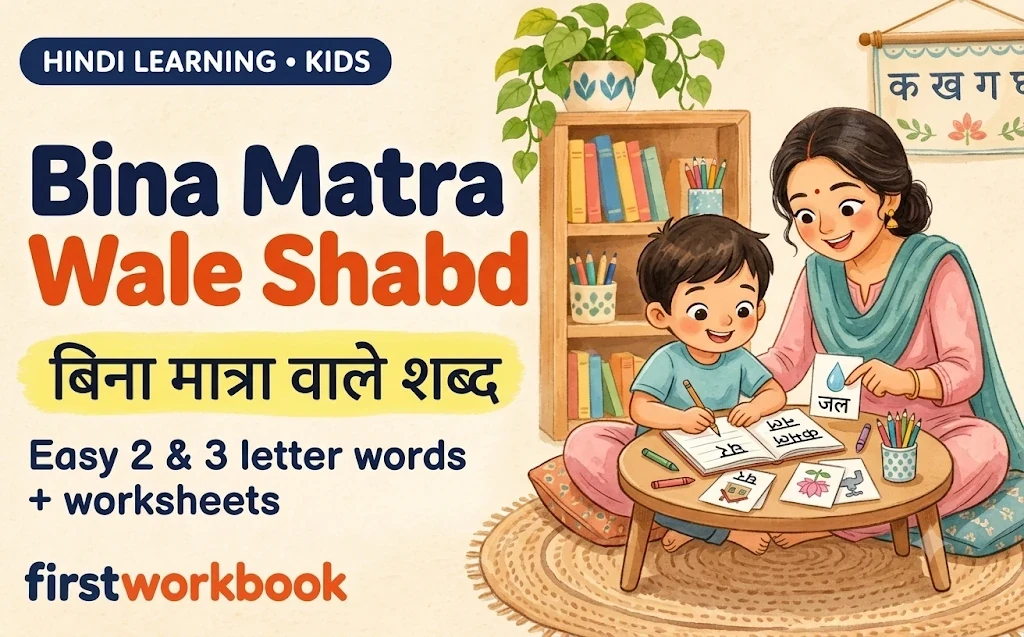
Bina matra wale shabd for LKG and Class 1: two-, three- and four-letter Hindi words without matra, short sentences, a teacher’s blending method, games and a 4-week plan.
Your child knows क, ख, ग. They can point to म in a book and say “म से मछली”. Then you show them the word कमल, and they read “क… म… ल” and stop. They know every letter, but they cannot yet read the word.
This is the exact moment बिना मात्रा वाले शब्द (words without matra) are made for. These are words built only from consonants and the hidden “अ” sound inside every consonant: जल, घर, कमल, अजगर. They are the bridge between knowing the Varnamala and reading real Hindi.
This guide gives you ready-to-use word lists (two-, three- and four-letter words), simple sentences, a teacher’s method for blending, games, a four-week plan and the common mistakes to watch for. It is written for parents of children in LKG, UKG and Class 1, roughly ages 4 to 6.
Quick answer: बिना मात्रा वाले शब्द are Hindi words with no vowel sign (ा, ि, ी…) on any letter, like जल, फल, घर, कमल, मटर, अजगर. Teach them in this order: two-letter words → three-letter words → four-letter words → short sentences such as “अमर, घर चल।” Read every word letter by letter first, then join the sounds, then read the whole word in one breath.
What Are Bina Matra Wale Shabd?
Every Hindi consonant already carries a short “a” sound. क is not just “k”, it is “ka”. A matra is the small sign we add to change that sound: क + ा = का, क + ि = कि. A word without matra uses no such sign. Each letter keeps its own built-in “अ”.
That is why these words come first. A child only needs one skill, joining letter sounds, before having to remember twelve vowel signs. In Hindi these are also called अ की मात्रा वाले शब्द or दो अक्षर / तीन अक्षर वाले शब्द, and most LKG and Class 1 Hindi syllabi cover them before the full barakhadi.
The one rule that makes children read correctly
Here is the tip many workbooks skip. When we say a Hindi word, the “अ” of the last letter is usually silent. We say कमल as “ka-mal”, not “ka-ma-la”. We say घर as “ghar”, not “gha-ra”. Linguists call this schwa deletion, and it is a well-known feature of how Hindi is spoken.
Beginners often read every letter with its full sound, so कमल comes out as “ka-ma-la”. Do not scold this. It is actually a sign that your child has learnt the letters correctly. Simply model the word: “क-म-ल… कमल!” and let them hear the difference. After a week of hearing you, most children start dropping the final “a” on their own.
Why Start With Words Without Matra?
- One new skill at a time. Children practise blending sounds without also juggling vowel signs.
- Fast success. A child can read जल, फल, नल on the very first day, and that early “I can read!” feeling matters more than any worksheet.
- Strong base for matras. Once blending is automatic, adding ा or ि later is just one small change.
- It matches how Hindi reading develops. Research on Hindi readers shows that children recognise simple consonant akshara much earlier than akshara with vowel signs or conjuncts. One study found that Grade 1 children named simple consonant akshara correctly about 72% of the time but were still struggling with the more complex forms. Starting with the simplest words follows that natural order.
Two-Letter Words (दो अक्षर वाले शब्द)
Begin here. Read each word aloud, ask your child to point to each letter, then say it together.
| Word | Meaning | Word | Meaning | Word | Meaning |
|---|---|---|---|---|---|
| जल | water | फल | fruit | नल | tap |
| घर | house | बस | bus | कप | cup |
| वन | forest | धन | money | रस | juice |
| पर | wing / on | जग | jug | हल | plough |
| छत | roof | रथ | chariot | गज | elephant |
| मन | mind | तन | body | कल | tomorrow / yesterday |
| सब | all | अब | now | कब | when? |
| जब | when | तब | then | डर | fear |
| हर | every | बल | strength | पल | moment |
| मत | don’t | खत | letter | नभ | sky |
Three-Letter Words (तीन अक्षर वाले शब्द)
Move here once your child reads most two-letter words without help. Three-letter words are where the “silent last अ” rule really shows up, so model each word slowly.
| Word | Meaning | Word | Meaning | Word | Meaning |
|---|---|---|---|---|---|
| कमल | lotus | मटर | peas | कलम | pen |
| महल | palace | नमक | salt | शहद | honey |
| सड़क | road | मगर | crocodile | नयन | eye |
| गरम | hot | फसल | crop | बटन | button |
| चमक | shine | नहर | canal | नगर | city |
| पवन | wind | गगन | sky | भवन | building |
| कदम | step | सफल | successful | मदद | help |
| हवन | havan | शरद | autumn | असर | effect |
| सरल | easy | अमर | immortal (a name) | भरत | a name |
| रतन | gem (a name) | अजय | a name | मदन | a name |
A note on बतख: you will see “बतख” in many no-matra lists, but the dictionary spelling of duck is बत्तख, with a half त. If your child’s school book uses बतख, follow the school. If not, it is better to leave this word out of the no-matra stage so your child does not learn two spellings.
Four-Letter Words (चार अक्षर वाले शब्द)
Four-letter words feel like a big achievement. Break them in the middle first (अज-गर, बर-गद) and then read the whole word.
| Word | Meaning | Word | Meaning | Word | Meaning |
|---|---|---|---|---|---|
| अजगर | python | बरगद | banyan tree | कसरत | exercise |
| सरगम | musical notes | मखमल | velvet | हलचल | bustle |
| खटमल | bedbug | शलगम | turnip | दलदल | swamp |
| झटपट | quickly | गपशप | chit-chat | उपवन | garden |
| कटहल | jackfruit | बचपन | childhood | धड़कन | heartbeat |
Rhyming Word Families
Rhymes help children notice that changing only the first letter makes a new word. Read each family as a little chant and clap on every word.
- -ल परिवार: जल, फल, नल, कल, बल, दल, पल
- -र परिवार: घर, पर, डर, हर
- -न परिवार: वन, धन, मन, तन
- -ब परिवार: सब, अब, कब, जब, तब
- -मल परिवार: कमल, खटमल, मखमल
Short Sentences Without Matra (बिना मात्रा वाले वाक्य)
Once your child reads ten to fifteen words easily, show them that words join into sentences. Every sentence below uses no matra at all. Read one, act it out, and laugh about it. Children remember what they act.
- अमर, घर चल।
- कमल, जल भर।
- रमन, बस पकड़।
- सरल, फल रख।
- नयन, कलम पकड़।
- अजय, छत पर मत चढ़।
- पवन, सड़क पर मत चल।
- गगन, कप रख।
- भरत, अब घर चल।
- मदन, शहद चख।
Notice that most of these sentences are commands. That is not an accident: a verb like चल, रख or पकड़ needs no matra in its command form, which is why traditional Hindi primers are full of sentences like “अमर, घर चल।”
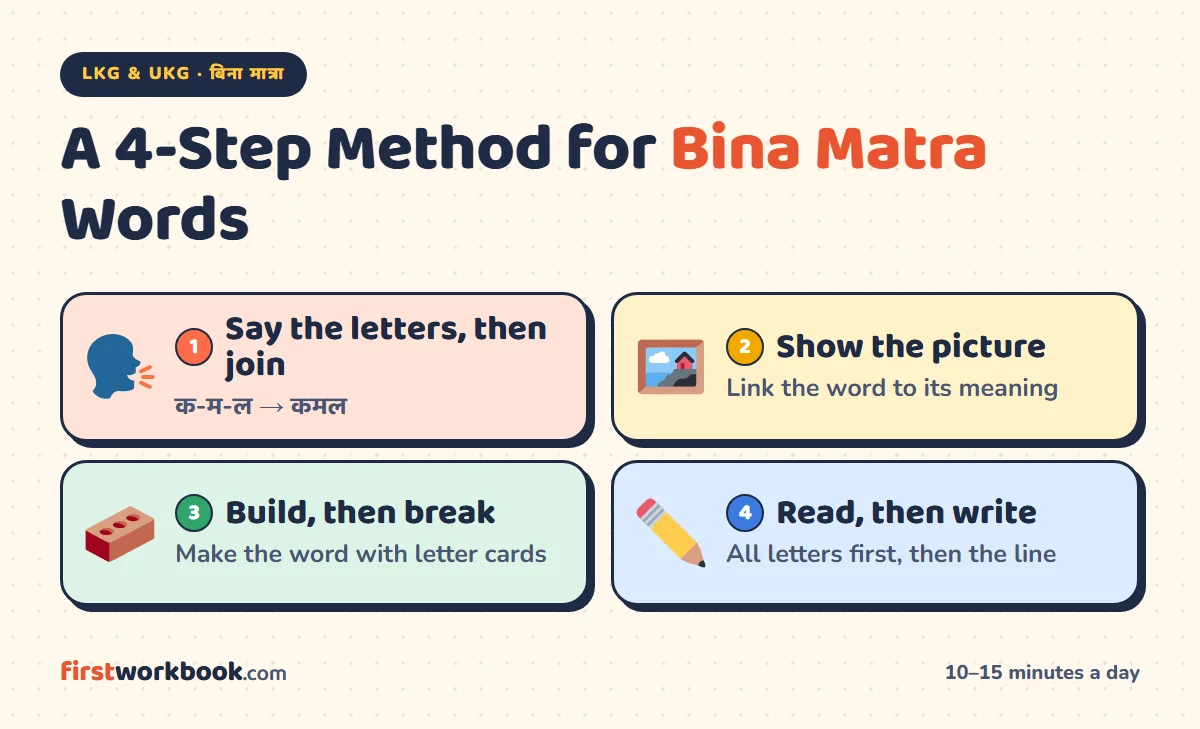
How to Teach Bina Matra Wale Shabd: A Teacher’s 4-Step Method
Step 1: Say the letters, then join them
Write जल on a card. Point to ज and say “ज”, then to ल and say “ल”. Now slide your finger under the whole word and say it smoothly: “जल”. Ask your child to do the same, finger and all. The moving finger shows the eye that sounds join from left to right.
Step 2: Show the picture
Words are much easier to read when they mean something. Keep a glass of water next to “जल” or a fruit next to “फल”. For three- and four-letter words, a picture card helps your child check their own reading: “Did I read कमल? Yes, there is the lotus!”
Step 3: Build the word, then break it
Give your child separate letter cards क, म, ल and ask them to make कमल. Then mix up the cards and ask them to break the word again. Building and breaking teaches far more than copying a word five times.
Step 4: Read, then write
Reading comes first, writing second. When your child writes, remind them of the order: first draw each letter, and only at the end draw one long top line (शिरोरेखा) over the whole word. In कमल there are three letters but only one shirorekha.
Six Games That Make Practice Fun
- शब्द की सीढ़ी (word ladder): change one letter at a time: जल → फल → फन → मन → मत. Can your child read each new word?
- Word hunt: give your child a Hindi newspaper headline and a pencil. How many no-matra words can they circle?
- Bingo: make a 3×3 grid of words. You call a word, your child finds and covers it with a bottle cap.
- Read and do: write commands like “कप रख” or “घर चल” on slips. Your child picks one, reads it and does it.
- Read and draw: your child reads a word like मगर or कमल and draws it. The drawing proves they understood.
- Mystery bag: put a cup, a jug, a button and a pen in a bag. Your child pulls one out and finds the matching word card (कप, जग, बटन, कलम).
A 4-Week Practice Plan
| Week | Focus | Daily time |
|---|---|---|
| Week 1 | 10 two-letter words with pictures (जल, फल, नल, घर, बस, कप, वन, रस, जग, छत). Read and build with letter cards. | 10 minutes |
| Week 2 | Remaining two-letter words and rhyming families. Start the word ladder game. | 10–12 minutes |
| Week 3 | Three-letter words, 4–5 new words a day. Model the silent final अ. | 12–15 minutes |
| Week 4 | Four-letter words and the 10 sentences. Read and act out one sentence a day. | 15 minutes |
Keep each session short and stop while your child is still enjoying it. Five calm days a week work better than one long weekend session.
Common Mistakes (and Easy Fixes)
- Reading “ka-ma-la” for कमल. Model the word and let your child copy you. Do not explain schwa deletion. Just say it naturally.
- Mixing look-alike letters. ब/व, घ/ध, भ/म and प/ष are confused by almost every child. Put the two letters side by side and play “spot the difference”.
- Guessing from the first letter. If your child sees क and says “कबूतर”, cover the word with a card and reveal one letter at a time.
- Moving on too fast. If three-letter words feel hard, go back to two-letter words for a few days. Confidence matters more than speed.
- Turning it into a test. Celebrate every word read. A tick, a sticker or a high-five keeps a 5-year-old coming back.
When Is My Child Ready for Matras?
Your child is ready to start matras (beginning with आ की मात्रा) when they can:
- read most two- and three-letter words without spelling them out loud,
- read a short no-matra sentence like “कमल, जल भर।” in one go, and
- build a word from letter cards when you say it aloud.
Our guide to Hindi matra worksheets shows the best order to teach the matras after this stage.
Printable Practice for LKG and UKG
If you would like this all on paper, the LKG Hindi Workbook – Bina Matra Wale Shabd follows exactly this path: a varnamala revision, a “how to write” page, two-, three- and four-letter words to trace and write, joining and breaking words, picture matching and short sentences, all in 32 pages. It is also part of the LKG Book Bundle.
When your child is ready for the next step, the UKG Hindi Workbook – Matra Gyan covers every matra with picture words, barakhadi and simple sentences. Still learning the letters? Start with our Hindi varnamala guide.
हिंदी में सार (Summary in Hindi)
बिना मात्रा वाले शब्द वे शब्द हैं जिनमें किसी भी अक्षर पर मात्रा नहीं होती, जैसे जल, घर, कमल, अजगर। वर्णमाला सीखने के बाद बच्चा इन्हीं शब्दों से पढ़ना शुरू करता है।
- पहले दो अक्षर वाले शब्द, फिर तीन अक्षर, फिर चार अक्षर वाले शब्द पढ़ाएँ।
- हर शब्द को पहले अक्षर-अक्षर बोलें (क-म-ल), फिर एक साथ (कमल)।
- आख़िरी अक्षर का ‘अ’ धीमा बोला जाता है: “कमल” को “क-म-ला” नहीं, “कमल” पढ़ते हैं। बच्चे को टोकें नहीं, बस सही बोलकर सुनाएँ।
- लिखते समय पहले सारे अक्षर बनाएँ, फिर पूरे शब्द के ऊपर एक शिरोरेखा खींचें।
- रोज़ 10–15 मिनट काफ़ी हैं। जब बच्चा “अमर, घर चल।” जैसा वाक्य आराम से पढ़ ले, तब आ की मात्रा शुरू करें।
Frequently Asked Questions
In which class are bina matra wale shabd taught?
Most schools introduce them in LKG or UKG and revise them at the start of Class 1, after children know the Varnamala. Some schools wait until Class 1. Readiness matters more than the class name.
Are words with ं (anusvara) like पतंग “bina matra” words?
Strictly, no. The bindu (ं) is taught along with the matras, so keep words like पतंग, बंदर and अंगूर for later.
Can words with ड़ or ढ़ be used?
Yes. ड़ and ढ़ are letters, not matras, so words like सड़क, पकड़ and धड़कन are fine once your child knows these letters.
How many words should my child learn in a day?
Three to five new words a day, plus a quick revision of old ones, is plenty for a 4–6 year old.
My child reads the words but cannot write them. Is that normal?
Yes. Reading usually runs ahead of writing at this age. Keep writing short (two or three words a day) and focus on correct letter shapes rather than speed.
Research Behind This Guide
- National Curriculum Framework for Foundational Stage (Ministry of Education, 2022): play-based early literacy, phonological awareness and print experiences for ages 3–8.
- Improving Hindi decoding skills via a mobile game (University of Oxford research archive): Hindi akshara types and how accurately Grade 1 and 2 children read them.
- The Community Library Project working paper on Hindi reading: recommends phonological awareness, systematic akshara phonics and read-alouds.
Free Worksheets to Practise This
Printable A4 PDFs, free to download. Pick a set and print it at home or school.
About the author

Er. Deepak Maurya
Founder, FirstWorkbook
Er. Deepak Maurya founded FirstWorkbook in Varanasi to make activity workbooks that children enjoy. A web developer with 8 years of experience, he writes practical guides for parents on learning at home, and plans the activities in our workbooks together with pre-primary teachers.
Spotted a mistake or have a question? Write to us and we'll correct it.