

Hindi Varnamala Worksheets for Kids: A Complete Guide for Parents
Teach Hindi Varnamala at home with printable worksheets. Learn the swar and vyanjan, a step-by-step plan, fun activities, and tips to help your child read Hindi.
📑 In this article
- What Is the Hindi Varnamala?
- Swar (Vowels)
- Vyanjan (Consonants)
- Why Use Hindi Varnamala Worksheets?
- 1. They Build Fine Motor Skills
- 2. They Connect Sound, Shape, and Meaning
- 3. They Give Structure to Learning
- 4. They Reduce Screen Time
- 5. They Show Visible Progress
- What Makes a Good Hindi Varnamala Worksheet?
- A Step-by-Step Plan to Teach Hindi Varnamala at Home
- Week 1–2: Listening and Speaking
- Week 3–4: Swar Tracing
- Week 5–8: Vyanjan by Varga
- Week 9–10: Matras (Vowel Signs)
- Week 11 Onwards: Words and Small Sentences
- Fun Activities to Pair With Worksheets
- Letter Hunt
- Sand or Rice Tray Writing
- Clay Letters
- Varnamala Flash Card Game
- Story Time in Hindi
- Common Mistakes Parents Make (and How to Avoid Them)
- Teaching Too Many Letters at Once
- Skipping the Correct Stroke Order
- Forgetting the Shirorekha
- Long, Tiring Sessions
- Correcting Too Harshly
- Hindi Varnamala Worksheets for Different Age Groups
- Ages 3–4 (Nursery / Pre-KG)
- Ages 4–5 (LKG)
- Ages 5–6 (UKG)
- Ages 6–7 (Class 1)
- How to Make the Most of a Printable Hindi Workbook
- Benefits That Go Beyond Hindi
- Frequently Asked Questions
- At what age should my child start learning the Hindi Varnamala?
- Should I teach swar or vyanjan first?
- How long does it take to learn the full Varnamala?
- My child confuses similar letters. What should I do?
- Are printable worksheets better than apps?
- Conclusion
Many parents want their child to read and write Hindi with confidence. In a lot of homes, English gets most of the attention because of school, cartoons, and apps. Hindi slowly becomes "the subject we will deal with later." But the early years, roughly ages 3 to 7, are the best time to build a strong base in the Hindi alphabet. This is when children pick up sounds and shapes quickly and without stress.
Hindi Varnamala worksheets are one of the simplest and most effective tools for this. They give your child a clear structure: see the letter, say the sound, trace it, write it, and connect it to a word or picture. In this guide, you will learn what the Hindi Varnamala includes, why worksheets work so well, a week-by-week plan you can follow at home, and practical tips that keep learning fun.
What Is the Hindi Varnamala?
The word Varnamala means "garland of letters." It is the complete set of letters used to write Hindi in the Devanagari script. It has two main groups:
Swar (Vowels)
Swar are the vowel sounds. They can be spoken on their own. The commonly taught swar are:
अ, आ, इ, ई, उ, ऊ, ऋ, ए, ऐ, ओ, औ, अं, अः
Children usually start here because the swar are fewer in number and each has a clear, open sound.
Vyanjan (Consonants)
Vyanjan are the consonant sounds. They are arranged in neat groups called vargas, based on where the sound is produced in the mouth:
- क-वर्ग: क, ख, ग, घ, ङ
- च-वर्ग: च, छ, ज, झ, ञ
- ट-वर्ग: ट, ठ, ड, ढ, ण
- त-वर्ग: त, थ, द, ध, न
- प-वर्ग: प, फ, ब, भ, म
- अन्तःस्थ: य, र, ल, व
- ऊष्म: श, ष, स, ह
- संयुक्त व्यंजन: क्ष, त्र, ज्ञ (and श्र in many textbooks)
This logical grouping is a big advantage. Once a child learns the pattern of one varga, the next one feels familiar.
Why Use Hindi Varnamala Worksheets?
You might wonder whether worksheets are really needed when there are videos and apps everywhere. Screens can help with listening, but writing and letter recognition develop best on paper. Here is why printable worksheets work so well.
1. They Build Fine Motor Skills
Devanagari letters have curves, loops, and the top line called the shirorekha. Tracing these shapes strengthens the small muscles in the fingers and wrist. These are the same muscles your child needs for neat handwriting in every subject.
2. They Connect Sound, Shape, and Meaning
A good worksheet shows the letter, a word that starts with it, and a picture. For example, क with कबूतर (pigeon) and a pigeon drawing. This three-way link helps the letter stick in memory much faster than repetition alone.
3. They Give Structure to Learning
Parents often ask, "Where do I even begin?" Worksheets answer that. They move step by step from tracing to free writing, from single letters to words. You do not need to plan every lesson yourself.
4. They Reduce Screen Time
Printable worksheets are a calm, offline activity. Your child sits, focuses, and creates something with their own hands. Many parents notice that children are more settled after a short worksheet session than after a video.
5. They Show Visible Progress
When a child finishes a page, they can see what they achieved. Keeping completed pages in a folder lets children look back and feel proud. That sense of progress keeps motivation high.
What Makes a Good Hindi Varnamala Worksheet?
Not every worksheet is equally useful. When choosing or printing Hindi alphabet worksheets for kids, look for these features:
- Large, clear letters with dotted lines for tracing.
- Stroke direction arrows so children learn the correct way to form each letter.
- The shirorekha shown clearly, since children often forget the top line.
- A picture and a simple word for every letter.
- Gradual difficulty: tracing first, then guided writing, then independent writing.
- Enough empty space so the page does not feel crowded.
- Fun extras such as colouring, matching, circle-the-letter, and fill-in-the-blank activities.
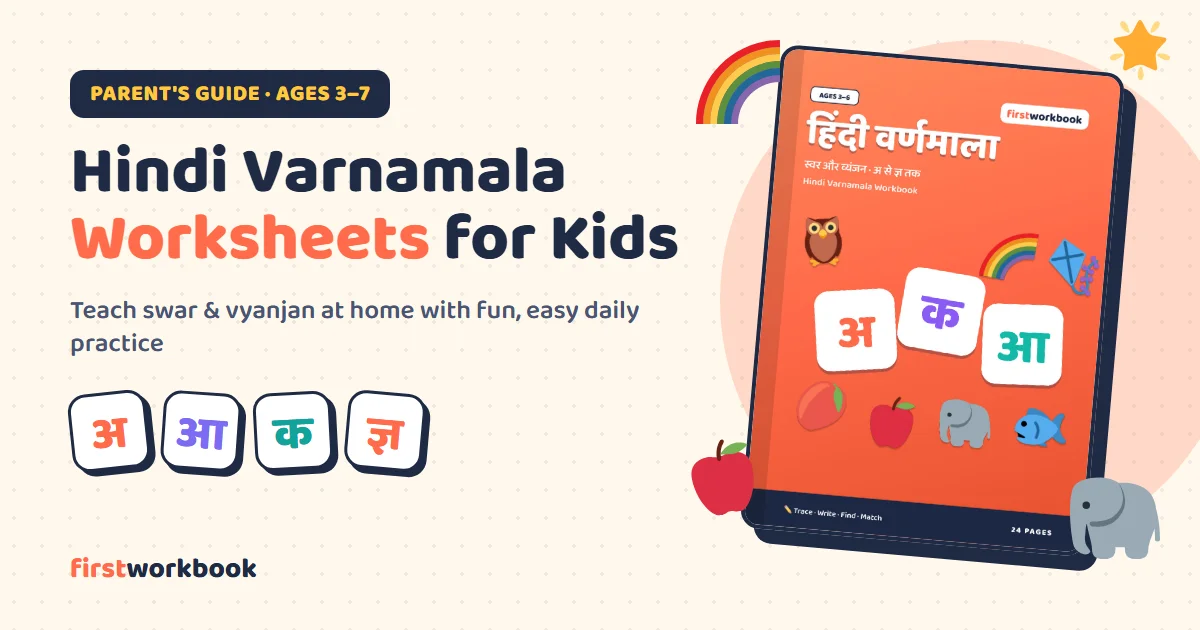
A well-designed workbook, like a 24-page Hindi Varnamala workbook, brings all of these together in one place. That saves you the trouble of collecting random sheets from different websites.
A Step-by-Step Plan to Teach Hindi Varnamala at Home
Here is a simple plan that works for most children aged 3 to 6. Adjust the pace to your child. Some children move faster, some need more time, and both are completely normal.
Week 1–2: Listening and Speaking
Before writing, make sure your child can hear and say the sounds.
- Sing a Varnamala rhyme together every day.
- Point to objects at home and say their first sound: "आ se आम."
- Play "I spy" in Hindi: "Mujhe ek cheez dikh rahi hai jo क se shuru hoti hai."
No pressure to write yet. The goal is comfort with sounds.
Week 3–4: Swar Tracing
Start with the swar worksheets.
- Introduce two or three vowels per day.
- Let your child trace each letter with a finger first, then with a crayon, then with a pencil.
- Say the sound aloud every time they trace.
- End with a colouring activity for the picture on that page.
Week 5–8: Vyanjan by Varga
Move to consonants, one varga at a time.
- Teach क-वर्ग in the first few days, then च-वर्ग, and so on.
- Revise the previous varga before starting a new one.
- Use matching worksheets: connect ग to गाय, म to मछली.
- Practice similar-looking letters side by side, such as ब and व, or घ and ध, so your child learns to notice the difference.
Week 9–10: Matras (Vowel Signs)
Once your child knows most letters, introduce matras. This is where real reading begins.
- Start with ा (aa ki matra): क + ा = का.
- Use simple two-letter words like का, मा, पापा, नाना.
- Add one new matra each week: ि, ी, ु, ू, and so on.
Week 11 Onwards: Words and Small Sentences
- Read simple words without matras first: कमल, घर, जल, नल, बस.
- Move to words with matras, then to short sentences: राम घर जा।
- Encourage your child to write their own name in Hindi. Children love this.
Fun Activities to Pair With Worksheets
Worksheets work best when mixed with play. Here are some ideas that cost almost nothing.
Letter Hunt
Write a few letters on sticky notes and hide them around the room. When your child finds one, they say the sound and a word that starts with it.
Sand or Rice Tray Writing
Spread a thin layer of rice, sand, or salt on a plate. Your child writes letters with a finger. This sensory practice is great for children who find pencils tiring.
Clay Letters
Roll clay or dough into long snakes and shape them into letters. Children understand curves and lines much better when they build them with their hands.
Varnamala Flash Card Game
Make simple cards with a letter on one side and a picture on the other. Show the picture and let your child guess the letter, or the other way around.
Story Time in Hindi
Read short Hindi picture books aloud. Pause and ask your child to find letters they know. This shows them that the letters they practise are used in real stories.
Common Mistakes Parents Make (and How to Avoid Them)
Teaching Too Many Letters at Once
The Varnamala has more than 45 letters. Trying to cover all of them in a week leads to confusion. Two to four new letters per day is plenty for young learners.
Skipping the Correct Stroke Order
If a child learns to form letters the wrong way, it becomes a habit that is hard to fix later. Use worksheets that show arrows, and watch your child closely in the beginning.
Forgetting the Shirorekha
Children often draw the letter but skip the top line. Remind them gently: "Letter ko topi pehnao!" A playful phrase like this makes it easy to remember.
Long, Tiring Sessions
Young children can focus for about 10 to 20 minutes at a time. Short daily practice beats one long weekend session. Stop while your child is still enjoying it.
Correcting Too Harshly
Mistakes are part of learning. Praise effort first, then show the correct way. A child who feels safe will try again happily.
Hindi Varnamala Worksheets for Different Age Groups
Ages 3–4 (Nursery / Pre-KG)
Focus on listening, speaking, finger tracing, and colouring. Use big letters with plenty of space. One page a day is enough.
Ages 4–5 (LKG)
Introduce pencil tracing for swar and the first few vargas. Add simple matching and circle-the-letter activities.
Ages 5–6 (UKG)
Complete the vyanjan, start matras, and read two- and three-letter words. Begin writing letters without dotted guides.
Ages 6–7 (Class 1)
Practise all matras, read short sentences, and write simple words from memory. Hindi worksheets for Class 1 can also include dictation and picture-based word writing.
How to Make the Most of a Printable Hindi Workbook
If you are using a complete printable workbook, a few small habits make a big difference:
- Print on thicker paper if possible, so pages do not tear during tracing.
- Laminate a few pages or put them in a plastic sheet protector. Your child can use a dry-erase marker and practise again and again.
- Keep a fixed time every day, such as after breakfast or before evening play.
- Use a reward chart. A small sticker for every completed page works wonders.
- Review on weekends. Spend five minutes looking back at the week's pages together.
Benefits That Go Beyond Hindi
Learning the Hindi Varnamala early does more than teach a language. It also:
- Strengthens memory and concentration.
- Improves hand-eye coordination and pencil grip.
- Builds a connection to culture, family, and heritage, especially for children who live away from Hindi-speaking regions.
- Makes learning other Devanagari-based languages such as Marathi, Nepali, and Sanskrit easier later on.
- Supports bilingual development, which research links to better problem-solving and flexible thinking.
Frequently Asked Questions
At what age should my child start learning the Hindi Varnamala?
Most children are ready to start listening to and saying Hindi sounds around age 3. Tracing usually begins around 3.5 to 4, and pencil writing around 4 to 5. Watch your child's interest and grip rather than following a strict age rule.
Should I teach swar or vyanjan first?
Start with swar. There are fewer of them, the sounds are simple, and they are needed later to understand matras.
How long does it take to learn the full Varnamala?
With 10 to 15 minutes of daily practice, most children recognise all the letters in about two to three months. Writing them neatly may take a little longer, and that is fine.
My child confuses similar letters. What should I do?
Practise confusing pairs side by side, such as ब/व, घ/ध, and भ/म. Point out the small difference in each pair and use a picture word for each letter.
Are printable worksheets better than apps?
Both have a place. Apps can help with sounds and listening. Printable worksheets are better for handwriting, fine motor skills, and focused, screen-free practice. A mix of both often works best.
Conclusion
Teaching your child Hindi does not need to be hard or stressful. With good Hindi Varnamala worksheets, a simple daily routine, and a few playful activities, your child can learn the swar and vyanjan, start reading words, and write with confidence, all from home.
Start small. Pick one worksheet today, sit with your child for ten minutes, and celebrate every letter they learn. Over a few weeks, you will be surprised how far they have come.
Ready to begin? Download our printable Hindi Varnamala Workbook, with tracing, matching, colouring, and word activities for every letter, and give your child a strong, joyful start in Hindi.
You may also like
Alphabet and Number Tracing Worksheets for Preschoolers: Benefits, Tips, and a Simple Plan
Discover how alphabet and number tracing worksheets help preschoolers build handwriting, focus, and early maths skills. Get a step-by-step plan and expert tips.