

Alphabet and Number Tracing Worksheets for Preschoolers: Benefits, Tips, and a Simple Plan
Discover how alphabet and number tracing worksheets help preschoolers build handwriting, focus, and early maths skills. Get a step-by-step plan and expert tips.
📑 In this article
- What Are Tracing Worksheets?
- Why Tracing Worksheets Matter for Young Children
- 1. Stronger Fine Motor Skills
- 2. Correct Letter and Number Formation
- 3. Letter and Number Recognition
- 4. Better Hand-Eye Coordination
- 5. Longer Attention Span
- 6. Confidence and Independence
- Is Your Child Ready for Tracing?
- The Best Order to Teach Letters
- Uppercase Letters First
- Then Lowercase Letters
- The Best Order to Teach Numbers
- A Simple 8-Week Tracing Plan
- Week 1: Pre-Writing Strokes
- Week 2: Uppercase Straight-Line Letters
- Week 3: Uppercase Diagonal Letters
- Week 4: Uppercase Curved and Mixed Letters
- Week 5: Numbers 2, 3, 5, 8 and 10
- Week 6: Lowercase "Magic c" and Tall Letters
- Week 7: Remaining Lowercase Letters
- Week 8: Review and Simple Words
- Tips to Make Tracing Fun (Not a Chore)
- Keep Sessions Short
- Use Different Tools
- Make Pages Reusable
- Turn It Into a Game
- Add Movement
- Praise the Effort
- Common Mistakes to Avoid
- Activities That Pair Well With Tracing Worksheets
- How to Choose the Right Tracing Workbook
- Frequently Asked Questions
- What age should children start tracing worksheets?
- Should I teach uppercase or lowercase letters first?
- How many tracing worksheets should my child do each day?
- My child writes numbers backwards. Is that a problem?
- Do tracing worksheets really improve handwriting?
- Conclusion
Before a child can write a story or solve a sum, they need to form letters and numbers with their own hands. For many preschoolers, that starts with a dotted line and a crayon. Alphabet and number tracing worksheets may look simple, but they play an important role in early learning. They prepare little hands for writing, teach the shapes of letters and numerals, and build the patience and focus children need for school.
In this guide, you will learn why tracing matters, how to tell if your child is ready, the best order to teach letters and numbers, a practical weekly plan, and tips to keep practice fun instead of frustrating.
What Are Tracing Worksheets?
Tracing worksheets show letters, numbers, shapes, or lines drawn with dotted or light grey strokes. Children follow these guides with a pencil, crayon, or marker. Most good worksheets also include:
- Arrows and numbers that show where to start each stroke and which way to move.
- A starting dot so the child knows exactly where to place the pencil.
- Picture cues, such as an apple for A or three balloons for 3.
- Practice space where the child tries to write without the dotted guide.
The idea is to move gently from "follow the line" to "write it yourself."
Why Tracing Worksheets Matter for Young Children
1. Stronger Fine Motor Skills
Writing uses tiny muscles in the fingers, hand, and wrist. Preschoolers are still developing these muscles. Tracing gives them focused, repeated practice in controlling a pencil, which leads to neater and less tiring handwriting later.
2. Correct Letter and Number Formation
Children who learn to form letters the right way from the start write faster and more neatly. For example, many children write the number 8 as two stacked circles instead of one continuous stroke. Tracing worksheets with arrows teach the correct movement early, before bad habits form.
3. Letter and Number Recognition
Every time a child traces B and says "B for ball," they strengthen the link between the shape, the name, and the sound. The same is true for numbers: tracing 5 next to five stars connects the symbol to the actual quantity.
4. Better Hand-Eye Coordination
Following a line requires the eyes and hands to work together. This skill helps with drawing, cutting, colouring, and even sports.
5. Longer Attention Span
Finishing a tracing page takes a few minutes of quiet focus. Over time, children learn to sit, concentrate, and complete a task. This is a key school-readiness skill.
6. Confidence and Independence
When a child sees a page full of letters they wrote themselves, they feel capable. That confidence spills over into other learning.
Is Your Child Ready for Tracing?
Most children are ready to start tracing between ages 3 and 4, but readiness matters more than age. Look for these signs:
- They can hold a crayon or thick pencil without dropping it every few seconds.
- They enjoy scribbling, drawing, or colouring.
- They can draw a rough vertical line, a horizontal line, and a circle.
- They can sit for at least five minutes on a calm activity.
- They show interest in letters, numbers, or their own name.
If your child is not there yet, start with pre-writing activities: drawing lines, zig-zags, waves, and circles. Many tracing workbooks include these pages at the beginning for exactly this reason.
The Best Order to Teach Letters
Teaching A to Z in order is common, but it is not always the easiest path. Letters are easier to learn when grouped by the strokes used to form them.
Uppercase Letters First
Capital letters are made from simple straight lines and curves, and they are all the same height. That makes them easier for small hands.
A helpful grouping:
- Straight lines only: L, F, E, H, T, I
- Straight lines with diagonals: A, K, M, N, V, W, X, Y, Z
- Curves: C, O, Q, G, S
- Lines and curves together: D, P, B, R, J, U
Then Lowercase Letters
Lowercase letters are trickier because they sit at different heights. Group them by their starting motion:
- "Magic c" letters: c, a, d, g, o, q
- Tall line letters: l, t, i, j, k
- Hump letters: n, m, h, r, b, p
- Diagonal letters: v, w, x, y, z
- Others: e, f, s, u
Once your child has learned the letters in groups, practising them in A–Z order is a great way to review.
The Best Order to Teach Numbers
For numbers, start with 1 to 10 and move to 11 to 20, then beyond.
- 1, 4, 7 are made with straight lines and are usually the easiest.
- 0, 6, 9 use curves.
- 2, 3, 5, 8 mix curves and lines, and they need extra practice.
Watch for common reversals, such as a backwards 3, 5, 7, or 9. These are completely normal at this age. Gentle correction and starting-point arrows help children get it right over time.
Always pair the numeral with a quantity. Tracing 4 next to four apples teaches counting and number sense, not just shape-copying. Once your child is confident, a 1–100 number workbook builds counting skills, number patterns, and readiness for addition.
A Simple 8-Week Tracing Plan
Use this plan as a starting point and adjust the pace to suit your child.
Week 1: Pre-Writing Strokes
Straight lines, slanting lines, curves, circles, zig-zags, and waves. Use thick crayons and big shapes.
Week 2: Uppercase Straight-Line Letters
L, F, E, H, T, I. Trace each letter three times, then try once without dots. Add numbers 1 and 4.
Week 3: Uppercase Diagonal Letters
A, K, M, N, V, W, X, Y, Z. Add number 7. Practise counting objects to 7.
Week 4: Uppercase Curved and Mixed Letters
C, O, Q, G, S, D, P, B, R, J, U. Add numbers 0, 6, and 9.
Week 5: Numbers 2, 3, 5, 8 and 10
Spend extra time on these trickier numerals. Use counting and matching activities alongside tracing.
Week 6: Lowercase "Magic c" and Tall Letters
c, a, d, g, o, q, l, t, i, j, k. Show how each lowercase letter matches its uppercase partner.
Week 7: Remaining Lowercase Letters
Hump letters, diagonal letters, and the rest. Begin writing the child's name in proper case, such as Aarav instead of AARAV.
Week 8: Review and Simple Words
Trace short words like cat, sun, and dog. Trace numbers 11 to 20. Celebrate with a "certificate" made at home.
Tips to Make Tracing Fun (Not a Chore)
Keep Sessions Short
Ten to fifteen minutes is perfect for preschoolers. Two short sessions a day work better than one long one.
Use Different Tools
Switch between crayons, colour pencils, markers, and chalk. Thick triangular crayons are excellent for beginners because they encourage a good grip.
Make Pages Reusable
Slide a worksheet into a clear sheet protector or laminate it. Your child can trace with a dry-erase marker, wipe it, and try again. This also saves printing.
Turn It Into a Game
- Rainbow tracing: trace the same letter in three different colours.
- Race the timer: can your child trace five letters before the song ends?
- Find it next: after tracing M, find something at home that starts with M.
Add Movement
Let your child "air-write" letters with a big arm movement, trace letters on your back with a finger, or form numbers with their whole body. Movement helps memory.
Praise the Effort
Say "You worked so hard on that S!" rather than only "That's perfect." Children who are praised for effort keep trying when things get hard.
Common Mistakes to Avoid
- Starting with a thin pencil too early. Begin with thick crayons, then move to pencils.
- Ignoring pencil grip. A tripod grip (thumb, index, and middle finger) makes writing easier. Small pencil grips can help.
- Too many pages at once. One or two pages a day is enough at this age.
- Skipping the "say it aloud" step. Saying the letter name, sound, or number while tracing doubles the learning.
- Comparing with other children. Every child develops at their own pace. Progress, not perfection, is the goal.
Activities That Pair Well With Tracing Worksheets
Tracing works even better alongside hands-on activities:
- Playdough letters and numbers: roll and shape them by hand.
- Salt or sand tray writing: write with a finger for a sensory experience.
- Dot-to-dot pictures: practise number order while drawing.
- Cut and paste activities: strengthen hand muscles with scissors and glue.
- Colouring pages: build control and stamina in a relaxed way.
- Shapes and patterns worksheets: prepare children for both letters and early maths.
How to Choose the Right Tracing Workbook
When choosing printable tracing worksheets for kids, look for:
- Large, clear letters and numbers with plenty of space.
- Stroke arrows and starting dots on every character.
- Both uppercase and lowercase letters.
- Numbers with matching quantities for real number sense.
- A gradual progression from tracing to independent writing.
- Cute, simple pictures that keep children interested without cluttering the page.
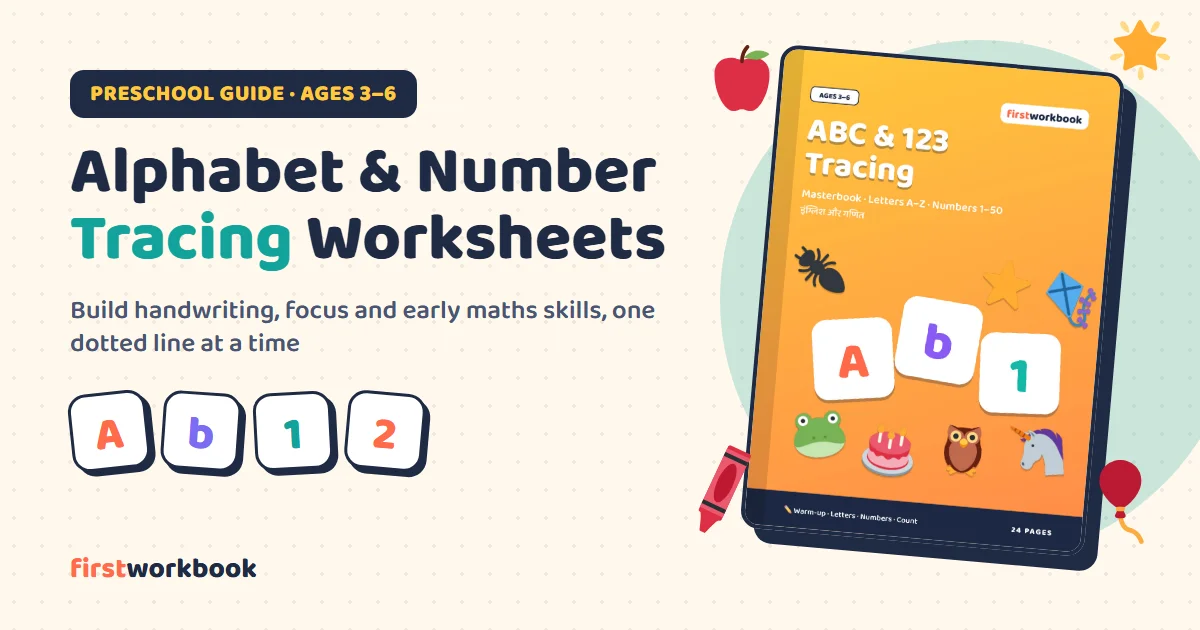
- A manageable length. A focused 24-page masterbook is often more useful than a 200-page bundle that never gets finished.
Frequently Asked Questions
What age should children start tracing worksheets?
Most children start between 3 and 4 years old. Begin with pre-writing lines and shapes, then move to letters and numbers when your child holds a crayon comfortably.
Should I teach uppercase or lowercase letters first?
Uppercase letters are usually easier because they use simple lines and are all the same height. Introduce lowercase once your child is comfortable with capitals.
How many tracing worksheets should my child do each day?
One or two pages, or about 10 to 15 minutes, is ideal for preschoolers. Consistency matters more than quantity.
My child writes numbers backwards. Is that a problem?
No. Reversals are very common until around age 6 or 7. Use worksheets with starting dots and arrows, and gently show the correct direction.
Do tracing worksheets really improve handwriting?
Yes. Tracing builds the muscle control and movement memory needed for neat handwriting, especially when combined with free writing and play-based activities.
Conclusion
Alphabet and number tracing worksheets are a small daily habit with big rewards. They strengthen little hands, teach the correct way to form every letter and number, build focus, and give children the confidence to start school ready to learn.
Keep sessions short, make them playful, and celebrate every bit of progress. With a good workbook and a few minutes a day, your preschooler will go from wobbly lines to confident letters and numbers sooner than you think.
Get started today with our printable Alphabet and Number Tracing Masterbook. It includes pre-writing strokes, A–Z uppercase and lowercase letters, numbers with counting activities, and fun practice pages your child will enjoy.
You may also like
Hindi Varnamala Worksheets for Kids: A Complete Guide for Parents
Teach Hindi Varnamala at home with printable worksheets. Learn the swar and vyanjan, a step-by-step plan, fun activities, and tips to help your child read Hindi.