Good Habits for Kids: Complete List and How to Teach Them
⚡ In short
A complete list of good habits for kids by age, with 9 practical ways to teach them, a sample daily routine and what to do when your child refuses.
Every parent has a version of this morning: the toothbrush is still dry, one shoe is missing, the school bag was never packed and someone is crying. Then the evening comes, and the same arguments start again about bath time, homework and the phone. It is tiring, and it can feel like you are saying the same things a hundred times a day.
Good habits are the way out of that loop. Once a habit is set, a child does the thing without a reminder, and you stop being the family alarm clock. This guide covers the most important good habits for kids, grouped by type, with practical ways to teach each one, an age-wise list, a sample daily routine and what to do when your child simply refuses.
Why Good Habits Matter So Much in Early Childhood
A habit is a behaviour that has become automatic. Adults rarely think about whether to brush their teeth; it just happens. Children between roughly 3 and 10 years old are in the best phase to build these automatic behaviours, because their days are already structured around routines set by parents and school.
How long does it take? A well-known study by researchers at University College London (Lally and colleagues, 2010) followed adults building a new daily habit and found it took about 66 days on average for the behaviour to feel automatic, with a very wide range depending on the person and the habit. The study was on adults, so treat the number as a rough guide, but the lessons apply to children too: it takes weeks, not days, and missing one day here and there does not undo the progress.
Good Habits for Kids: The Complete List
Rather than one long list, it helps to think of habits in five groups. Pick one or two from different groups at a time; trying to fix everything together is the fastest way to fail.
1. Health and hygiene habits
- Brushing teeth twice a day, morning and before bed, for about two minutes.
- Washing hands with soap before eating, after using the toilet and after coming home from outside.
- Bathing daily and wearing clean clothes.
- Trimming nails regularly and not biting them.
- Covering the mouth with an elbow or a tissue when coughing or sneezing.
- Drinking enough water through the day, especially in summer and after play.
- Eating fruits and vegetables and not filling up on packaged snacks.
- Sleeping on time. Sleep experts (the American Academy of Sleep Medicine, with backing from the American Academy of Pediatrics) recommend 10–13 hours a day for children aged 3–5, including naps, and 9–12 hours for children aged 6–12.
2. Good manners and social habits
- Using the magic words: please, thank you, sorry and excuse me.
- Greeting elders with a namaste or a hello when guests come home or when meeting people.
- Waiting for their turn to speak, play or be served.
- Sharing toys and food with siblings and friends.
- Table manners: eating with the mouth closed, not wasting food, staying seated during meals.
- Listening when someone else is speaking, without interrupting.
3. Study and learning habits
- Reading every day, even 10–15 minutes. Daily reading is probably the single most useful learning habit a child can have.
- Doing homework at a fixed time and place, at a table, not on the bed.
- Packing the school bag the night before using the timetable.
- Keeping books and notebooks covered and neat.
- Asking questions when something is not clear, instead of staying quiet.
4. Responsibility and independence habits
- Putting things back after use: toys in the box, shoes on the rack, uniform on the hanger.
- Doing small chores: watering plants, setting the table, folding their own clothes.
- Getting ready on their own: buttoning shirts, tying shoes (or velcro for little ones), combing hair.
- Saving money in a piggy bank and learning to wait for something they want.
- Being on time for school, the school van and family plans.
5. Emotional and digital habits
- Naming feelings: “I am angry,” “I am sad,” instead of hitting or throwing things.
- Calming down with a simple strategy: three deep breaths, counting to ten or going to a quiet corner.
- Saying sorry and fixing the mistake where possible.
- Limited screen time with clear rules, and no screens at the dinner table or in bed. Paediatric guidance also suggests switching screens off at least 30 minutes before bedtime.
- Playing outdoors every day, even for a short while.
- Telling a parent when something online or around them makes them uncomfortable.
Age-Wise Good Habits: What to Expect When
Expecting too much too early causes frustration on both sides. This table gives a realistic idea of what children can usually manage at each stage. Every child is different, so use it as a guide, not a test.
| Age | Habits to focus on | How much help they need |
|---|---|---|
| 2–3 years | Washing hands, putting toys in a box, saying thank you, brushing with help | Do it together every time |
| 3–5 years | Brushing teeth, using the toilet, eating independently, greeting elders, sharing, tidying up toys | Reminders and a picture chart |
| 5–7 years | Bathing, dressing, packing the school bag, daily reading, simple chores, waiting for a turn | Checklist, occasional checking |
| 7–10 years | Homework on time, managing screen time, saving money, keeping their room in order, being on time | Mostly independent, weekly review |
How to Teach Good Habits to Kids: 9 Methods That Work
1. Start with one habit at a time
Choose the habit that causes the most daily stress. If mornings are chaos, start with packing the bag at night. Work on it for three or four weeks until it runs smoothly, then add the next one. Two habits that stick are worth far more than ten that are tried for a week.
2. Attach the new habit to an old one
Habits stick better when they are linked to something that already happens every day. “After dinner, we brush teeth.” “When we come home, shoes go on the rack and hands get washed.” The old habit becomes the reminder, so you don’t have to be.
3. Show, don’t just tell
Children copy what they see far more than what they hear. If you want your child to read daily, let them see you reading. If you want “please” and “thank you,” use them with your child, with your partner and with the vegetable seller. A child who is scolded for using a phone at the dinner table while the parents scroll will notice the difference.
4. Make it visual
Young children cannot read a long list of instructions, but they can follow pictures. Make a simple chart with drawings: toothbrush, bath, clothes, breakfast, bag. Stick it at eye level near the bathroom or the door. Children love ticking off the steps themselves, and it gives them a sense of control.
5. Use a reward chart (for a while)
A weekly chart with stickers or stars works very well for children aged 3–8. Keep the rules clear (“a star every night the bag is packed”) and the reward small and non-material where possible: choosing the Sunday dinner, an extra story, a trip to the park. Once the habit is automatic, slowly drop the chart and move it to a new habit.
6. Explain the “why” in simple words
“Brush your teeth” is an order. “We brush so the tiny germs don’t make holes in your teeth” is a reason a five-year-old can understand and remember. Stories help a lot here; children remember a lesson from a story much longer than one from a lecture. Our collection of short moral stories for kids is a good place to start.
7. Make it fun
Play a two-minute song while brushing. Race the timer to tidy the toys. Turn the hand-washing steps into a rhyme. Habits that feel like games get done with much less arguing, especially with children under six.
8. Praise the effort, specifically
“Good boy” is nice, but “You packed your bag all by yourself without me asking. That was really responsible!” tells the child exactly what they did right. Specific praise is one of the strongest tools you have, and it costs nothing.
9. Be consistent, especially at weekends and holidays
Most habits fall apart during holidays and family functions. You don’t need to be strict about everything, but keep the core habits (brushing, bedtime, a little reading) the same even on holidays. That consistency is what turns a routine into a habit.
A Sample Daily Routine for School-Going Kids (Age 5–8)
This is a simple template you can adjust to your child’s school timings. The exact times matter less than doing the same things in the same order every day.
| Time | Habit |
|---|---|
| 6:30 am | Wake up, use the toilet, brush teeth, drink a glass of water |
| 6:45 am | Bath, get dressed, comb hair |
| 7:05 am | Breakfast at the table (no screens) |
| 7:25 am | Shoes on, water bottle and tiffin in the bag, say bye to family |
| After school | Shoes on the rack, wash hands and face, change clothes, snack |
| 4:30 pm | Outdoor play (about an hour) |
| 5:45 pm | Homework and revision at the study table |
| 7:00 pm | Free time, a small chore (watering plants, setting the table) |
| 8:00 pm | Dinner with family |
| 8:30 pm | Pack the school bag, keep uniform ready, brush teeth |
| 8:45 pm | Story or reading time, then lights off by about 9:00 pm |
Notice there are no long screen blocks in the weekday routine. If you want ideas to fill the free time, see our list of screen-free activities for kids at home.
Bad Habits to Gently Replace
Breaking a bad habit works better when you put a good one in its place. Simply saying “stop” leaves a gap, and the old habit usually fills it again.
- Nail biting: Keep nails short, and give the hands something to do (a stress ball, play-dough) during TV time or while reading. Don’t shame the child; it often happens when they are anxious or bored.
- Interrupting: Teach a “hand on shoulder” signal. Your child puts a hand on your arm when they want to speak, and you acknowledge it by putting your hand on theirs and finishing your sentence first.
- Too much screen time: Agree on fixed screen times rather than open-ended use, keep devices out of the bedroom and use a timer the child can see.
- Wasting food: Serve small portions and let them ask for more. Involve them in cooking simple things; children waste less of what they helped to make.
- Lying: Make it safe to tell the truth. If honesty always leads to a big punishment, children learn to hide things. Praise the truth first, then deal with the mistake.
What If My Child Refuses?
Every child pushes back at some point. That is normal and actually healthy; it is how children test independence. A few things help:
- Offer choices within the habit. Not “Do you want to brush?” but “Do you want the blue toothbrush or the green one?” The habit is not up for discussion, but the details are.
- Use “when–then.” “When your toys are in the box, then we can go to the park.” It is calm, clear and not a threat.
- Check the reason. A child who refuses to bathe might find the water too cold. A child who won’t do homework may not understand it. Refusal often has a simple, fixable cause.
- Stay calm and repeat. Arguments give the habit a lot of attention. A short, calm reminder said the same way every day works better than a long lecture.
- Accept a bad day. If you miss one day, just start again the next. As the habit research suggests, an occasional slip does not wipe out the progress.
Teaching Good Habits Through Activities
Children learn habits best when they do something with the idea, not only hear about it. Some activities that work well at home and in class:
- Right or wrong picture sorting: Show pictures of a child throwing a wrapper on the road and a child putting it in a dustbin. Ask which is the good habit and why.
- “What would you do?” questions: “Your friend falls down in the playground. What would you do?” These build thinking, not just obedience.
- Role play: Act out greeting a guest, asking for something politely or saying sorry. Then swap roles.
- Drawing and colouring: Ask your child to draw their own morning routine. Children follow a chart they made far more willingly than one you made.
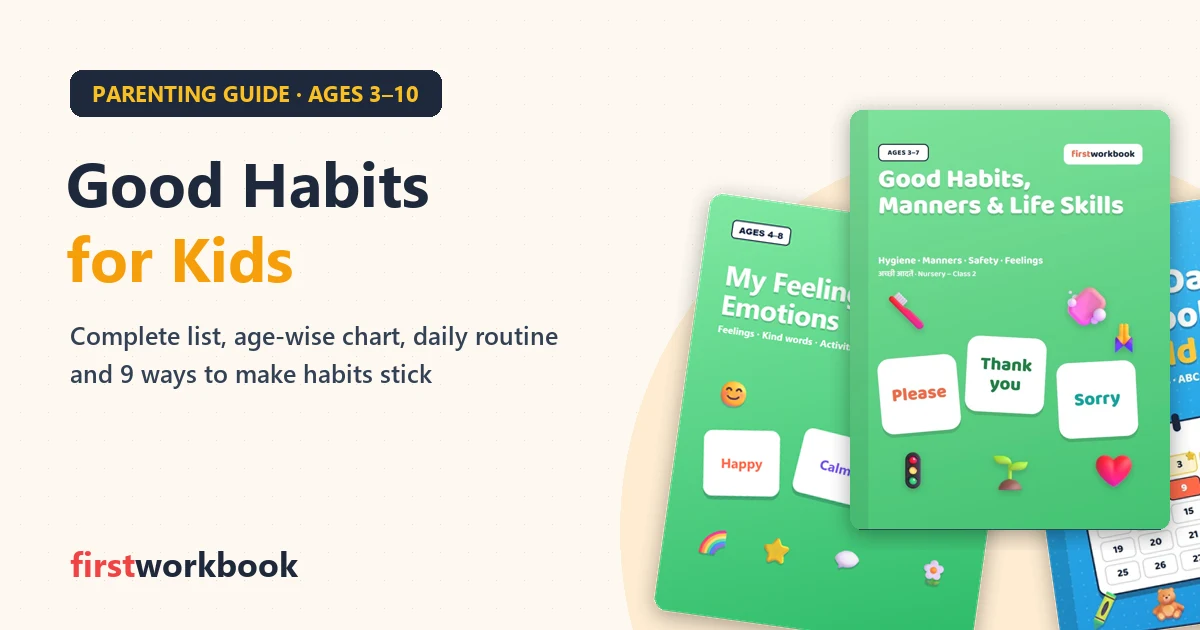
If you want a ready set of these activities, our Good Habits, Manners & Life Skills workbook covers healthy habits, the magic words, table manners, sharing, safety at home and on the road, good touch and bad touch, screen time and naming feelings, with right-or-wrong picture choices, colouring and “what would you do?” questions. It also includes a weekly good-habits reward chart and parent tips, and since it is a printable PDF, you can print the chart again every week. For more on feelings and calming down, the My Feelings & Emotions activity workbook pairs well with it.
Frequently Asked Questions
What are the 10 most important good habits for kids?
A good starting set is: brushing teeth twice a day, washing hands before eating, sleeping on time, eating fruits and vegetables, saying please and thank you, sharing, putting things back after use, reading every day, packing the school bag the night before and limiting screen time.
At what age should I start teaching good habits?
As early as age 2, with simple habits like washing hands and putting toys away. The earlier you start, the more natural the habit feels to the child. But it is never too late; 8- and 9-year-olds can build new habits too, they just need more explanation of why.
Do reward charts make children expect rewards for everything?
Not if you use them for a limited time and for specific habits. Use the chart for three to four weeks, keep rewards small, and then move the chart to a new habit once the old one is automatic. Praise and a sense of being “a big kid” gradually take over from stickers.
How do I teach good habits to a stubborn child?
Give choices within the habit, use “when–then” language, keep reminders short and calm, and model the habit yourself. Most importantly, focus on one habit at a time. Stubborn children dig in harder when they feel everything is being corrected at once.
Final Thoughts
Good habits are not built with one big speech or a strict new rule on the first day of the month. They are built quietly, one small action repeated every day, linked to something that already happens, shown by the adults around the child and noticed with a few words of praise. Start with one habit that would make your mornings or evenings easier, stick with it for a few weeks, and then add the next. A year from now, you will be reminding a lot less, and your child will be doing a lot more on their own.