Homework for Nursery, LKG and UKG: How Much, What to Give and a 30-Day Plan
In short
Should preschoolers get homework? What India’s School Bag Policy says, how much homework suits each class, what a good homework page looks like, class-wise ideas and a 30-day plan.
The school diary comes home with a note: “Homework: write अ to अः, page 12.” For a three- or four-year-old, that can turn into tears at the dining table. Yet many parents also feel their child forgets letters and numbers without a little practice at home.
This guide answers the questions parents ask most about homework for Nursery, LKG and UKG: does a preschooler need homework at all, how much is right for each class, what a good homework page looks like, class-wise homework ideas and a simple 30-day routine you can start this week.
Should Nursery, LKG and UKG Children Get Homework?
In India, the Ministry of Education’s School Bag Policy 2020 recommends no homework for Classes 1 and 2, and only about two hours a week for Classes 3 to 5. Several states, including Madhya Pradesh and Jammu & Kashmir, have written this into their own rules. Pre-primary classes come before Class 1, so the spirit is clear: young children should not carry heavy written homework.
Research points the same way. Harris Cooper of Duke University reviewed more than 180 homework studies and found that, for children below Class 5, the link between homework and marks was close to zero. The popular “10-minute rule” (about 10 minutes per class level per night) gives a Class 1 child only 10 minutes, so a preschooler needs even less.
So does that mean no homework at all? Not quite. What helps at this age is short, playful practice that builds habits rather than marks:
- sitting at a table for 10 minutes and finishing one small task,
- holding a crayon or pencil correctly and making controlled lines,
- saying letter sounds and counting real objects,
- talking with a parent about pictures, animals and festivals.
Think of preschool homework as a daily 10-minute habit, not a test. If your school sends written homework, keep it light and stop while your child is still happy.
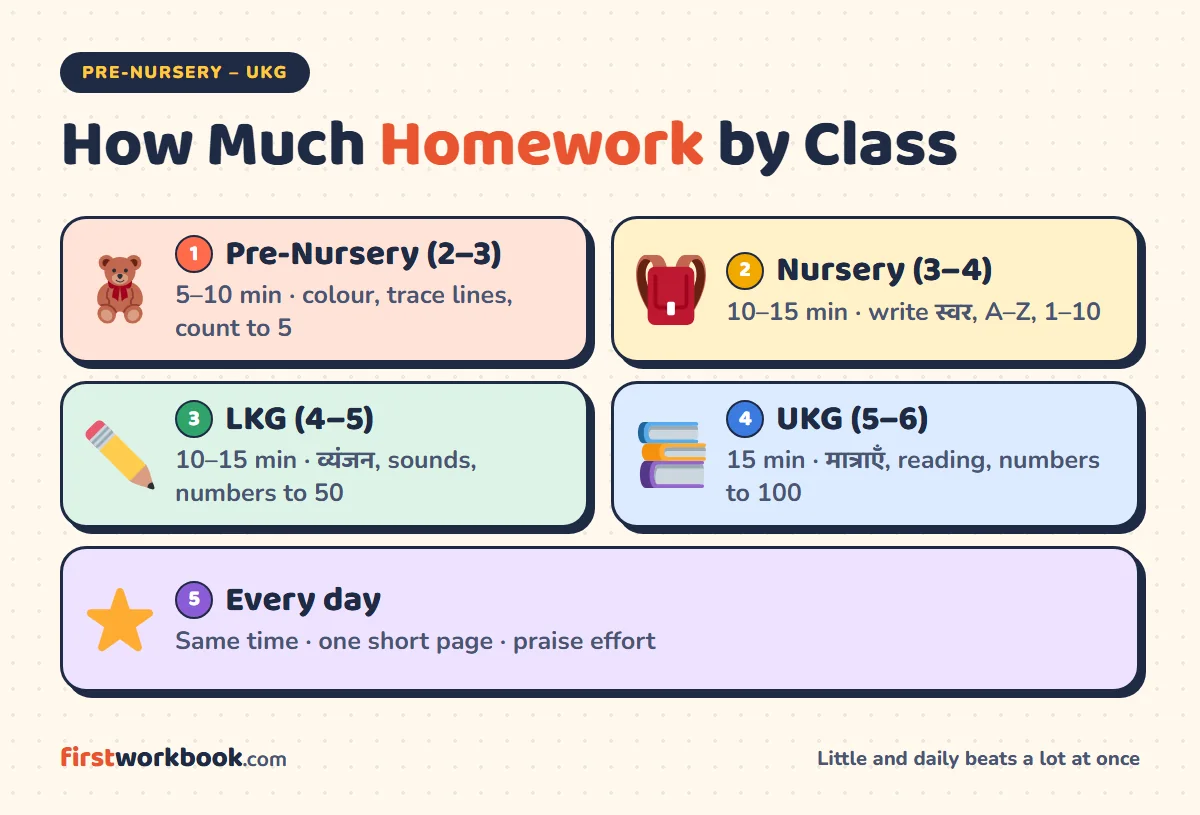
How Much Homework by Class
These limits suit most children. Some days your child will want more, and some days less; both are fine.
| Class (age) | Time a day | What it should look like |
|---|---|---|
| Pre-Nursery (2–3) | 5–10 minutes | Picture tasks: colour a big letter, trace lines with a finger, count 1–5, point and name |
| Nursery (3–4) | 10–15 minutes | Write स्वर and capital letters, numbers 1–10, find and circle, simple matching |
| LKG (4–5) | 10–15 minutes | व्यंजन, A–Z with sounds, small words, numbers to 50, adding with pictures |
| UKG (5–6) | 15 minutes | मात्राएँ and small sentences, reading short English words, numbers to 100, time and money |
Leave one or two days a week completely free, and skip homework on festival days and when your child is unwell.
What a Good Homework Page Looks Like
A good preschool homework page is short, mixed and has pictures. Long rows of the same letter bore children and tire small hands. A balanced page has five tiny parts:
- Hindi: one or two letters (or one मात्रा in UKG) with a picture word, traced and then written once.
- English: a letter and its sound, or a small word such as cat, hen or sun.
- Maths: counting, writing numbers, more or less, or a picture sum.
- GK or EVS: fruits, animals, our body, family, good habits, transport or festivals.
- A fun task: colouring, odd one out, matching shadows or a small drawing.
Add a line for the date, a space for a parent’s sign and a star to colour, and the page becomes a small daily ritual that children look forward to.
Class-Wise Homework Ideas
Pre-Nursery homework (ages 2–3)
- Colour a big outline letter: “अ से अनानास”, “A for apple”.
- Pre-writing lines: standing, sleeping, slanting, curved and zig-zag lines, first with a finger, then with a fat crayon.
- Count real things to 5: spoons, shoes, rotis. Then circle the right number on paper.
- Big and small, long and short, same and different, with picture cards.
- Circle the fruits, the animals or the things we wear.
At this age, the parent reads and the child points, circles and colours. For the full picture of what Pre-Nursery children learn, see our Pre-Nursery syllabus guide.
Nursery homework (ages 3–4)
- Write स्वर अ to अः, one letter a day, and find it in a row of letters.
- Write capital letters A to Z and circle the matching small letter.
- Write numbers 1 to 10; count pictures and write the number; before and after.
- Read व्यंजन क to न and say the first letter of a picture.
- Shapes, colours and simple patterns.
LKG homework (ages 4–5)
- All व्यंजन with picture words, then simple words without मात्रा such as जल, घर, बस. Our guide to बिना मात्रा वाले शब्द has word lists.
- Small letters, letter sounds and three-letter word families like -at, -an, -en. See CVC words for kids.
- Numbers to 50, before, after and between, bigger and smaller.
- Adding and taking away with pictures, up to 10.
- EVS: my body, my family, good habits, plants, water and road safety.
UKG homework (ages 5–6)
- मात्राएँ from ा to ं with picture words, then short sentences like “मोर नाचता है।” The बारहखड़ी chart guide helps here.
- Short vowels, a and an, one and many, rhyming words, and reading small sentences.
- Numbers to 100, tens and ones, skip counting, adding and subtracting to 20.
- Telling time to the hour and counting coins.
- GK: India, seasons, helpers and their tools, festivals, days and months.
Want the full year’s topics? See the Pre-Nursery, Nursery, LKG and UKG syllabus guides.
How to Build a Daily Homework Routine
- Same time, same place. Choose a calm 15 minutes, for example after the evening snack, at a small table with good light.
- Get everything ready first: a pencil, an eraser, crayons and the page for today. Searching for a crayon is where attention is lost.
- Read the instruction aloud and do the first answer together. Then let your child do the rest.
- Say it while writing. “क… कबूतर”, “B… ball”. Saying and writing together helps memory.
- Check the grip. Thumb and first finger hold the pencil and the middle finger supports it. Our handwriting guide shows simple grip fixes.
- Praise effort, not neatness. “You tried the hard one!” works better than “Make it neater.”
- Finish with a reward ritual: sign the page and let your child colour a star on a chart.
For a whole-day plan that includes play, reading and outdoor time, see our daily learning routine for kids.
Common Homework Mistakes Parents Make
- Too much at once. Two pages a day for a four-year-old leads to fights. One short page is enough.
- Correcting every letter. Point out one thing to improve, then let the rest go.
- Doing it for the child so the diary looks neat. Teachers would rather see your child’s own wobbly letters.
- Homework at bedtime. A tired child cannot concentrate; earlier in the evening works better.
- Comparing with other children. Children in the same class can be a year apart in readiness, and that is normal.
- Only writing, no talking. At this age, talking about the picture is as important as writing the letter.
A Simple 30-Day Homework Plan
Use this four-week shape for any class. Each day is one short page; every seventh day is a light revision day.
| Week | Hindi | English | Maths | Day 7 |
|---|---|---|---|---|
| Week 1 | New letters (or मात्राएँ in UKG) | New letters and sounds | Counting and writing numbers | Revise the week, colour a picture |
| Week 2 | Next letters, picture words | More letters, matching capital and small | Before, after, bigger, smaller | Missing-letter and number games |
| Week 3 | Letters + first words | Sounds and word families | Shapes, patterns, adding with pictures | “I can…” checklist |
| Week 4 | Words or small sentences | Reading small words | Taking away, mixed sums | Show the whole book to a grandparent |
Our class-wise homework books follow exactly this plan, with one ready-made page for each of the 30 days.
Homework Books and Free Worksheets
If you would rather not make pages every night, these books give you 30 days of ready homework (Hindi, English, Maths, GK, EVS and a fun task on every page), with a parent sign, revision days and an answer key:
- Pre-Nursery All-in-One Homework Book – 30 Days (picture pages, no writing needed)
- Nursery All-in-One Homework Book – 30 Days
- LKG All-in-One Homework Book – 30 Days
- UKG All-in-One Homework Book – 30 Days
For the school break, each class also has a Winter Holiday Homework Book, and both books come together for less in the class bundle: Pre-Nursery, Nursery, LKG and UKG homework bundles. Planning the holidays? Read our winter vacation homework guide.
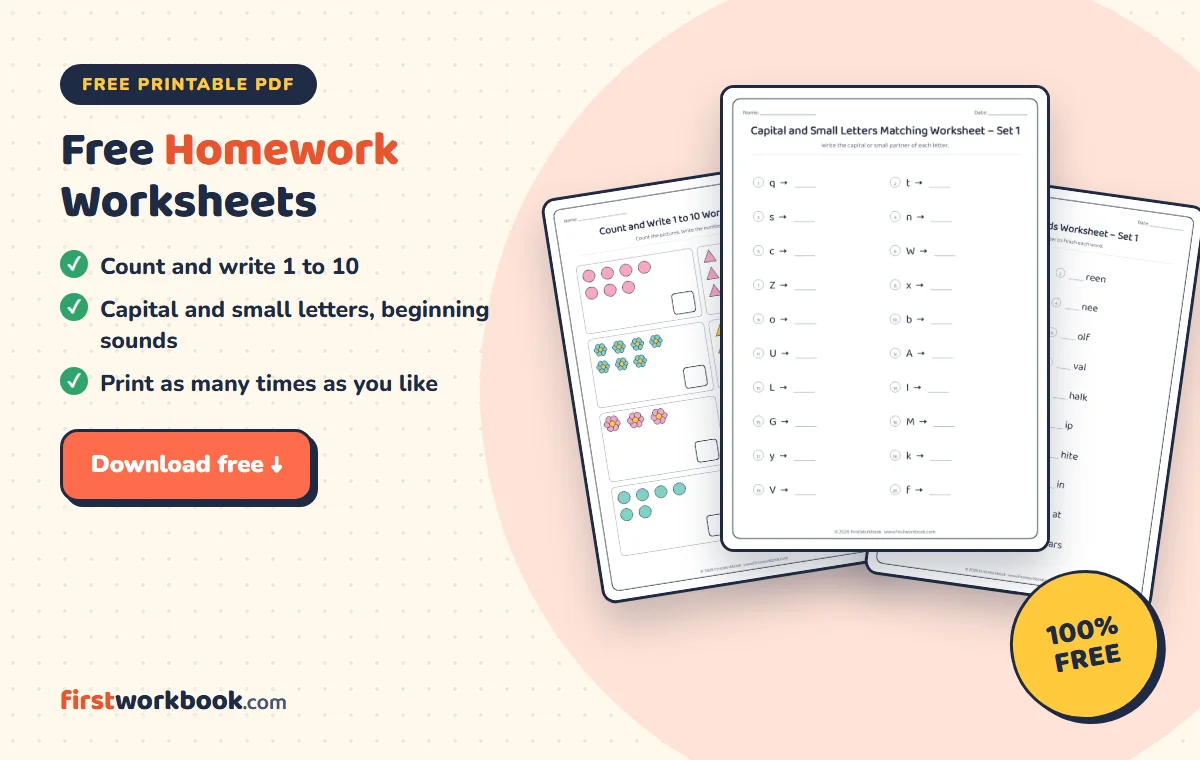
Prefer to print single sheets? Browse free Pre-Nursery, Nursery, LKG and UKG worksheets.
हिंदी में सार (Summary in Hindi)
नर्सरी, LKG और UKG के बच्चों के लिए होमवर्क भारी नहीं होना चाहिए। शिक्षा मंत्रालय की स्कूल बैग नीति 2020 कक्षा 1 और 2 तक होमवर्क न देने की सलाह देती है, इसलिए प्री-प्राइमरी में होमवर्क सिर्फ़ 5 से 15 मिनट का, खेल जैसा अभ्यास होना चाहिए। हर दिन एक छोटा पेज करवाएँ, जिसमें थोड़ी हिंदी, थोड़ी अंग्रेज़ी, गिनती, GK/EVS और एक मज़ेदार गतिविधि हो। रोज़ एक ही समय पर बैठें, पहला उत्तर साथ में करें, अक्षर बोलकर लिखवाएँ, और साफ़-सुथरे लेख से ज़्यादा मेहनत की तारीफ़ करें। हर सातवें दिन दोहराई करें और पेज पूरा होने पर तारा रंगवाएँ।
Frequently Asked Questions
Is homework necessary for Nursery and LKG?
Written homework is not necessary, and Indian policy discourages it in the early years. A short daily practice habit of 10–15 minutes, with talking, tracing and counting, is helpful and enough.
How much homework should a UKG child do?
About 15 minutes a day is plenty: a few words with मात्राएँ, a short English reading task, a few sums and one GK question. Stop if your child is tired.
My child cries during homework. What should I do?
Make the task smaller. Do half the page, sit next to your child, make it a game and praise every try. Check whether the page is too hard for their level, and do homework earlier, not at bedtime.
Should I correct my child’s mistakes in homework?
Correct one thing at a time, gently. Show the right way, let your child try once more and move on. Too many corrections make children give up.
What is the best time to do homework?
A fixed time after a snack and some play in the evening works for most families. Avoid the hour before bed.
Research Behind This Guide
- Ministry of Education, School Bag Policy 2020 – no homework up to Class 2, as reported by ThePrint and Careers360.
- State rules: Madhya Pradesh and Jammu & Kashmir.
- Harris Cooper’s review of homework research, Duke University (2006), and American Psychological Association, “Is homework a necessary evil?” (2016).
About the author

Er. Deepak Maurya
Founder, FirstWorkbook
Er. Deepak Maurya founded FirstWorkbook in Varanasi to make activity workbooks that children enjoy. A web developer with 8 years of experience, he writes practical guides for parents on learning at home, and plans the activities in our workbooks together with pre-primary teachers.
Spotted a mistake or have a question? Write to us and we'll correct it.