25 Learning Activities for Nursery Kids at Home: 10-Minute Ideas for Ages 3 to 4
In short
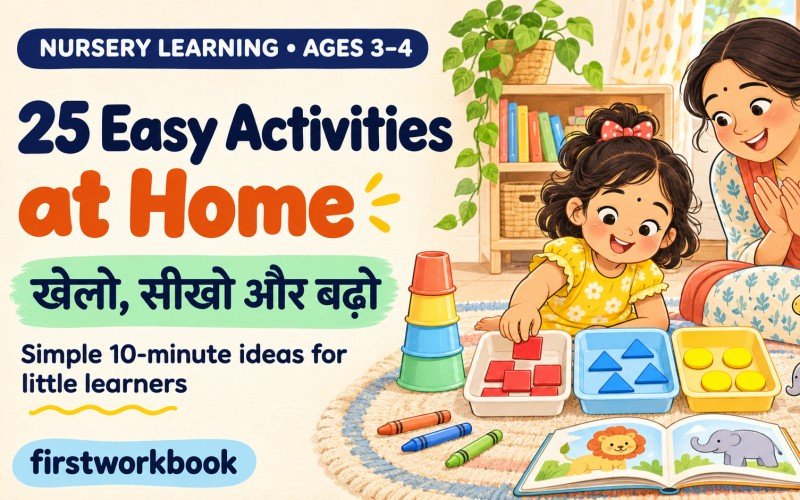
Try 25 easy nursery activities at home for ages 3 to 4: language, pre-writing, early maths, movement and pretend play, each designed for a simple 10-minute routine.
25 Learning Activities for Nursery Kids at Home: 10-Minute Ideas for Ages 3 to 4
Nursery learning is not supposed to look like a long school day at the dining table. At ages 3 and 4, children learn through movement, talk, play, repetition, and ordinary household moments. A child who sorts socks, hears a story twice, rolls dough into a snake, or notices birds on a walk is learning.
India’s National Curriculum Framework for the Foundational Stage describes a balance of free play, guided play, and structured play. That balance is useful at home too: give your child time to choose, join in with a small purpose, and keep any adult-led activity short enough to stay enjoyable.
This article offers 25 nursery activities at home, grouped by skill. Most need only paper, crayons, household objects, or your attention. Choose one or two a day; there is no need to do all of them.
A simple daily target: 10 minutes of a focused activity, a story or rhyme, some active play, and lots of conversation during normal routines is plenty for most nursery children.
What Do Nursery Children Need to Practise?
The goal is not to rush into pages of letters or sums. Nursery children benefit from opportunities to:
- listen and talk;
- notice colours, shapes, sounds, and patterns;
- strengthen fingers, hands, and whole-body movement;
- practise waiting, choosing, trying again, and tidying up;
- hear stories, rhymes, and new vocabulary;
- begin to recognise a few letters, numbers, and their own name when ready.
If your child is already at preschool, treat home activities as connection and reinforcement—not extra homework.
Language and Listening Activities
1. Picture Talk
Open any picture book, calendar, or magazine. Ask: “What can you see?” “What is the dog doing?” Follow your child’s interest and add one or two new words. You do not have to finish the page.
2. Rhyme Finish
Say a familiar rhyme and pause before the final word: “Twinkle, twinkle, little…” Let your child supply “star.” Hindi rhymes work just as well. Repetition is a feature, not a problem.
3. Sound Hunt
Pick a sound, such as /b/ or /m/. Walk around one room finding things that begin with it: ball, book, bag. Say the sound, not only the letter name.
4. Story Basket
Put three safe objects in a basket—a spoon, toy car, and scarf. Invite your child to make up a story. You can begin with one line: “एक दिन कार को एक चमच मिला…”
5. Follow-the-Instruction Game
Give playful two-step directions: “Touch the chair and clap twice.” Increase difficulty only when your child is enjoying it. This builds listening without feeling like a test.
Fine-Motor and Pre-Writing Activities
6. Sticker Roads
Draw a wide road, zigzag, or curve. Let your child place stickers along it. If you do not have stickers, use dots made with a crayon or small paper pieces and glue.
7. Play-Dough Snakes
Roll dough into long snakes, then bend them into circles, waves, or the first letter of a name. Supervise young children and use age-appropriate materials.
8. Clothespin Match
Clip clothespins around a cardboard circle or box edge. Add coloured dots so your child can match colour to colour. Opening the pin is excellent hand work; help if it is too stiff.
9. Tear-and-Paste Collage
Tear coloured paper into pieces and paste them inside a large outline of a fruit, fish, or house. Tearing is easier and safer than cutting for many nursery children.
10. Water Painting
Give your child a brush and a little water to “paint” a balcony floor, wall, or slate outdoors. They practise controlled strokes without worrying about a perfect picture.
11. Line Trails
Draw a few large vertical, horizontal, curved, and zigzag lines. Ask the child to drive a crayon “car” along each one. Begin with one line, not a crowded worksheet.
For more hand-strength and pencil-control ideas, visit our fine motor skills activities for preschoolers.
For colouring ideas suited to nursery children, from jumbo crayons to copy colouring, see our guide to colouring for kids.
Early Maths Activities
12. Sock Sorting
Ask your child to pair clean socks by colour, pattern, or size. Count each pair together. The learning is in noticing and explaining: “These two both have stripes.”
13. Snack Counting
Place three grapes, crackers, or pieces of fruit on a plate. Count slowly, touching one item for each number word. Never make food a reward or pressure point—keep it casual.
14. Cup Tower
Stack paper or plastic cups. Ask, “Which tower is taller?” “Can we make one with three cups?” This introduces comparing, counting, balance, and problem-solving.
15. Shape Walk
Look for circles, rectangles, and squares at home: a clock, door, window, plate. A triangle may be harder to find, so make one together with straws or sticks.
16. Spoon Sort
Mix two or three kinds of safe household items, such as large buttons, spoons, and blocks. Ask your child to sort by type, colour, or size. Talk about their rule.
17. Clap Patterns
Clap a pattern—clap, clap, tap—and invite your child to copy it. Then take turns leading. Patterns are early maths and a wonderful way to burn off a little energy.
Science, Senses, and the World Around Us
18. Sink or Float
With close supervision, fill a bowl with water and test a few safe objects: leaf, spoon, bottle cap, stone. Before each test, ask for a prediction: “What do you think will happen?”
19. Texture Detective
Find objects that are smooth, rough, soft, hard, warm, or cool. Let the child touch first, then choose a word. This is a language activity as much as a sensory one.
20. Seed to Sprout
Soak a bean or chana in cotton, keep it moist, and observe it daily. Draw or talk about what changes. Avoid promising an exact number of days; growth depends on the seed and conditions.
21. Weather Window
Each morning, look outside and choose a weather word: sunny, cloudy, rainy, windy. Add a simple drawing to a weekly chart. The chart is optional—the conversation is the important part.
Movement, Imagination, and Social Skills
22. Animal Moves
Call out an animal and copy its movement: hop like a frog, stomp like an elephant, stretch like a cat. Let your child choose animals too.
23. Obstacle Path
Use cushions, tape lines, or safe furniture spacing to make a short route: step over, crawl under, walk along. Stay nearby and remove anything that could slip or topple.
24. Pretend Shop
Set up empty packets, a basket, and a few play coins. Take turns being customer and shopkeeper. Children practise vocabulary, turn-taking, and simple number language.
25. Helper of the Day
Choose one small real job: put napkins on the table, water a plant, match lids, or place toys in a basket. Describe the work and thank the child. UNICEF India specifically encourages involving young children in everyday household activities; real responsibility can feel more meaningful than another craft.
An Easy Weekly Routine
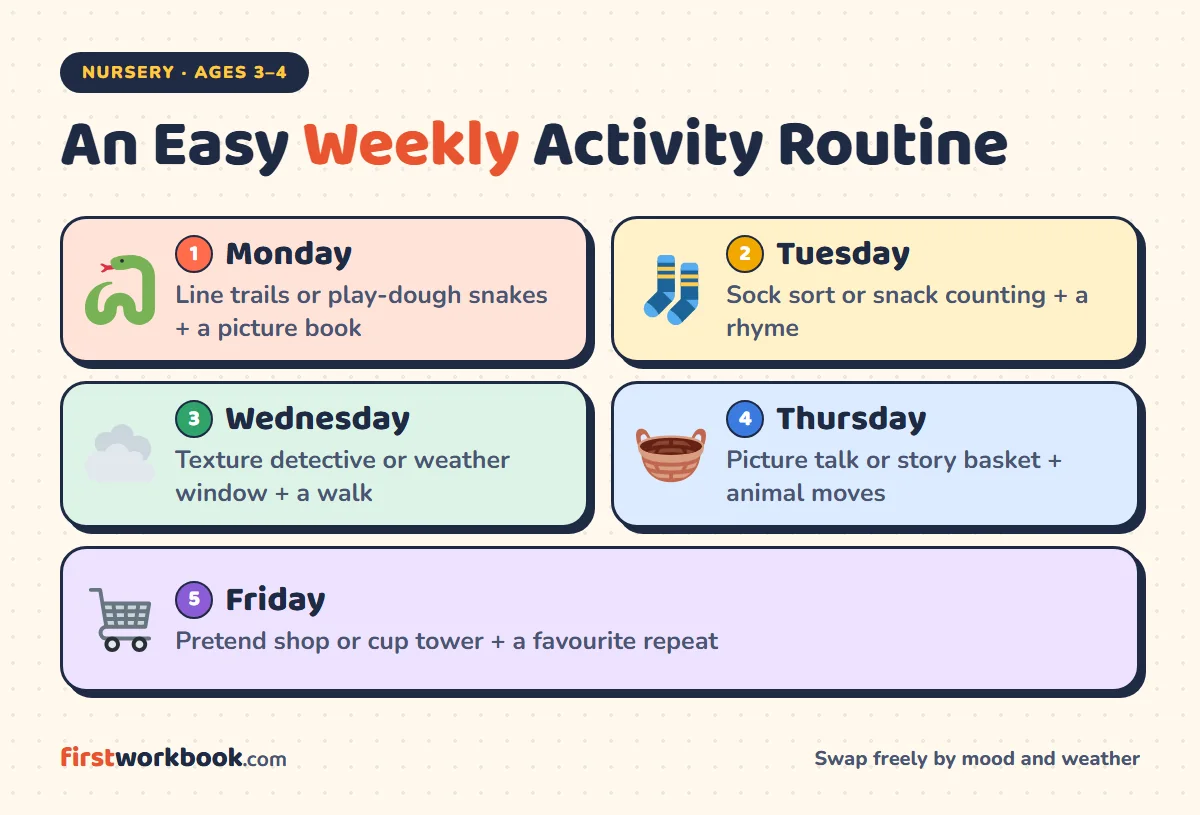
Use this only as inspiration. Swap activities freely according to materials, weather, and mood.
| Day | One focused activity | Add-on |
|---|---|---|
| Monday | Line trails or play-dough snakes | Read one picture book |
| Tuesday | Sock sort or snack counting | Sing a rhyme |
| Wednesday | Texture detective or weather window | Outdoor walk |
| Thursday | Picture talk or story basket | Animal moves |
| Friday | Pretend shop or cup tower | Let your child choose a favourite repeat activity |
Repeated activities are valuable. Children learn by doing the same thing with a little more independence each time.
How to Keep Activities Playful Instead of Stressful
Follow Your Child’s Lead
If your child turns a counting activity into a car game, join the car game and add counting naturally. The goal is engagement, not completing your original plan.
Offer Two Choices
“Would you like crayons or play dough?” gives a preschooler agency without making the day feel unstructured.
Make the Setup Small
Put out only what you need for one activity. A large pile of supplies can be overwhelming and increases clean-up friction.
End Before the Meltdown
Ten happy minutes are more useful than thirty difficult ones. Say, “We can do more tomorrow,” and finish with a clear tidy-up routine.
Avoid Worksheets as a Measure of Ability
A child may be able to name colours while refusing to colour inside a line; another may love tracing but not yet hold a conversation. Development is uneven. Watch progress over time rather than judging a single page.
When Should You Seek Extra Advice?
Every child develops differently. A teacher or qualified health professional can help if you are concerned about a child’s hearing, vision, movement, communication, loss of previously learned skills, or a persistent difficulty that affects everyday life. Seeking advice is not a label—it is a way to understand what support may help.
Frequently Asked Questions
How long should a nursery child do learning activities at home?
Aim for about 10 minutes of one adult-guided activity at a time, then move on. Some children will choose to continue; others will be ready to stop sooner. Both are normal.
What should a 3-year-old learn at home?
At 3, focus on language, play, movement, hand strength, everyday routines, colours, shapes, and simple counting. Formal writing and reading can wait until the child shows interest and readiness.
Should nursery children do worksheets every day?
No. A short worksheet can be useful for lines, matching, or colouring, but it should be one option among stories, outdoor play, conversation, hands-on sorting, art, and pretend play.
How can I teach a nursery child who does not sit still?
Use movement: animal walks, treasure hunts, chalk jumps, clapping patterns, and acting out stories. A child does not need to sit at a table to learn.
Where can I find simple practice pages?
Our Alphabet and Number Tracing Worksheets for Preschoolers guide explains how to use tracing gently. If your child enjoys short printable tasks, the Alphabet & Number Tracing Masterbook offers structured practice alongside pictures and warm-up lines.
The Bottom Line
The best nursery activities are ordinary, repeatable, and enjoyable enough to become part of family life. Talk while you cook. Count while you put toys away. Read the same book again. Let your child run, build, pretend, and help.
Those small moments build the foundations for later reading, writing, maths, independence, and confidence—without turning home into another classroom.
Research Behind This Guide
- National Curriculum Framework for Foundational Stage, Ministry of Education — play-based, child-centred learning at the Foundational Stage.
- UNICEF India: Early childhood development parenting — play, talking, stories, outdoor activity, routines, and involving children in household tasks.
- UNICEF: 21 learning activities for babies and toddlers — age-appropriate learning through everyday interaction and play.
About the author

Er. Deepak Maurya
Founder, FirstWorkbook
Er. Deepak Maurya founded FirstWorkbook in Varanasi to make activity workbooks that children enjoy. A web developer with 8 years of experience, he writes practical guides for parents on learning at home, and plans the activities in our workbooks together with pre-primary teachers.
Spotted a mistake or have a question? Write to us and we'll correct it.