English Grammar for Class 1: Topics, Examples and How to Teach at Home
In short
The full Class 1 English grammar topic list with child-friendly rules and examples, home activities, 7 games, common mistakes and a 4-week plan.
In Class 1, English grammar suddenly appears on the timetable. Your child comes home with words like “naming words”, “a or an” and “is, am, are”, and a worksheet that asks them to circle the noun. Many parents remember grammar as a list of rules to learn by heart, so they start with definitions. Six-year-olds do not learn that way.
This guide lists the grammar topics most Class 1 schools cover, explains each one in words a child understands, with examples, a quick home activity and the mistake to watch for. It ends with a 4-week plan, games and answers to the questions parents ask most.
What Is English Grammar for Class 1?
At Class 1 level, grammar simply means how words work together to make a sentence. A child learns that some words name things (nouns), some show actions (verbs), some describe (adjectives), and that small words like a, is and in have their own jobs.
The NCERT English textbook for Class 1, Mridang, was written for the new National Curriculum Framework for the Foundational Stage. It does not have separate grammar chapters. Grammar is picked up through stories, poems, talking and picture activities. Most private schools add a separate grammar book on top of it, so the topic list below is what you will usually see in a Class 1 grammar book or worksheet file.
The aim in Class 1 is use, not definitions. A child who says “She is my sister” and writes “I have a red ball.” correctly has learnt more grammar than a child who can recite “A noun is the name of a person, place, animal or thing” but writes “i has a apple”.
Class 1 English Grammar Topics (Full List)
Schools differ a little, but these topics appear in almost every Class 1 grammar syllabus. Teach them roughly in this order: each one builds on the one before.
| # | Topic | What your child learns | Example |
|---|---|---|---|
| 1 | Alphabetical order, vowels and consonants | ABC order; a, e, i, o, u are vowels | bat, cat, dog |
| 2 | Sentences | A sentence starts with a capital letter and ends with a full stop | The cat is black. |
| 3 | Nouns (naming words) | Names of people, animals, places and things | Riya, dog, park, bag |
| 4 | Common and proper nouns | Special names start with a capital letter | city – Delhi |
| 5 | Singular and plural | One and many | cup – cups, box – boxes |
| 6 | Gender | Masculine and feminine words | king – queen |
| 7 | Articles | a, an, the | a bus, an egg, the sun |
| 8 | Pronouns | Words used in place of nouns | I, we, you, he, she, it, they |
| 9 | is, am, are | Which helping word goes with whom | I am, he is, they are |
| 10 | has, have | Showing what someone owns | She has a doll. |
| 11 | Verbs (action words) | Words that show doing | run, eat, jump |
| 12 | Adjectives (describing words) | Colour, size, number, feeling | a big, red ball |
| 13 | Prepositions | Where something is | in, on, under, near |
| 14 | Opposites and rhyming words | Word pairs | hot – cold, cat – hat |
| 15 | this/that, these/those | Near and far | This is my pen. |
| 16 | and, but · was, were | Joining words; talking about the past (in some schools) | I was happy. |
If your child is in UKG, topics 1–9 and 11–13 are usually introduced in a very simple, picture-based way. In Class 2, the same topics come back with more rules (collective nouns, tenses, adverbs).
Each Topic Explained, With Examples
For each topic: the child-friendly rule, examples, a 5-minute activity and the mistake to watch for.
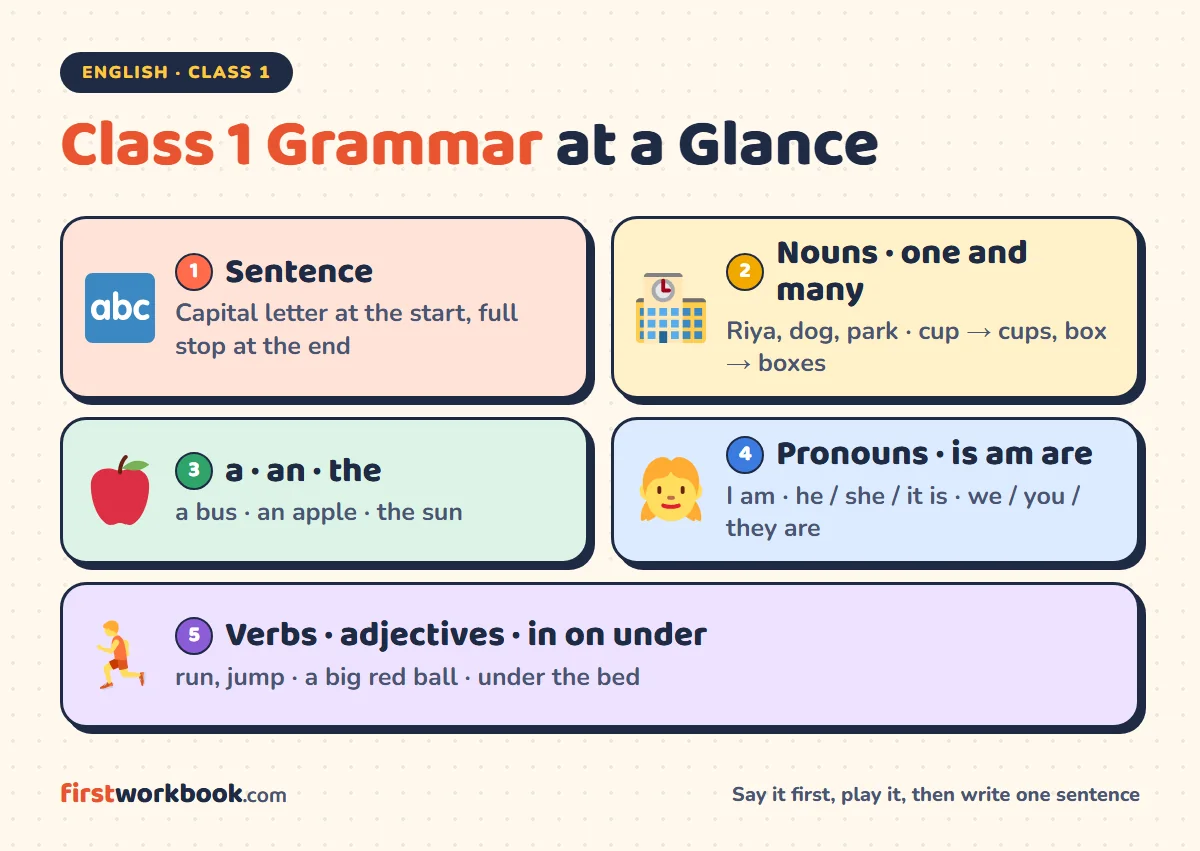
1. The sentence: capital letter and full stop
Rule for kids: “A sentence tells a full idea. It begins with a capital letter and ends with a full stop.”
Examples: The dog is sleeping. · I like mangoes.
Activity: Write 3 sentences with the capital and full stop missing (“my bag is blue”). Your child is the “sentence doctor” and fixes them with a coloured pencil.
Watch for: a small i for “I”. Teach early that I is always capital, even in the middle of a sentence.
2. Nouns – naming words
Rule for kids: “A noun is a naming word. It names a person, an animal, a place or a thing.”
Examples: Person – mother, doctor, Aman. Animal – cow, parrot. Place – school, market. Thing – pencil, kite.
Activity: Play “Noun Hunt”: in 2 minutes, your child touches 10 things in the room and names them. Then sort them into four columns: person, animal, place, thing.
Common vs proper: girl is a common noun; Meera is a proper noun and starts with a capital letter. Easy pairs: river – Ganga, city – Mumbai, festival – Diwali, day – Monday.
3. Singular and plural
Rule for kids: “One thing is singular. More than one is plural.”
- Most words add s: pen – pens, tree – trees.
- Words ending in s, sh, ch, x add es: bus – buses, dish – dishes, bench – benches, box – boxes.
- Consonant + y becomes ies: baby – babies, lady – ladies (but toy – toys, because o is a vowel).
- Special words to learn by heart: man – men, woman – women, child – children, tooth – teeth, foot – feet, mouse – mice.
Activity: Put 1 spoon and then 3 spoons on the table. “One spoon… three spoons.” Repeat with boxes and glasses so your child hears the extra “-es” sound.
4. Gender: masculine and feminine
Pairs most Class 1 books use: boy – girl, man – woman, father – mother, brother – sister, king – queen, uncle – aunt, son – daughter, prince – princess, lion – lioness, cock – hen. Make pair cards and play memory (turn two over; keep them if they are a pair).
5. Articles: a, an, the
Rule for kids: “Use an before a word that begins with a vowel sound (a, e, i, o, u). Use a before other sounds. Use the for one special thing we both know.”
Examples: a cat, a mango, an apple, an owl, an umbrella · the sun, the moon, the Taj Mahal.
Activity: Say a word aloud; your child claps once for “a” and twice for “an”. Saying the pair aloud (“an egg” vs “a egg”) helps them hear why an is easier to say.
Watch for: it is the sound that matters, not the letter. Older children will meet a uniform and an hour; in Class 1, stick to simple words.
6. Pronouns
Rule for kids: “A pronoun is a word we use instead of a naming word, so we don’t repeat it.”
Example: “Rohan is my friend. Rohan plays cricket.” becomes “Rohan is my friend. He plays cricket.”
Class 1 pronouns: I, we, you, he, she, it, they (and in some books my, his, her). Teach: he for a boy or man, she for a girl or woman, it for an animal or thing, they for many.
Activity: Point at family members and objects: “Papa?” – “He!”, “Didi?” – “She!”, “The fan?” – “It!”, “The shoes?” – “They!”
7. is, am, are
This is the topic Class 1 children get wrong most often, so practise it a lot, mostly by speaking.
- I → am (I am six.)
- He, she, it and one person or thing → is (The cat is sleepy.)
- We, you, they and many → are (The birds are flying.)
Activity: “Who am I?” – describe yourself with “I am…”, then a family member with “She is…”, then the family with “We are…”. Five sentences a day at dinner are enough.
8. has and have
I, we, you, they → have. He, she, it and one person → has. I have a pencil. Riya has a red bag. The dog has a long tail. Notice the pattern: the same words that take is also take has.
9. Verbs – action words
Rule for kids: “A verb is a doing word.” Examples: run, jump, eat, sing, write, sleep, read, clap.
Activity: Play “Simon Says” with verbs. Then reverse it: your child acts and you guess the verb. Later, ask “Who is doing it?” to link verbs with pronouns: “She is dancing.”
10. Adjectives – describing words
Rule for kids: “An adjective tells us more about a noun: its colour, size, shape, number or how it feels.”
Examples: a tall tree, two birds, a soft pillow, a sweet laddoo.
Activity: “Mystery bag”: put an object in a cloth bag; your child feels it and uses 3 describing words (round, hard, small) before guessing.
11. Prepositions – position words
In, on, under, behind, in front of, near, between. Hide a toy and let your child say where it is in a full sentence: “The teddy is under the bed.” This one topic also practises nouns, articles and is.
12. Opposites, rhyming words and this/that
Opposites (big – small, open – close, day – night) and rhyming words (cat – hat, sun – fun) are vocabulary topics that sit inside most grammar books. This/these are for things near you, that/those for things far away: “This is my book. That is a bird.”
How to Teach Grammar to a Class 1 Child at Home
Research on grammar teaching gives one clear message: grammar learnt as isolated rules and drills does little for children’s writing, but grammar taught inside real reading, talking and writing can help. In a large randomised controlled trial in England, Myhill and colleagues found that pupils whose grammar lessons were linked to their own writing made better progress in writing. Use that idea at home, in a way that suits a 6-year-old:
- Say it before you write it. Children learn grammar first by ear. If a sentence sounds right to them, they will write it right. Spend most of the time talking.
- Use real things. Nouns are the things on the table; prepositions are where the toy is hidden; adjectives are what the mango tastes like.
- One topic a week, 10 minutes a day. Short, daily practice works better than one long weekend session.
- Find it in a story. After you read a picture book, ask: “Find 3 naming words on this page,” or “Which word tells what the boy is doing?”
- Then write one sentence. End with one sentence of their own that uses the topic: “Write a sentence with an.” Check the capital letter and full stop every time.
- Use worksheets to check, not to teach. A worksheet is the last step, after talking and playing, to see what your child has understood.
- Correct by repeating, not by scolding. If your child says “He are going,” reply “Yes, he is going to school!” and move on. Children pick up the correct form when they hear it often.
7 Grammar Games for Class 1
- Noun Hunt: 10 naming words from the kitchen in 2 minutes.
- Sentence Doctor: fix sentences with missing capitals and full stops.
- Clap for a / an: one clap for a, two for an.
- Pronoun Point: point at a person or thing and shout the pronoun.
- Verb Charades: act an action word; others guess.
- Mystery Bag: 3 describing words before you guess the object.
- Where’s Teddy?: hide a toy and answer in a full sentence with in / on / under / behind.
A 4-Week Class 1 Grammar Plan
About 10–15 minutes a day, five days a week. Day 5 of each week is for one worksheet and a game.
| Week | Topics | Daily idea |
|---|---|---|
| Week 1 | Sentences, capital letters, nouns (common and proper) | Noun Hunt; Sentence Doctor; write 1 sentence about a family member |
| Week 2 | Singular/plural, gender, a/an/the | Count real objects; pair-card memory; Clap for a/an |
| Week 3 | Pronouns, is/am/are, has/have | Pronoun Point; 5 “I am / She is / We are” sentences at dinner |
| Week 4 | Verbs, adjectives, prepositions | Verb Charades; Mystery Bag; Where’s Teddy?; describe a picture in 3 sentences |
At the end of the month, ask your child to describe a picture in 4–5 sentences. You will see nouns, adjectives, is/are and prepositions all working together. That is the real test. For the next step, read our guide to picture composition for Class 1.
Common Mistakes Class 1 Children Make (and Quick Fixes)
| Mistake | Correct | Quick fix |
|---|---|---|
| i like milk. | I like milk. | “I” is always a capital letter. |
| a apple, a egg | an apple, an egg | Say both aloud; “an” is easier before a vowel sound. |
| They is playing. | They are playing. | Many → are. Count: one or many? |
| She have a cat. | She has a cat. | The “is” words (he, she, it) also take “has”. |
| two box, three childs | two boxes, three children | Learn the -es rule and the special words. |
| my friend name is rahul | My friend’s name is Rahul. | Names start with a capital letter. |
| No full stop | …ends with a full stop. | Make “dot at the end” a habit for every sentence. |
Free Grammar Worksheets and Workbooks
Once a topic has been practised by talking and playing, a worksheet shows you what your child has really understood. Our free printable worksheets cover nouns, singular and plural, a and an, pronouns, is, am, are, verbs, adjectives, in, on, under, masculine and feminine and punctuation. All grammar sets are in one place under grammar worksheets.

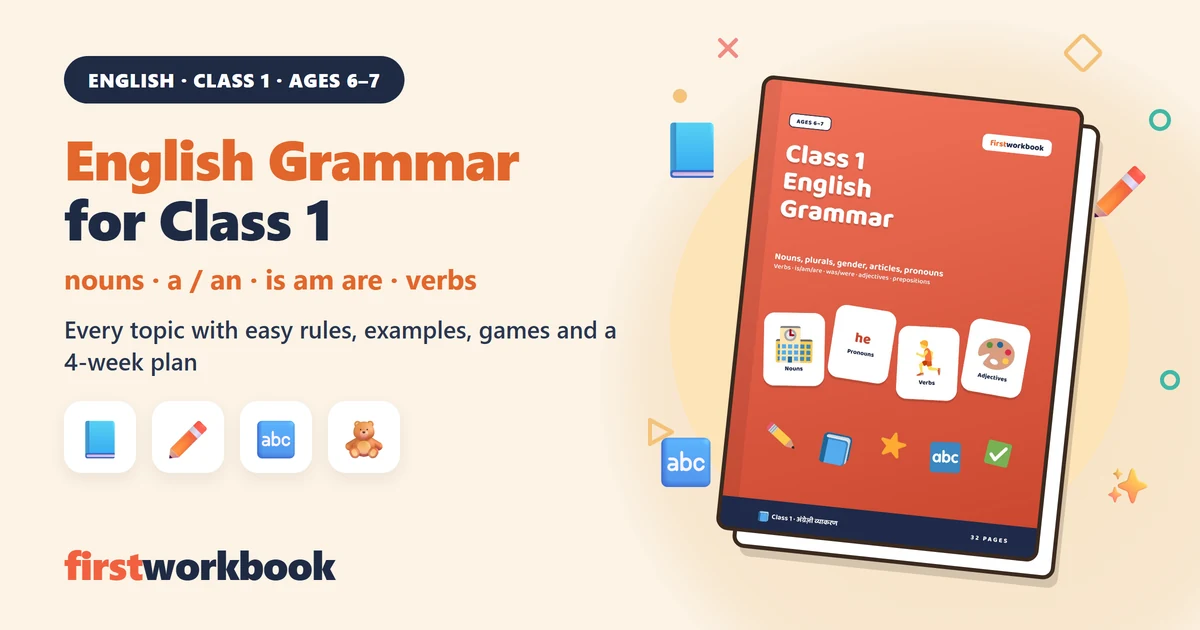
If you prefer one book for the whole year, the Class 1 English Grammar Workbook covers these topics: each topic page has a simple Learn box and graded exercises, and the book has 2 tests and an answer key. The same series has a UKG, Class 2 and Class 3 book, so your child can move up one level at a time. For reading practice alongside grammar, see the English Reading Comprehension book or all Class 1 books.
For a full list of opposites with Hindi meanings, games and worksheets, see 100 opposite words for kids. For every Class 1 subject, read our Class 1 syllabus guide.
हिंदी में सार (Summary in Hindi)
Class 1 में English grammar का मतलब है – शब्द मिलकर वाक्य कैसे बनाते हैं। इस उम्र में बच्चे को परिभाषाएँ (definitions) रटाने की ज़रूरत नहीं है; ज़रूरी है कि वह सही वाक्य बोले और लिखे। ज़्यादातर स्कूलों में ये topics पढ़ाए जाते हैं: sentence (capital letter और full stop), noun (naming words), singular–plural, gender, a/an/the, pronoun (I, he, she, it, they), is/am/are, has/have, verb (action words), adjective (describing words) और in/on/under जैसे prepositions।
घर पर रोज़ 10–15 मिनट काफ़ी हैं। हर हफ़्ते एक topic लें: पहले बोलकर और खेल के ज़रिए सिखाएँ (Noun Hunt, Verb Charades, Where’s Teddy?), फिर कहानी में वही शब्द ढूँढें, और आख़िर में बच्चा अपना एक वाक्य लिखे। Worksheet सिर्फ़ यह देखने के लिए दें कि बच्चे ने क्या समझा। गलती होने पर डाँटें नहीं, बल्कि सही वाक्य दोहरा दें – जैसे बच्चा कहे “He are going”, तो आप कहें “Yes, he is going!”।
Frequently Asked Questions
What grammar is taught in Class 1 English?
Most schools cover sentences with capital letters and full stops, nouns (common and proper), singular and plural, gender, articles a/an/the, pronouns, is/am/are, has/have, verbs, adjectives, prepositions (in, on, under), opposites and this/that. Some also introduce was/were and joining words like and/but.
Does the NCERT Class 1 English book have grammar?
The NCERT Class 1 English textbook, Mridang, has no separate grammar chapters. Grammar is built into its stories, poems and activities. Many schools add a separate grammar book or worksheets.
How do I teach nouns to a Class 1 child?
Start with real objects: let your child name 10 things in a room, then sort them into person, animal, place and thing. Next, find naming words in a storybook, and finally write a sentence using two nouns. Proper nouns (names like Meera or Delhi) come after, with the capital-letter rule.
When should I use “a” and when “an”?
Use “an” before a word that begins with a vowel sound (an apple, an egg, an owl) and “a” before other sounds (a ball, a kite). It is the sound, not the letter, that decides, which is why we say “an hour” but “a uniform”.
How much time should a Class 1 child spend on grammar every day?
About 10–15 minutes a day is enough, mostly as talk and games, with one short worksheet or one written sentence at the end. Daily short practice works better than a long session once a week.
My child knows the rules but still writes wrong sentences. Why?
Knowing a rule and using it are different skills. Ask your child to write one or two sentences of their own every day and check them together for capital letters, full stops and is/are. Speaking the sentence aloud before writing it also helps.
Research Behind This Guide
- Myhill, Jones, Lines and Watson (2012), Re-thinking grammar: the impact of embedded grammar teaching on students’ writing, Research Papers in Education: a randomised controlled trial in which grammar taught in the context of writing improved pupils’ writing.
- Wyse et al. (2025), trial of a grammar programme with 6–7-year-olds, Journal of Writing Research: found no effect of separate grammar lessons on children’s narrative writing, a reminder to keep grammar tied to real reading and writing.
- NCERT, Teachers’ Handbook for Classes 1 and 2: the foundational-stage approach in which language is learnt through stories, rhymes, talk and activities.
- Class 1 grammar syllabus lists from Indian schools, for example Don Bosco Liluah’s Class 1 English syllabus (2026–27), used for the topic list above.
Free Worksheets to Practise This
Printable A4 PDFs, free to download. Pick a set and print it at home or school.
About the author

Er. Deepak Maurya
Founder, FirstWorkbook
Er. Deepak Maurya founded FirstWorkbook in Varanasi to make activity workbooks that children enjoy. A web developer with 8 years of experience, he writes practical guides for parents on learning at home, and plans the activities in our workbooks together with pre-primary teachers.
Spotted a mistake or have a question? Write to us and we'll correct it.