Best Workbooks for Kids Aged 3 to 5: A Parent's Complete Guide

In short
Choosing the right workbook for your preschooler can feel overwhelming. This guide breaks down what to look for — and which types of books deliver the best results for ages 3–5.
Walking into an educational bookstore or scrolling through digital marketplaces presents modern parents with an overwhelming abundance of early childhood workbooks. Shelves and catalogs boast hundreds of titles featuring brightly colored covers, popular cartoon characters, and glowing promises of early academic brilliance. Yet, many well-meaning parents discover a frustrating reality shortly after purchase: within two or three days, the expensive activity book is abandoned, tears erupt over frustrating handwriting lines, or the child refuses to open the pages altogether.
The problem is rarely the child’s capability or willingness to learn. Rather, the market is saturated with poorly designed workbooks that ignore the fundamental stages of early pediatric biomechanics and cognitive development. Some books introduce complex handwriting before intrinsic hand muscles have developed; others rely on repetitive, monotonous drills that extinguish natural childhood curiosity.
This comprehensive, definitive guide cuts through commercial marketing hype. Rooted in developmental pediatric principles, Montessori sensorimotor pedagogy, and foundational early childhood curricula (CBSE, ICSE, and international frameworks), this handbook details exactly what to look for, what critical red flags to avoid, developmental milestone progressions, and how to use workbooks at home to build authentic, joyful confidence in children aged 3 to 5 (Nursery, LKG, and UKG).
The Pedagogical Science of Early Paper-and-Pencil Learning
In an era dominated by interactive digital tablets and touchscreens, parents frequently ask: "Why do physical paper workbooks remain indispensable for preschoolers?" Neurological and developmental research provides unambiguous answers.
1. Palmar Arches and Hand Muscle Architecture
When an adult grips a pen, they utilize a dynamic tripod grasp, coordinating the thumb, index finger, and middle finger while the pinky side of the hand rests stably on the paper. A three-year-old child, however, does not possess this fine-motor muscular architecture. The human hand contains 27 small bones and dozens of intrinsic muscle fibers that ossify and strengthen gradually between birth and age seven.
Swiping a flat glass screen requires zero finger resistance. In contrast, gripping an ergonomic crayon or triangular pencil against tactile paper provides authentic friction and sensory resistance. This resistance exercises the adductor pollicis, lumbricals, and interossei muscles, building the finger-arch strength necessary for lifelong writing stamina, precision cutting, and musical dexterity.
2. Spatial Tracking and Proprioceptive Mapping
Before a young child can write a single letter like 'A' or number like '4', their visual-spatial system must master two-dimensional orientation. They must comprehend abstract spatial concepts: top-to-bottom, left-to-right, inside versus outside, and diagonal convergence. High-quality physical workbooks provide physical boundaries—bordered boxes, dashed guiding paths, and tactile page margins—that train optical tracking and ocular muscle coordination far more effectively than infinitely scrolling screen displays.
3. Tangible Self-Efficacy and the Psychology of Completion
Child psychologists emphasize the profound psychological value of tangible achievement. When a four-year-old completes a paper worksheet, colors in the illustration, and receives a physical star, they experience a concrete sense of agency. The completed paper can be held, displayed upon the refrigerator, shown to grandparents, and archived in a keepsake folder. Digital apps, with endless animations and pop-ups, offer superficial entertainment but lack this lasting sense of physical craftsmanship.
Developmental Milestones: What Skills to Target by Exact Age
| Age Level | Stage / Class Equivalent | Fine Motor & Hand Milestones | Core Curricular Objectives |
|---|---|---|---|
| Age 3 (36–48 Months) | Playgroup / Nursery | Fisted grasp transitioning to digital pronate grasp; hand dominance emerging | Pre-writing paths (vertical, horizontal, curved), shape matching, colors, numbers 1–5, body parts |
| Age 4 (48–60 Months) | Lower Kindergarten (LKG) | Static tripod grasp developing; scissor cutting along straight lines | Uppercase English alphabet (A–Z), numbers 1–20, phonological beginning sounds, Hindi Varnamala recognition (Swar) |
| Age 5 (60–72 Months) | Upper Kindergarten (UKG) | Dynamic tripod grasp maturing; precise cut-and-paste manipulation | Lowercase alphabet (a–z), 3-letter CVC word blending, single-digit addition, basic Hindi Vyanjan, logic patterns |
What Makes a Truly Exceptional Preschool Workbook?
1. Progressive Scaffolding (The Rule of Incremental Mastery)
An exceptional workbook never throws a child directly into tracing complex letters. Letter formation must be systematically scaffolded:
- Phase 1: Pre-Writing Strokes. Broad tracing paths featuring thick lines—straight standing lines, sleeping lines, slanting diagonals, zigzag mountains, and sweeping waves.
- Phase 2: Closed Geometric Enclosures. Circles, squares, and triangles that teach the child to stop their pencil stroke precisely at a junction point.
- Phase 3: Broad Letter Paths with Directional Guides. Letters with visual indicators: a solid green circle indicating the starting point, directional arrows guiding movement, and a red stop dot.
- Phase 4: Dotted Outlines to Independent Production. Fading the density of dots from fully connected lines to three landmark dots, guiding the child toward autonomous writing.
2. Generous White Space and Visual Breathing Room
Young eyes are easily overwhelmed by visual crowding. Poorly formatted workbooks pack six different exercises and ten cramped illustrations onto a single page to save printing costs. Exceptional books dedicate ample whitespace around every exercise. One primary activity per page—accompanied by bold, clear borders—allows the child's attention to settle without cognitive overload.
3. Multimodal Engagement: Variety Within Each Session
Preschoolers learn through multiple sensory channels. A superior workbook balances different motor actions across consecutive sheets. After completing a fine-motor tracing sheet, the subsequent page should feature a coloring exercise, followed by a cut-and-paste sorting challenge or a visual maze. This alternating structure prevents muscular cramping and keeps cognitive engagement fresh.
4. Cultural Relevance and Relatable Iconography
For children growing up in India and South Asia, contextual imagery matters significantly. While understanding global animals is valuable, early phonics and general knowledge books that depict familiar local fruits (mangoes, guavas), cultural festivals (Diwali, Eid, Pongal), and recognizable everyday environments foster immediate conceptual connection and linguistic relevance.
Critical Red Flags: What Parents Must Avoid
- Tiny, Cramped Line Spacing: Standard four-line notebooks designed for primary school students are completely inappropriate for 3- and 4-year-olds. Preschoolers require extra-large ruling (at least 20mm to 25mm line height) to accommodate their emerging motor coordination.
- Endless Repetitive Mechanical Drills: Pages containing thirty identical lines of the letter 'B' do not build writing skills; they build profound resentment toward books. Quality always supersedes quantity: writing five beautifully formed letters with full mindful concentration is infinitely superior to scribbling fifty rushed repetitions.
- Excessive Explanatory Text for the Child: Preschoolers cannot read complex instructional paragraphs. Instructions should be concise, visually intuitive, and accompanied by symbolic cues (an eye icon for 'Look', a scissors icon for 'Cut', a pencil icon for 'Trace').
- Flimsy, Low-Opacity Paper: Young children exert significant physical downward pressure with crayons and pencils. Ultra-thin paper tears easily and allows ink to bleed through, causing intense frustration. Opt for workbooks with heavy, durable paper stock (minimum 80–100 GSM).
Subject-by-Subject Breakdown for the 3–5 Age Group
1. Pre-Writing and English Literacy
Begin with uppercase letters. Neurologically, capital letters consist primarily of simple straight lines and large curves (e.g., L, T, H, E, F) which align naturally with early motor milestones. Introduce lowercase letters only after uppercase mastery is established. Phonics instruction should link letter shapes directly to phonemes using vibrant, memorable visual anchors (such as "S slithers like a Snake").

2. Early Mathematical Concepts and Number Sense
Avoid workbooks that treat math solely as numeral tracing. Genuine early numeracy requires connecting three distinct components:
- The concrete quantity (counting four physical apples)
- The verbal number word (hearing and pronouncing "four")
- The abstract numeral symbol (identifying and tracing the digit "4")
Look for pages featuring "count and circle", "match numeral to quantity", and geometric pattern continuation (e.g., circle, square, circle, ?).
3. Hindi Varnamala and Mother-Tongue Foundations
Hindi script (Devanagari) presents unique, beautiful geometric challenges: intricate top-hanging lines (Shirorekha), distinct loops, and subtle tonal curves. High-quality Hindi workbooks begin with broad, playful Swar tracing (अ से अः) before advancing to Vyanjan (क से ज्ञ). Ensure the workbook provides step-by-step stroke orders to establish proper writing flow early.
4. Cognitive Logic and Visual Discrimination
Critical thinking can and should be practiced without words. Maze navigation develops visual foresight and pen control; "spot the difference" puzzles sharpen focus on subtle details; and "odd-one-out" exercises build categorical reasoning.
How to Implement Workbook Time at Home: A Parent's Practical Guide
The Golden Rule: Two Pages Per Day, Five Days Per Week
The most common parent pitfall is bingeing through fifteen pages in an enthusiastic afternoon, causing burnout. Limit workbook time strictly to two or three pages per day (approximately 15 to 20 minutes maximum). Always stop while the child is still enjoying the activity. Ending on an energetic high note leaves the child eagerly anticipating tomorrow’s session.
The "Crayon-First" Approach
Never hand a standard thin #2 graphite pencil to a three-year-old. Begin with thick, triangular beeswax crayons or chubby washable markers. Triangular grips naturally position little fingers into an ergonomic tripod grip without requiring awkward rubber accessories. Transition to triangular beginner pencils only around age 4.5 to 5.
Celebrate Effort Over Mechanical Perfection
When reviewing completed pages, refrain from red-pen corrections or demanding that wobbly lines be erased and redrawn. Constant erasing destroys confidence and teaches perfectionist paralysis. Instead, ask the child to evaluate their own work: "Which of these three circles do you think looks the roundest? Let us draw a little smiley face next to your favorite one!" This builds intrinsic motivation and self-assessment.
The Ergonomics of Early Writing: Posture, Grip, and Paper Angle
Often, a child's resistance to workbooks is caused not by cognitive difficulty, but by subtle physical discomfort. When little bodies are improperly positioned, fatigue sets in within minutes, leading to slumped postures and frustration.
1. The 90-90-90 Seating Rule
Ensure your preschooler's desk setup adheres to the fundamental biomechanical standard:
- Hips bent at a 90-degree angle against the back of a firm chair.
- Knees bent comfortably at a 90-degree angle.
- Feet resting firmly flat at a 90-degree angle on a supportive footrest or floor.
When feet dangle unsupported, the child's core stability collapses, forcing the shoulder and wrist muscles to overcompensate. Sturdy foot support immediately improves hand stability and pen control.
2. Dynamic Tripod Grip Milestones
Do not force a three-year-old into an adult tripod pencil grip prematurely. Hand development progresses through clear biomechanical stages:
- Cylindrical Grasp (1–2 years): The entire fist wraps around the marker, utilizing whole-arm movements from the shoulder.
- Digital Pronate Grasp (2–3 years): Fingers point downward toward the paper, powered primarily by elbow movement.
- Static Tripod Grasp (3.5–4.5 years): Three fingers hold the utensil, but hand movements remain rigid and powered by the wrist.
- Dynamic Tripod Grasp (4.5–6 years): The thumb, index, and middle finger move independently with fluid, localized dexterity.
Utilizing chubby triangular crayons naturally bridges the transition from digital pronate to static tripod grip without adult reprimands.
Weekly Subject Rotation Framework for Nursery, LKG, and UKG
To prevent burnout and maintain broad developmental progress, avoid drilling the same subject every single day. A balanced weekly rotation creates excitement through anticipation:
| Day of Week | Primary Focus Module | Secondary Complementary Module | Daily Target Duration |
|---|---|---|---|
| Monday | English Pre-Writing & Letter Tracing | Freehand Coloring within Bold Outlines | 15 minutes |
| Tuesday | Number Sense & Quantity Counting | Pattern Identification & Mazes | 15 minutes |
| Wednesday | Hindi Varnamala (Swar / Vyanjan) | Sensory Playdough Letter Shaping | 15 minutes |
| Thursday | General Knowledge (Animals, Fruits, Seasons) | Cut-and-Paste Matching Activities | 15 minutes |
| Friday | Fine Motor Logic & Spot-the-Difference | Creative Drawing & Story Prompt | 15 minutes |
| Weekend | Review Favorite 2 Pages of the Week | Shared Bedtime Storybook Reading | 10 minutes |
Frequently Asked Questions (FAQs)
Q1: My 4-year-old is left-handed. Do they need specialized workbooks?
While left-handed children do not necessarily require separate workbooks, they need thoughtful environmental adaptations. Ensure the sample letters are visible on both the left and right sides of the line, as left-handed writers frequently obscure the left margin with their writing hand. Teach them to angle the paper slightly clockwise to prevent wrist strain.
Q2: Should I force my child to practice workbooks if they show zero interest?
Never force or punish. Resistance at age 3 or 4 typically signals that the workbook is misaligned with their motor readiness or that sessions are too long. Step back to open-ended playdough sculpting, finger painting, and outdoor chalk drawing for two weeks to rebuild hand strength before gently reintroducing short, 5-minute workbook games.
Q3: What are the advantages of printable PDF workbooks over bound paperback books?
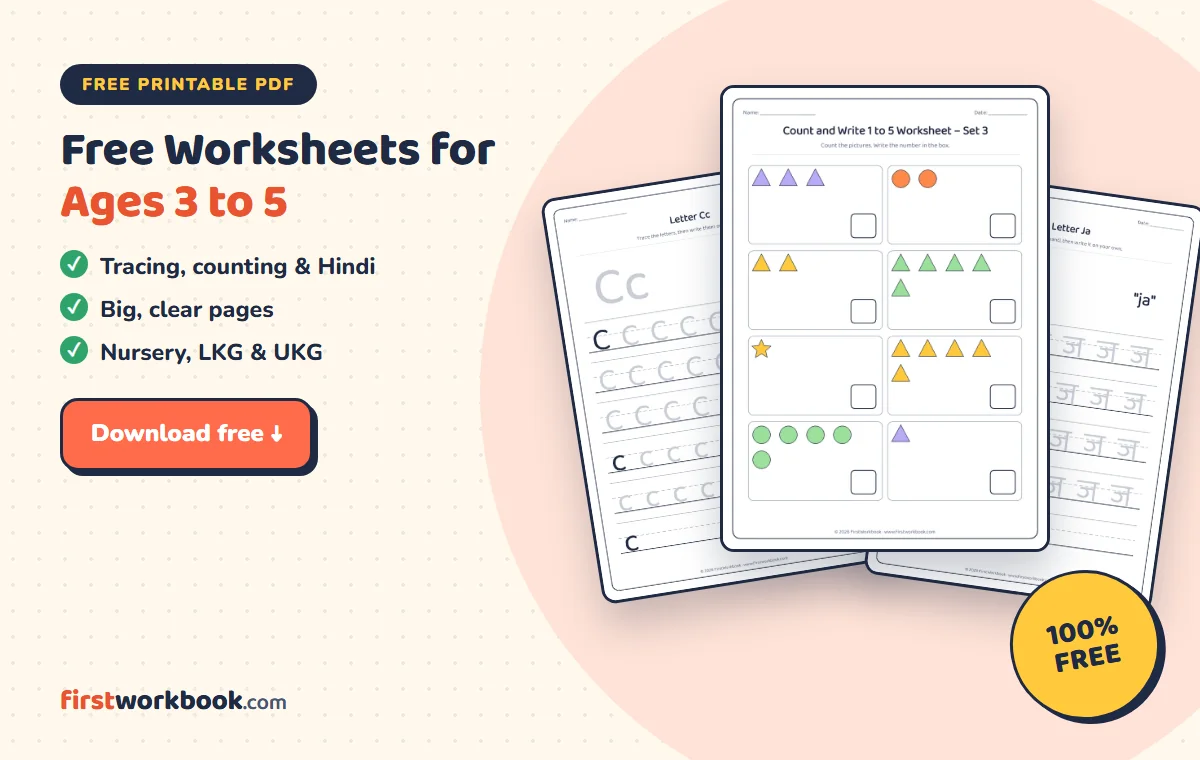
Printable PDF workbooks—such as those created by FirstWorkbook—offer immense practical advantages. Bound books cannot be repeated once written in. With digital printables, parents can print specific pages multiple times, allowing children to practice challenging skills until mastered. Additionally, you can print only the exact two pages needed for today's session, completely eliminating the intimidating bulk of a thick book.
Conclusion: Setting the Stage for a Lifelong Love of Learning
The early preschool years are not a competitive race to academic perfection; they are a tender, foundational window for building curiosity, focus, and self-belief. When you select workbooks thoughtfully designed for little hands and developing minds, daily practice becomes a joyful bonding ritual rather than a chore.
Choose quality over quantity, embrace wobbly first strokes with warm praise, and provide your preschooler with the physical, tactile tools they need to flourish.
Explore FirstWorkbook's collection of printable preschool workbooks—expertly crafted for Nursery, LKG, and UKG students across English, Hindi, Mathematics, and Cognitive Reasoning.
About the author

Er. Deepak Maurya
Founder, FirstWorkbook
Er. Deepak Maurya founded FirstWorkbook in Varanasi to make activity workbooks that children enjoy. A web developer with 8 years of experience, he writes practical guides for parents on learning at home, and plans the activities in our workbooks together with pre-primary teachers.
Spotted a mistake or have a question? Write to us and we'll correct it.