Abacus for Kids: How It Works, Right Age and How to Start at Home
In short
What an abacus is, how to read numbers on it, the right age to begin, what research with Indian school children found, and the first formulas (small friends and big friends) with a 4-week home plan.
A friend’s child adds five numbers in her head faster than you can type them into a phone. “Abacus class,” says the parent. Now you are wondering: what exactly is an abacus, is your child the right age, does it really help, and could you start at home before paying for a course?
This guide answers those questions plainly. You will learn how the abacus works, how to read numbers on it, the right age to begin, what a large study with Indian school children actually found, the first formulas (small friends and big friends) with worked examples, and a 4-week plan to start at home.
What Is an Abacus?
An abacus is a counting frame with beads that slide on rods. People have used counting frames for many centuries, long before paper sums and calculators. The kind used in children’s abacus classes today is the Japanese soroban, a slimmer version of the older Chinese abacus.
On a soroban every rod has one bead above the bar and four beads below it. The upper bead is worth 5. Each lower bead is worth 1. With these five beads a rod can show any digit from 0 to 9, and each rod stands for one place value: ones, tens, hundreds and so on.
That is the whole idea. A child who uses an abacus is not doing a trick; they are moving tens and ones with their fingers. After enough practice they can picture the beads and move them in the mind. This is called mental abacus or mental maths.
Parts of the Abacus
- Frame: the outer box that holds everything.
- Beam (bar): the strip across the middle. A bead counts only when it touches the beam.
- Rods: the upright sticks. Each rod is one place: ones, tens, hundreds. A student abacus usually has 13 or 17 rods.
- Upper bead: one on each rod, above the beam. Worth 5 when pushed down to the beam.
- Lower beads: four on each rod, below the beam. Worth 1 each when pushed up to the beam.
- Dots on the beam: small marks on every third rod. Pick one dotted rod as your ones rod; the rod to its left is tens.
When no bead touches the beam, the abacus shows zero. Sliding all beads away from the beam is called clearing the abacus, and every sum starts with it.
How to Read Numbers on the Abacus
To show a digit, push beads towards the beam. Lower beads go up; the upper bead comes down.
| Digit | Upper bead (5) | Lower beads (1 each) | How to think of it |
|---|---|---|---|
| 0 | away | none | nothing touches the beam |
| 1 | away | 1 up | 1 |
| 2 | away | 2 up | 1 + 1 |
| 3 | away | 3 up | 1 + 1 + 1 |
| 4 | away | 4 up | 1 + 1 + 1 + 1 |
| 5 | down | none | 5 |
| 6 | down | 1 up | 5 + 1 |
| 7 | down | 2 up | 5 + 2 |
| 8 | down | 3 up | 5 + 3 |
| 9 | down | 4 up | 5 + 4 |
Two-digit numbers use two rods. For 27, push 2 lower beads up on the tens rod, and on the ones rod bring the upper bead down and push 2 lower beads up (5 + 2). For 60, the tens rod shows 6 (upper bead and 1 lower bead) and the ones rod stays clear.
Notice that a child reading 27 on the abacus is seeing “2 tens and 7 ones” with their own eyes. This is why the abacus sits so well beside school place value.
What Is the Right Age to Start Abacus?
Most abacus institutes in India take children from about 5 or 6 years, and many children start between 6 and 8. There is no research that fixes one best age; the range comes from teaching experience. What matters more is whether your child is ready:
- They can count, read and write numbers up to 99.
- They understand that 5 is 3 and 2, and that 10 is 6 and 4, with objects or fingers.
- They can do simple sums such as 4 + 3 and 9 − 2.
- They can sit with one activity for 10 to 15 minutes.
- Their fingers are steady enough to move one small bead at a time.
If your child is 4 or younger, do not rush. Counting games, number writing and pencil control will do more good now, and the abacus will come easily later. Our guide to building number confidence covers that stage. Starting at 9 or 10 is also perfectly fine; older children simply move through the early levels faster.
Does Abacus Really Help? What the Research Says
Abacus advertisements promise sharper memory, better concentration and “whole brain development”. The research is more modest, and more useful.
The strongest study so far was done in India. Researchers from the University of California, Harvard and Stanford followed 204 children at a school in Vadodara, Gujarat, for three years, starting when they were 5 to 7 years old. Half the children were chosen at random to learn abacus and mental abacus for three hours a week. The other half spent the same three hours on extra practice from a regular maths textbook. The results were published in the journal Child Development in 2016.
- Arithmetic improved. The abacus group did better than the textbook group on calculation: addition, subtraction, multiplication and division.
- General brain power did not change. Abacus training did not raise scores on tests of working memory or reasoning. The study found no “smarter brain” effect.
- Children differed. Those who began with stronger spatial memory (remembering where things are) gained the most. Others gained about as much as they would from the same hours of ordinary maths practice.
- It took time. The children had more than 100 hours of teaching over the three years.
Other, smaller studies do report better attention or memory in children who learn abacus, but they are less rigorous. A fair summary for parents: abacus is a good way to build fast, accurate calculation and a feel for place value, if your child enjoys it and practises regularly. It is not a shortcut to a higher IQ, and it does not replace school maths, which also includes word problems, shapes, measurement and reasoning.
Finger Rules: How to Move the Beads
Abacus teachers are strict about fingers from day one, because correct fingering is what makes speed possible later. The usual rules are:
- Thumb: pushes lower beads up to the beam (adding 1, 2, 3 or 4).
- Index finger: pushes lower beads down away from the beam, and moves the upper bead both ways.
- Other hand: holds the frame steady. Many classes later teach children to use both hands.
- Clear first: before every sum, run a finger along the beam so no bead touches it.
- Left to right: set and add numbers from the tens rod to the ones rod, the same way we read them.
Some institutes teach small variations. If your child later joins a class, follow that teacher’s fingering.
Abacus Level 1: First Steps at Home
Abacus courses are divided into levels, usually eight to ten, each taking around three months. Level 1 is always the same set of ideas, and you can teach it at home in this order.
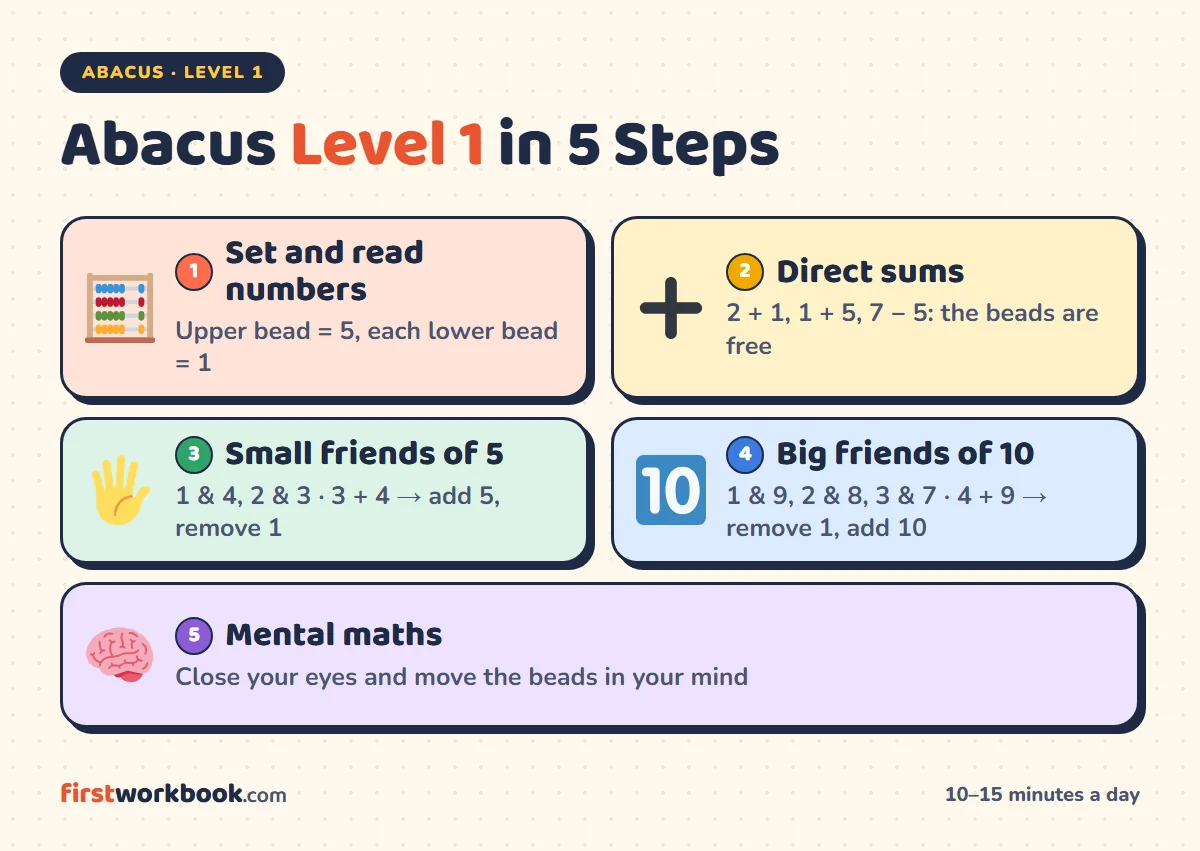
Step 1: Set and read numbers
Call out a number from 0 to 9 and let your child show it on the ones rod. Then do the reverse: you set the beads and they read the number. Move on to two-digit numbers up to 99. Spend a full week here.
Step 2: Direct adding and taking away
“Direct” sums are those where the beads you need are free to move.
- 2 + 1: set 2, push one more lower bead up. Answer 3.
- 1 + 5: set 1, bring the upper bead down. Answer 6.
- 7 − 5: set 7, push the upper bead away. Answer 2.
- 23 + 51: set 23. Add 5 on the tens rod (upper bead down), add 1 on the ones rod. Answer 74.
Step 3: Small friends of 5
Now try 3 + 4. Three lower beads are up and only one is left, so you cannot push up four more. The answer is to use the 5 bead. Two numbers that make 5 are called small friends: 1 and 4, 2 and 3.
| To add | Do this | To take away | Do this |
|---|---|---|---|
| + 1 | add 5, remove 4 | − 1 | add 4, remove 5 |
| + 2 | add 5, remove 3 | − 2 | add 3, remove 5 |
| + 3 | add 5, remove 2 | − 3 | add 2, remove 5 |
| + 4 | add 5, remove 1 | − 4 | add 1, remove 5 |
- 3 + 4: set 3. Bring the upper bead down (+5) and push one lower bead away (−1). The rod shows 5 + 2 = 7.
- 6 − 4: set 6. Push one lower bead up (+1) and the upper bead away (−5). The rod shows 2.
Use a small-friend formula only when the direct move is not possible. For 2 + 1 there is still a free lower bead, so simply push it up.
Step 4: Big friends of 10
Next try 4 + 9. The ones rod cannot hold 13. Two numbers that make 10 are called big friends: 1 and 9, 2 and 8, 3 and 7, 4 and 6, 5 and 5. To add a number, take away its big friend from the ones rod and add one bead on the tens rod.
| To add | Do this | To take away | Do this |
|---|---|---|---|
| + 9 | remove 1, add 10 | − 9 | remove 10, add 1 |
| + 8 | remove 2, add 10 | − 8 | remove 10, add 2 |
| + 7 | remove 3, add 10 | − 7 | remove 10, add 3 |
| + 6 | remove 4, add 10 | − 6 | remove 10, add 4 |
| + 5 | remove 5, add 10 | − 5 | remove 10, add 5 |
- 4 + 9: set 4. Push one lower bead away on the ones rod (−1), then push one lower bead up on the tens rod (+10). The abacus shows 13.
- 9 + 6: set 9. Push four lower beads away (−4), then add one bead on the tens rod. The abacus shows 15.
- 13 − 9: set 13. Push the tens bead away (−10), then push one lower bead up on the ones rod (+1). The abacus shows 4.
If you look closely, big friends are the same “making ten” and “carrying” that school teaches, done with beads instead of a small 1 written above the sum.
Step 5: From beads to mental maths
When bead sums are easy, ask your child to put the abacus down, close their eyes and move the beads “in the air” with their fingers. Start with tiny sums such as 2 + 5 + 1. Then let the fingers go still too. This picture in the mind is what abacus classes call mental arithmetic, and it grows slowly. Never force speed before the bead moves are correct.
A 4-Week Abacus Starter Plan
Ten to fifteen minutes a day works better than one long weekend session.
| Week | Focus | Daily practice |
|---|---|---|
| Week 1 | Parts, fingers, numbers 0–9 | Name the parts · set and read 10 numbers · clear the abacus each time |
| Week 2 | Numbers 10–99, direct sums | Set and read 10 two-digit numbers · 10 direct sums such as 2 + 1, 6 + 3, 8 − 5 |
| Week 3 | Small friends of 5 | Say the pairs (1–4, 2–3) · 5 adding sums, 5 taking-away sums · revise direct sums |
| Week 4 | Big friends of 10 | Say the pairs (1–9, 2–8, 3–7, 4–6, 5–5) · 10 sums · 3 tiny sums with eyes closed |
Four weeks will not finish Level 1, and they do not need to. By the end, you will know whether your child enjoys the abacus enough to continue at home or join a class. To fit practice into the day, see our daily learning routine for kids.
Abacus Class or Learning at Home?
A good class gives a trained teacher, a fixed routine, friends to practise with and competitions that some children love. It also costs money every month for several years and needs regular homework. Home learning is free and flexible, but depends on a parent being willing to learn the bead moves first.
A sensible middle path is to start at home with a simple student abacus and a beginner workbook. If your child is still keen after two or three months, a class will take them further, especially for the higher levels with multiplication, division and mental sums of many numbers.
When you buy an abacus, choose a soroban-style student abacus with one upper bead and four lower beads on each rod and 13 or 17 rods. The colourful ten-beads-in-a-row counting frames sold for toddlers are useful for counting, but they are not the abacus used for these methods.
Common Mistakes to Avoid
- Chasing speed too early. Speed comes from correct, repeated moves. Timers can wait until sums are right nine times out of ten.
- Letting any finger do the work. Wrong fingering is hard to undo later.
- Forgetting to clear. One stray bead on the beam spoils the whole sum.
- Memorising formulas without meaning. “+4 is +5 −1” makes sense once the child sees that 4 and 1 make 5. Show it with the beads first.
- Dropping school methods. Your child still needs written addition, tables and word problems. See how to teach multiplication tables.
- Expecting miracles. Abacus builds calculation. Praise the effort and the accuracy, not a promised jump in marks.
Free Practice Worksheets and Workbooks
We do not have abacus bead worksheets on the site yet. For extra practice with the same kind of sums, set each one on the abacus and write the answer on these free printable sheets:

- Addition within 10 worksheets: direct sums and small friends of 5
- Addition within 20 worksheets: sums on the tens and ones rods, including big friends of 10
- Subtraction within 20 worksheets
- Place value of 2-digit numbers worksheets: tens and ones, as on the rods
For a book that follows the same order as this guide:
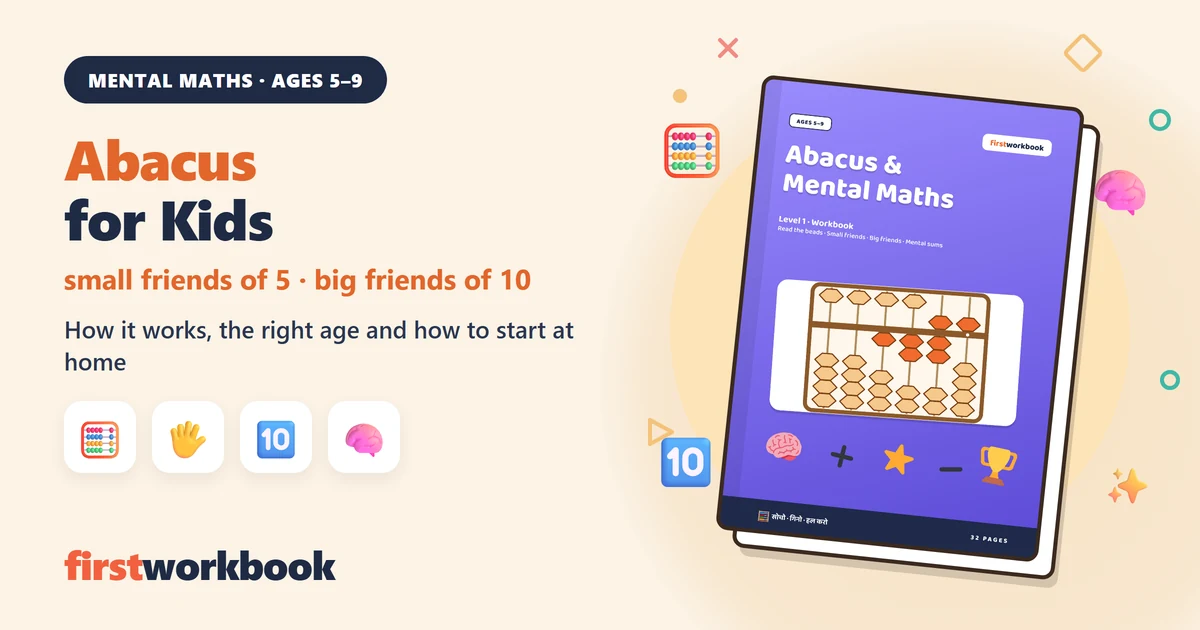
- Abacus & Mental Maths Workbook Level 1: parts of the abacus and finger rules with bead pictures, reading and drawing numbers 0 to 99, direct sums, small friends of 5, big friends of 10, two-digit sums, a speed-practice page, a Level 1 test and a full answer key (ages 5–9).
- Addition & Subtraction Practice: written sums to keep school methods strong.
- Times Tables & Mental Maths: for children who are ready for multiplication.
हिंदी में सार (Summary in Hindi)
अबेकस मोतियों वाला एक गिनती का फ़्रेम है। बच्चों की कक्षाओं में जापानी अबेकस (सोरोबान) इस्तेमाल होता है। इसकी हर छड़ पर बीच की पट्टी के ऊपर एक मोती होता है जिसका मान 5 है, और नीचे चार मोती होते हैं जिनका मान 1-1 है। मोती तभी गिना जाता है जब वह बीच की पट्टी को छूता है। इकाई की छड़ के ठीक बाईं ओर दहाई की छड़ होती है।
ज़्यादातर बच्चे 5 से 8 साल की उम्र में अबेकस शुरू करते हैं। शुरू करने से पहले बच्चे को 99 तक गिनती लिखनी-पढ़नी और छोटे जोड़-घटाव आने चाहिए। पहले स्तर में बच्चा संख्याएँ बनाना, सीधा जोड़-घटाव, 5 के छोटे दोस्त (1–4, 2–3) और 10 के बड़े दोस्त (1–9, 2–8, 3–7, 4–6, 5–5) सीखता है। जैसे 3 + 4 करने के लिए 5 जोड़ें और 1 हटाएँ; 4 + 9 करने के लिए इकाई से 1 हटाएँ और दहाई में 1 जोड़ें।
वडोदरा के एक स्कूल में 204 बच्चों पर तीन साल चले शोध में पाया गया कि अबेकस सीखने वाले बच्चों का हिसाब (जोड़, घटाव, गुणा, भाग) बेहतर हुआ, लेकिन याददाश्त या बुद्धि अपने-आप नहीं बढ़ी। इसलिए अबेकस को तेज़ और सही गणना के अभ्यास की तरह देखें, जादू की तरह नहीं। रोज़ 10–15 मिनट का अभ्यास काफ़ी है।
Frequently Asked Questions
What is the best age to start abacus?
Most children start between 5 and 8 years. Readiness matters more than age: the child should know numbers up to 99 and be able to do simple addition and subtraction.
Can I teach abacus to my child at home?
Yes, the first level can be taught at home with a student abacus and a beginner workbook, if a parent learns the bead moves first. For higher levels most families find a trained teacher helpful.
What are small friends and big friends in abacus?
Small friends are pairs that make 5 (1 and 4, 2 and 3). Big friends are pairs that make 10 (1 and 9, 2 and 8, 3 and 7, 4 and 6, 5 and 5). They are used when the beads needed for a sum are not free to move.
Does abacus improve memory and concentration?
The best controlled study found that abacus training improved children’s arithmetic but did not change general abilities such as working memory. Some smaller studies report gains in attention, so treat such claims with caution.
How many levels are there in abacus?
It depends on the institute. Most courses in India have about eight to ten levels of roughly three months each, so the full course takes two to three years.
Is abacus the same as Vedic maths?
No. Abacus uses beads, and later a mental picture of beads, and suits children from about 5 years. Vedic maths is a set of written and mental shortcuts for calculation and is usually taught to older children who already know their tables.
Research Behind This Guide
- Barner, Alvarez, Sullivan, Brooks, Srinivasan and Frank (2016), Learning Mathematics in a Visuospatial Format: A Randomized, Controlled Trial of Mental Abacus Instruction, Child Development: three-year trial with 204 children in Vadodara, India.
- Wikipedia, Soroban: structure of the Japanese abacus and how numbers are shown.
- Education Sciences (2021), soroban abacus training trial: an eight-week study with children aged 7 to 11 reporting effects on concentration, attention and memory.
- Ministry of Education, Government of India, NIPUN Bharat guidelines: numeracy targets for Classes 1 to 3.
About the author

Er. Deepak Maurya
Founder, FirstWorkbook
Er. Deepak Maurya founded FirstWorkbook in Varanasi to make activity workbooks that children enjoy. A web developer with 8 years of experience, he writes practical guides for parents on learning at home, and plans the activities in our workbooks together with pre-primary teachers.
Spotted a mistake or have a question? Write to us and we'll correct it.